AMD's RADV Vulkan driver now supports protected memory through AMD's Trusted Memory Zone (TMZ) hardware feature, enabling secure memory handling for DRM and encrypted content on newer Radeon GPUs.
RADV Vulkan Driver Adds Memory Protection Using AMD Trusted Memory Zone
The Mesa Radeon Vulkan driver (RADV) has gained a significant security enhancement with the addition of protected memory support using AMD's Trusted Memory Zone (TMZ) hardware feature. This development, which will be part of Mesa 26.2, represents an important step forward for secure graphics rendering on Linux systems with modern AMD GPUs.
Protected memory in graphics contexts is most commonly associated with Digital Rights Management (DRM) content and other encrypted media handling. While Vulkan has supported protected memory since version 1.1, RADV has only now implemented the "protectedMemory" option, leveraging AMD's TMZ hardware capabilities for memory encryption on recent Radeon GPUs.
Understanding Trusted Memory Zone
AMD's Trusted Memory Zone is a hardware-level security feature that provides isolated memory regions with encryption capabilities. First introduced in AMD's RDNA 2 architecture (found in Radeon RX 6000 series GPUs), TMZ creates a protected memory space that's isolated from the rest of the system memory. This isolation prevents unauthorized access to sensitive data stored in these memory regions.
The Linux kernel has supported TMZ since 2019, but this RADV implementation makes the feature accessible to Vulkan applications through the standard Vulkan protected memory extension. This means developers can now implement secure media playback and other DRM-protected content solutions on Linux with AMD hardware.
Technical Implementation
The RADV implementation of protected memory support follows the standard Vulkan API for protected memory allocations. Applications can specify VK_MEMORY_PROPERTY_PROTECTED_BIT when allocating memory, indicating that the memory should be protected using the GPU's TMZ capabilities.
From a performance perspective, the overhead of using protected memory is minimal when not actively accessing protected content. The encryption/decryption operations happen transparently in hardware, with the TMZ engine handling the security operations without significant impact on rendering performance.
Compatibility and Requirements
This feature requires:
- A Radeon GPU with TMZ support (RDNA 2 and newer architectures)
- Linux kernel with TMZ support (5.4 and newer)
- Mesa 26.2 or newer
- Vulkan driver with protected memory support
The RadeonSI driver already supports TMZ, so this brings Vulkan graphics applications in line with OpenGL applications in terms of secure memory handling.
Performance Considerations
While protected memory does introduce some overhead, it's primarily relevant when actively accessing protected content. For typical gaming and general computing workloads, the performance impact is negligible. The TMZ hardware is designed to handle encryption operations efficiently without significantly impacting rendering performance.
For applications that frequently switch between protected and unprotected memory, there may be a slight performance penalty due to the context switching between normal and protected memory regions. However, this is a specialized use case and wouldn't affect most Vulkan applications.
Use Cases
The primary use cases for RADV's protected memory support include:
DRM-Protected Media: Secure playback of protected video content through applications like Steam, Netflix, or other media services that require content protection.
Enterprise Applications: Business applications that handle sensitive data and require secure memory isolation.
Security-Critical Rendering: Applications in fields like finance, healthcare, or government that require additional security measures for rendering operations.
Game Development: Future game engines could leverage protected memory for anti-cheat systems or secure in-game transactions.
Future Implications
The addition of protected memory support to RADV positions Linux as a more viable platform for media and applications requiring DRM protection. This could lead to better support for services like Netflix, Disney+, and other streaming platforms on Linux.
For developers, this opens up new possibilities for implementing secure rendering pipelines and content protection mechanisms in Vulkan applications without relying on proprietary solutions.
Testing and Verification
Users interested in testing this feature can look for the protected memory extension in their Vulkan implementation. The feature can be verified using tools like vulkaninfo or by checking for the presence of the VK_KHR_protected_memory extension in application support.
For those who want to experiment with protected memory, there are sample applications available in the Vulkan SDK that demonstrate proper usage of protected memory allocations.
Conclusion
The addition of protected memory support to the RADV Vulkan driver represents a significant step forward for secure graphics rendering on Linux with AMD hardware. By leveraging AMD's Trusted Memory Zone hardware capabilities, this implementation provides a robust security feature for applications handling sensitive or protected content.
While the primary use cases currently focus on DRM and media protection, the underlying technology has broader implications for secure computing across various applications. As Linux continues to gain traction in desktop and workstation environments, features like this will become increasingly important for mainstream adoption.
For developers and power users, this enhancement demonstrates the ongoing maturation of the open-source graphics stack on Linux, bringing it closer to feature parity with proprietary solutions while maintaining the security and transparency that Linux users value.
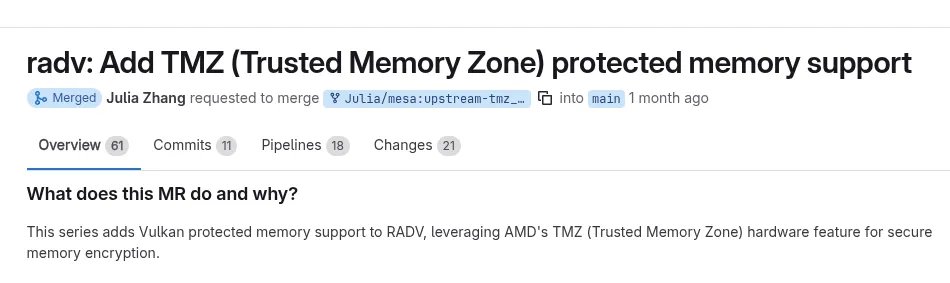
The implementation details can be found in the Mesa 26.2 merge request for those interested in the technical specifics of the implementation.
Comments
Please log in or register to join the discussion