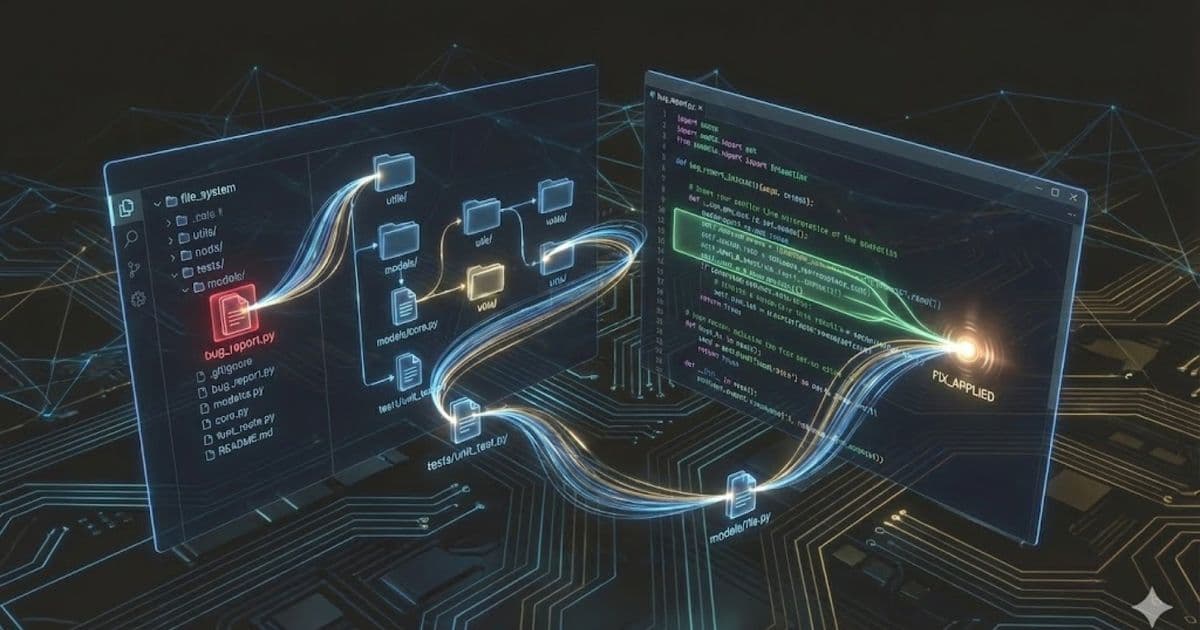
Reinforcement learning (RL) is moving beyond LeetCode puzzles into the messy, stateful world of real software development. By leveraging massive offline GitHub histories, decomposing tasks into atomic skills, and training models on execution traces, researchers are building agents that can navigate file systems, run tests, and understand runtime state. The result is a new class of verifiable coding assistants that learn from human work rather than brute‑force trial and error.
Reinforcement Learning Is Rewriting the Rules of AI‑Driven Code
The promise of large language models (LLMs) to write code has been clear for years: fine‑tune on source‑code corpora, and the model can generate plausible snippets. Yet the leap from a single function to a fully functioning, test‑passing module has remained stubbornly out of reach. The missing ingredient is feedback: a way to tell the model whether its edits actually improve the system.
The RL–SFT Divide
Supervised fine‑tuning (SFT) teaches LLMs the syntax and style of code by showing them examples. Reinforcement learning (RL), by contrast, rewards or penalizes actions based on outcomes, enabling the model to discover strategies that lead to success. In the context of coding, RL can reward a model when a patch passes a test suite or when a bug is fixed. However, applying RL to software engineering introduces three hard problems: data scarcity, signal sparsity, and state tracking.
Data availability: Running a model against a compiler or test harness for every possible edit is prohibitively expensive.
Signal sparsity: The reward signal (e.g., a test passing) often appears only after many edits, making credit assignment difficult.
State tracking: A model must understand not just the text of code but the dynamic runtime state that emerges after each change.
1. Bypassing the Online Bottleneck – SWE‑RL
Meta’s recent work, SWE‑RL: Advancing LLM Reasoning via Reinforcement Learning on Open Software Evolution, demonstrates how to sidestep the need for live simulation. By mining the vast history of GitHub pull requests, the researchers constructed an offline proxy reward system. Instead of executing code, they compare the generated patch to the actual developer‑approved solution using fine‑grained text similarity. If the model’s patch closely matches the human version, it receives a continuous reward; otherwise, it is penalized.
 )
)
This approach allowed the model to learn file‑system navigation, dependency management, and project conventions from static history alone, setting the stage for later RL fine‑tuning.
2. Decomposing Tasks – Kimi‑Dev
The next hurdle is credit assignment. Kimi‑Dev: Agentless Training as Skill Prior for SWE‑Agents tackles this by breaking software engineering into atomic skills: a BugFixer that edits logic and a TestWriter that generates tests. Each skill is trained on short‑horizon tasks with dense, outcome‑based rewards. For example, the BugFixer receives a positive signal when a patch passes the test suite, while the TestWriter is rewarded when it reproduces a bug.
By first mastering these isolated skills, a model can later be assembled into a multi‑turn agent that orchestrates them in sequence. The result is a more efficient learning curve than attempting to solve the entire problem end‑to‑end from scratch.
3. Teaching Execution Dynamics – Code World Model
Finally, Meta introduced the Code World Model (CWM) to address state tracking. Rather than waiting until RL to learn how code changes affect runtime state, CWM injects process supervision during mid‑training. Two massive datasets underpin this effort:
- Python Execution Traces – 120 million examples where the model predicts the next line of code and the exact state of all runtime variables after execution.
- ForagerAgent Trajectories – 3 million Docker‑based agent interactions that solve real coding tasks.
With an internal world model, the agent knows that writing x = y + 1 will change variable x to y+1. When RL finally begins, the reward signal (e.g., passing tests) is sparse, but the model can choose the path that leads to that outcome because it already understands the physics of code.
 )
)
Toward Verifiable Coding Agents
The trajectory from SWE‑RL to Kimi‑Dev to CWM illustrates a clear engineering roadmap: start with offline, proxy‑reward learning from real code history; decompose tasks into reusable skills; and embed execution‑aware world models before the RL phase. The end product is a verifiable agent that can navigate a repository, run tests, and understand the dynamic state of its environment.
“Future models will be more than just smart. They will be grounded in repository history, capable of self‑verification through test writing, and possess an explicit internal model of runtime state.” – Meta AI
These advances signal a shift from generic reasoning to domain‑specific engineering. As the field matures, developers can expect AI assistants that not only generate code but prove its correctness in situ.
Related Papers
- SWE‑RL: Advancing LLM Reasoning via Reinforcement Learning on Open Software Evolution
- Kimi‑Dev: Agentless Training as Skill Prior for SWE‑Agents
- CWM: An Open‑Weights LLM for Research on Code Generation with World Models
Source: https://docs.getpochi.com/developer-updates/reinforcement-learning-in-ai-coding/
Comments
Please log in or register to join the discussion