Reverend Jesse Jackson, a towering figure in American civil rights and politics who ran for president twice and fought for economic justice, has died at 84. His legacy spans decades of activism, from the streets of Selma to the halls of power.
Reverend Jesse Jackson, a towering figure in American civil rights and politics who ran for president twice and fought for economic justice, has died at 84.
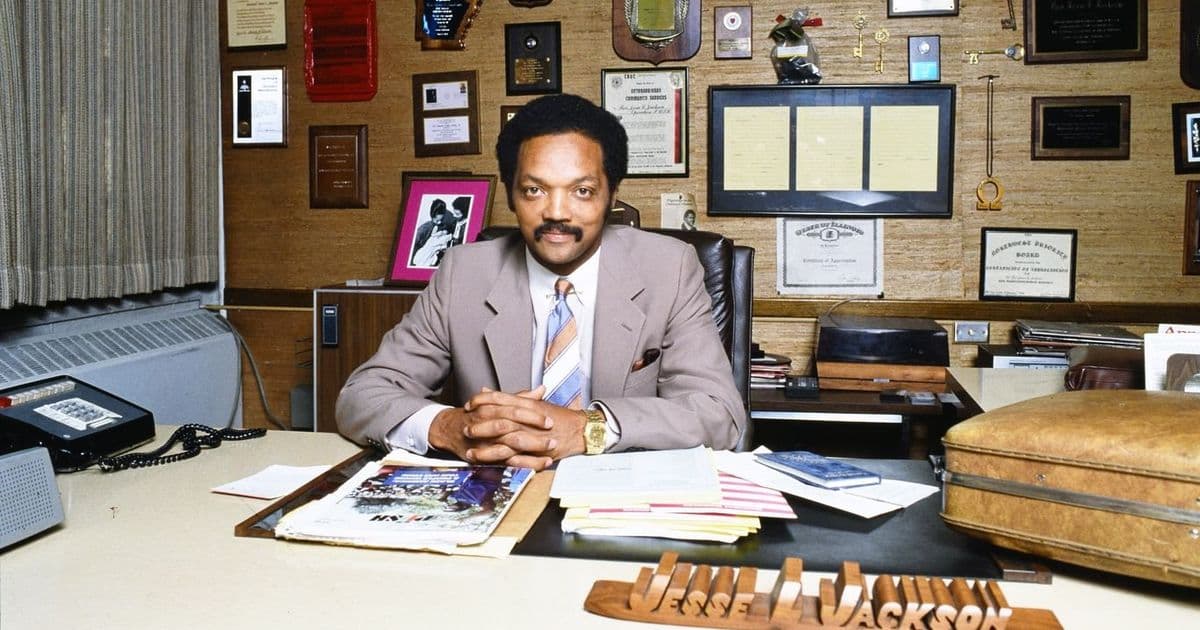
The Rev. Jesse Jackson poses for a portrait at his Operation PUSH office in 1982. Photo: Steve Kagan/Getty Images
Jackson's death marks the end of an era in American activism. Born in 1941 in Greenville, South Carolina, he rose from the Jim Crow South to become one of the most influential African American leaders of the 20th century. His journey from civil rights foot soldier to presidential candidate embodied the evolution of the movement itself.
Jackson's activism began in the 1960s when he joined the Southern Christian Leadership Conference under Martin Luther King Jr. He was present at the Lorraine Motel in Memphis on April 4, 1968, when King was assassinated. That moment would shape his life's work, pushing him to carry forward the torch of nonviolent resistance while developing his own distinct approach to racial and economic justice.
In 1971, Jackson founded Operation PUSH (People United to Save Humanity) in Chicago, creating a platform for economic empowerment and political mobilization. The organization became a powerful force, pressuring corporations to hire more minorities and advocating for increased African American representation in politics and business.
His two presidential campaigns in 1984 and 1988 broke new ground. In 1988, he won 6.9 million votes and 1,218.5 delegates, finishing second in the Democratic primaries. These campaigns expanded the Democratic coalition, registering millions of new voters and forcing the party to address issues of racial and economic inequality more directly.
Beyond electoral politics, Jackson became known for his diplomatic missions and economic activism. He traveled to Syria in 1984 to secure the release of a captured American pilot, to Cuba in 1984 and 1989 to negotiate the release of political prisoners, and to Yugoslavia in 1999 to free three American soldiers. His ability to operate in international conflicts earned him both praise and criticism, but his effectiveness was undeniable.
In the 1990s and 2000s, Jackson continued his advocacy through the Rainbow PUSH Coalition, focusing on issues from voting rights to corporate accountability. He pressured companies like Toyota and Nike to diversify their boards and workforces, using shareholder activism as a tool for social change.
Jackson's health declined in recent years. He revealed in 2017 that he had been diagnosed with Parkinson's disease, a condition that gradually limited his public appearances. Despite this, he remained active in social justice causes, supporting movements like Black Lives Matter and continuing to speak out on issues of racial and economic inequality.
His legacy extends beyond his individual achievements. Jackson helped create the template for modern civil rights activism that combines street protests with corporate pressure and electoral politics. He mentored a generation of leaders and showed that the fight for justice could take many forms - from marching in the streets to negotiating in boardrooms.
Jackson is survived by his wife Jacqueline Lavinia Brown, whom he married in 1962, and their five children. His son, Jesse Jackson Jr., served as a U.S. Representative from Illinois from 1995 to 2012.
The impact of Jackson's work continues to resonate in today's political landscape. The voter registration drives he pioneered, the coalition-building he mastered, and the economic justice framework he developed remain central to contemporary civil rights organizing. As America grapples with ongoing issues of racial inequality and economic disparity, Jackson's life reminds us that progress comes through persistent, multifaceted struggle.
His death at 84 closes a remarkable chapter in American history, but the movements he helped build and the strategies he developed will continue to shape the fight for justice for generations to come.
Comments
Please log in or register to join the discussion