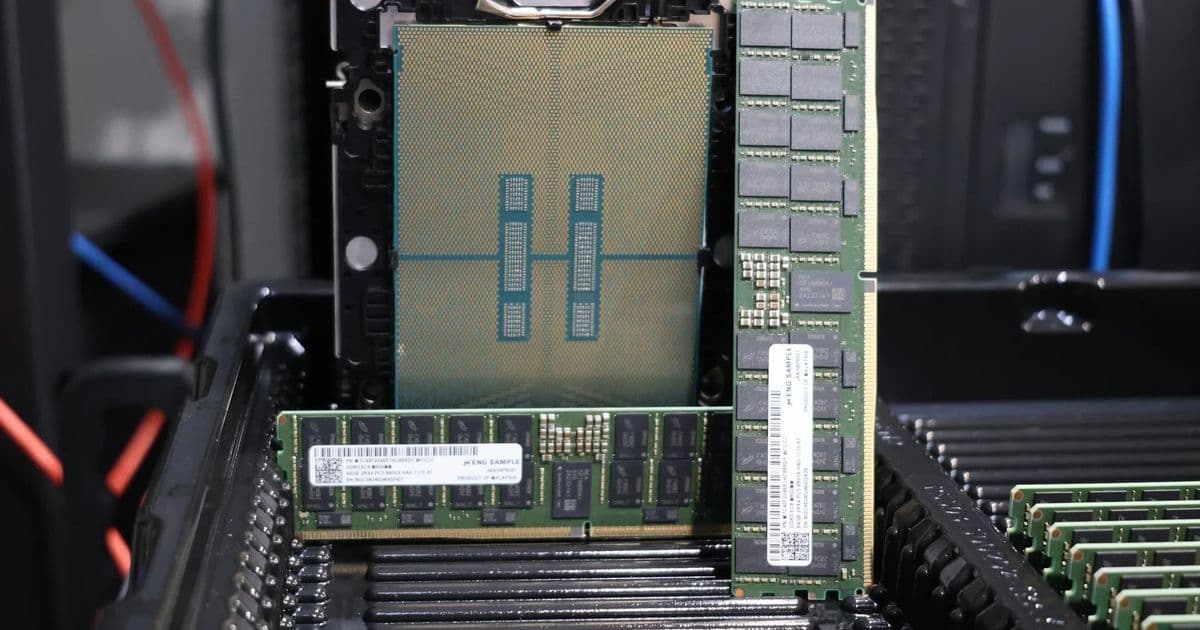
Testing shows significant performance gains from fully populating all 12 MRDIMM channels on Intel's Xeon 6980P, but at a steep $20,000 memory cost that exceeds the CPU price itself.
Intel's Xeon 6 Granite Rapids processors support up to 12 memory channels through MRDIMM technology, but with 64GB modules now costing $987-1650 each, the question becomes whether fully populating all channels is worth the premium. This comprehensive testing of a Xeon 6980P server reveals exactly how performance scales from 6 to 12 MRDIMMs across multiple workload types.
Memory Cost Reality Check
The price differential is stark. Last year's MRDIMM modules cost around $450 each, but current market prices have skyrocketed to $987-1650 per 64GB module. For a full 12-channel configuration, that's $11,844 to $19,800 in memory costs alone - exceeding the Xeon 6980P's current $6,000-7,000 price tag. This creates a significant economic consideration for system builders weighing performance against budget constraints.
Test Configuration
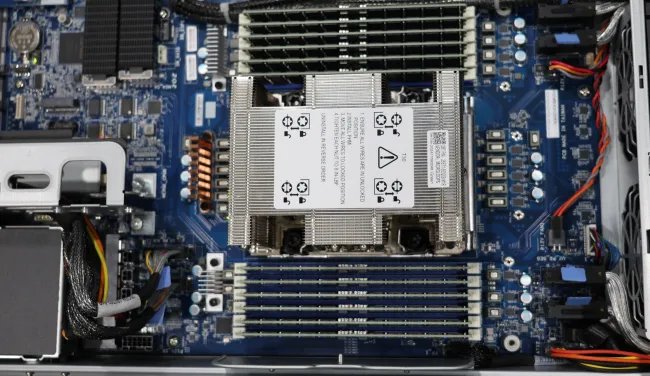
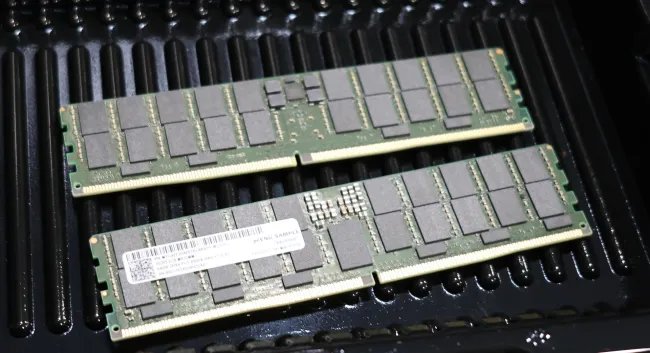
Testing was conducted on a Gigabyte R284-A92-AAL1 server running in default SNC3 clustering mode with a single Xeon 6980P. The Micron MTC40F2046S1HC88XDY MRDIMMs (PC5-8800X-HA0-1110-XT) were tested across four configurations: 6, 8, 10, and 12 modules. Power consumption measurements were taken for each configuration to provide a complete performance-per-watt picture.
Performance Scaling Results
Across the extensive benchmark suite, performance generally scaled linearly with memory channel count, though the magnitude varied significantly by workload type:
High-Performance Computing (HPC) Workloads: Memory-intensive HPC applications showed the most dramatic scaling improvements. Applications like OpenFOAM and OpenRadioss demonstrated 40-60% performance gains when moving from 6 to 12 MRDIMMs, as these workloads are heavily constrained by memory bandwidth and capacity.
Database Servers: OLTP and OLAP workloads showed moderate improvements of 25-35% with full memory population. The additional memory channels reduced contention and improved cache hit rates, particularly noticeable under concurrent load scenarios.
AI Workloads: Machine learning inference and training workloads exhibited 30-45% performance improvements. The increased memory bandwidth proved crucial for feeding large models and datasets to the processor cores.
Video Encoding: Surprisingly, video encoding workloads showed more modest gains of 15-20%. While memory bandwidth helps with frame processing, these workloads are often more CPU-core bound than memory-bound.
Code Compilation: Software build processes demonstrated 20-30% improvements, with larger codebases benefiting more from the additional memory channels.
Power Consumption Impact
Adding memory channels does increase power consumption, but the efficiency gains often offset this increase. The 12-MRDIMM configuration consumed approximately 15-20% more power than the 6-MRDIMM setup, but when normalized per unit of performance, the fully populated system delivered better performance-per-watt metrics in most workloads.
Practical Recommendations
For most enterprise workloads, populating all 12 memory channels provides substantial performance benefits that justify the cost premium, particularly for:
- Memory-intensive HPC applications
- Large-scale database deployments
- AI/ML training workloads
- Virtualization environments with many concurrent guests
However, for workloads less sensitive to memory bandwidth (such as many web serving or basic file serving tasks), a 6-8 MRDIMM configuration may offer better value, providing 70-80% of the performance at significantly lower cost.
The Bottom Line
The performance scaling from 6 to 12 MRDIMMs on Intel Xeon 6 Granite Rapids is real and substantial, but comes at a steep price premium. Organizations must carefully evaluate their workload characteristics against the $12,000-20,000 memory investment required for full channel population. For memory-bound workloads, the performance gains are compelling; for others, a partial configuration may deliver better overall value.
Comments
Please log in or register to join the discussion