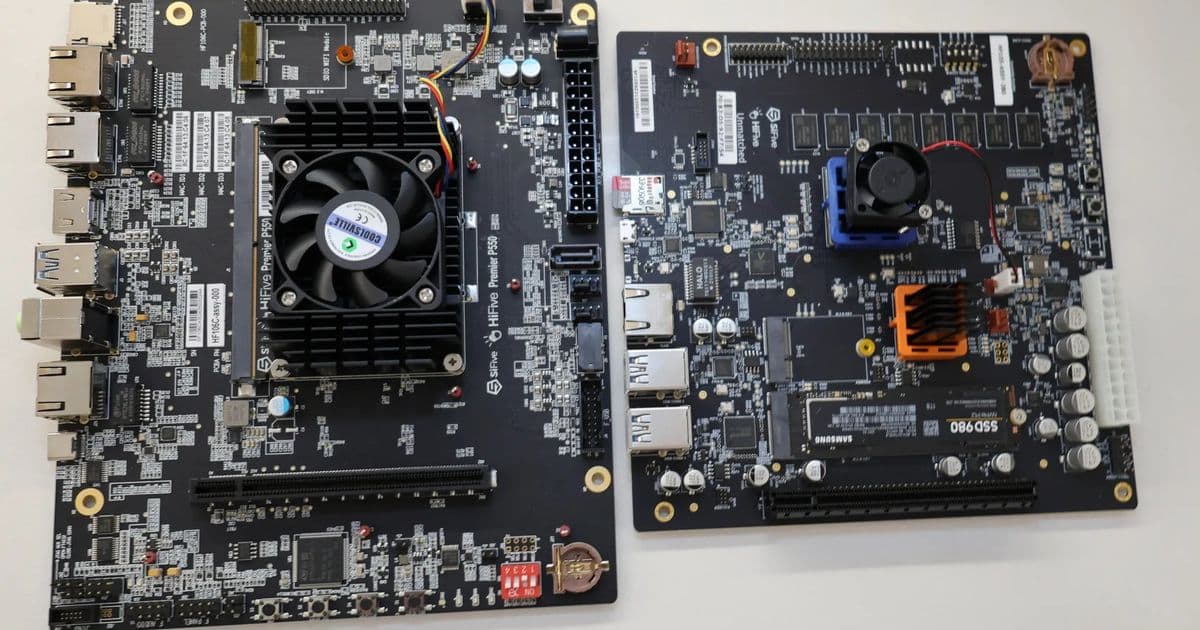
Linux 7.0 brings RISC-V user-space CFI protection and strlen assembly optimizations, marking significant performance and security improvements for the open architecture.
The RISC-V architecture has reached a major milestone with Linux 7.0, bringing critical security features and performance optimizations that position it alongside established architectures like x86 and ARM. The most significant addition is user-space Control Flow Integrity (CFI) support, which has been available on Intel and AMD processors for years but is now finally ready for RISC-V systems running Linux.
Control Flow Integrity for RISC-V
CFI represents a fundamental shift in how Linux protects user-space applications from sophisticated attacks. The feature specifically targets Return-Oriented Programming (ROP) attacks, where malicious actors manipulate control flow to execute arbitrary code. By enforcing that all indirect calls must land on designated landing pad instructions, RISC-V's CFI implementation creates a robust defense mechanism that raises software check exceptions when violations occur.
The implementation leverages two new RISC-V instructions: zicfilp and zicfiss. These instructions work in tandem with shadow stack handling to ensure return flows remain secure. This mirrors the approach taken by Intel's CET (Control-flow Enforcement Technology) and AMD's SMEP/SMAP features, bringing RISC-V to parity with these established security mechanisms.
strlen Assembly Optimization
Beyond security, Linux 7.0 delivers tangible performance improvements through optimized string handling. The strlen implementation has been completely rewritten in hand-coded Assembly, reducing the loop body from 4 instructions to just 3. This optimization eliminates an unconditional jump, streamlining the most common string operation in C programs.
For developers and system builders, this optimization translates to measurable performance gains in string-heavy applications. The reduction in instruction count means fewer CPU cycles per strlen call, which compounds across large codebases and high-throughput systems. While the change appears minor on paper, in practice it can significantly impact performance in text processing, networking stacks, and any application that manipulates strings frequently.
Additional RISC-V Improvements
Linux 7.0 also addresses several practical concerns for RISC-V developers. The ptrace behavior around vector registers has been improved, making debugging and profiling more reliable for applications using vector instructions. This is particularly important as RISC-V's vector extensions gain adoption for scientific computing and machine learning workloads.
The kernel now enables ISO-8859-1 code page as built-in for EFI volume mounting, simplifying boot processes and filesystem access on RISC-V systems. This change reduces the complexity of handling international character sets during early boot stages, which can be crucial for embedded and IoT applications.
Looking Forward
These changes represent just the beginning of RISC-V's evolution in the Linux kernel. The developers note that further Assembly optimizations may land in future releases, suggesting an ongoing commitment to performance tuning. The CFI implementation itself may see refinements as real-world deployment reveals edge cases and performance considerations.
For the RISC-V ecosystem, Linux 7.0 marks a coming-of-age moment. The architecture now offers security features comparable to x86 and ARM, while continuing to improve performance through targeted optimizations. As more hardware vendors adopt RISC-V and more developers target the architecture, these kernel improvements will play a crucial role in ensuring RISC-V remains competitive in both embedded and server markets.
The integration of these features also signals Linux's maturing support for RISC-V. What began as experimental support has evolved into production-ready capabilities that meet the demands of modern computing environments. For organizations considering RISC-V for their next project, Linux 7.0 provides a compelling foundation with enterprise-grade security and performance characteristics.
Comments
Please log in or register to join the discussion