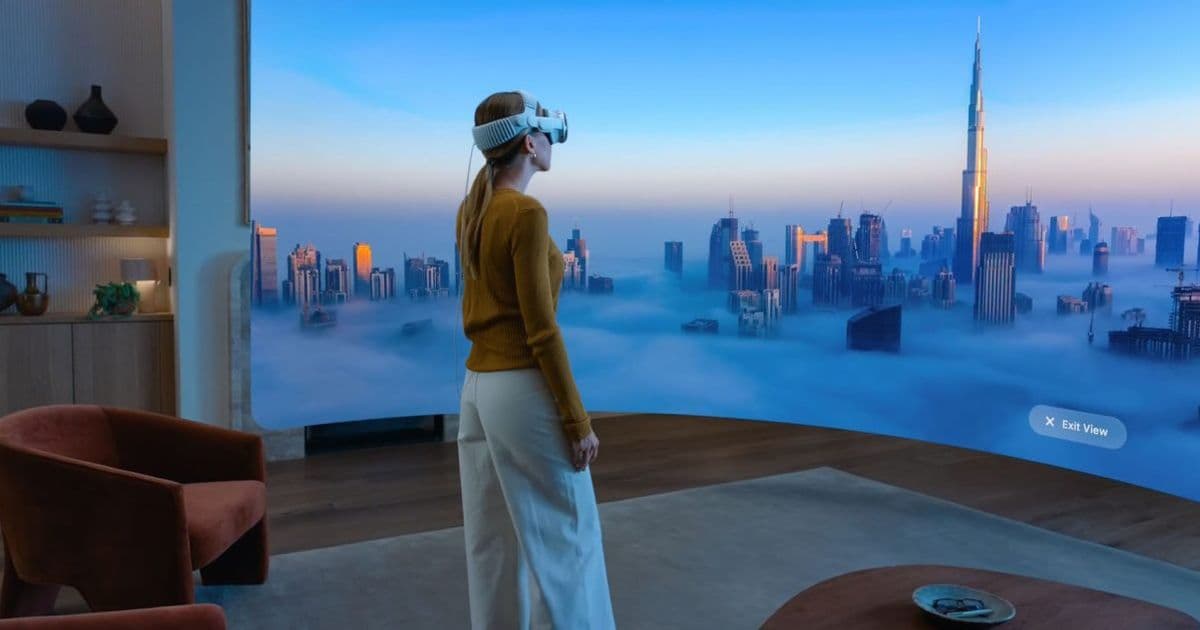
Apple's visionOS 26.4 beta introduces foveated streaming support, enabling high-quality VR content streaming to Vision Pro with improved performance and new development possibilities.
Apple has unveiled visionOS 26.4 beta 1, bringing a significant new capability to the Apple Vision Pro: foveated streaming support. This feature, which leverages NVIDIA CloudXR technology, promises to dramatically improve how VR applications and games are delivered to Apple's spatial computing headset.
What Is Foveated Streaming?
Foveated streaming is a rendering technique that optimizes performance by focusing high-resolution rendering only where the user is looking, while reducing quality in peripheral areas. This approach takes advantage of the fact that human peripheral vision naturally has lower acuity, allowing developers to conserve processing power without sacrificing the user experience.
The technology works by streaming high-quality content from a remote computer or cloud server to the Vision Pro, with the device using gaze tracking data to determine where to allocate rendering resources. This means that processor-intensive environments can be rendered remotely while the headset handles native spatial elements locally.
Developer Opportunities
For developers, foveated streaming opens up new possibilities for bringing existing VR content to Vision Pro. According to Apple's developer documentation, if you have an existing virtual reality game, experience, or application built for desktop computers or a cloud server, you can now stream it to Apple Vision Pro using the Foveated Streaming framework.
This capability is particularly significant because it lowers the barrier for developers who have invested in VR content for other platforms. Rather than rebuilding entire applications from scratch, they can leverage their existing assets and infrastructure while taking advantage of Vision Pro's native capabilities.
The framework also allows for hybrid experiences where native spatial content can be layered over streamed content. Apple provides a compelling example: a racing game can render the gauges and interior elements using RealityKit (Apple's native 3D framework), while streaming the processor-intensive outdoor environment from a remote computer. This approach combines the best of both worlds—native performance for critical UI elements and remote rendering for complex 3D environments.
Another example from Apple illustrates the versatility of this approach: a flight simulator app can render a detailed cockpit using RealityKit while streaming a vast, processor-intensive landscape from a remote computer. This demonstrates how foveated streaming can handle both intimate, detailed interactions and expansive environments within the same application.
Technical Implementation
The integration with NVIDIA CloudXR is particularly noteworthy. CloudXR is a third-party technology already employed by other VR and computing platforms, suggesting that Apple is positioning Vision Pro as a compatible endpoint in the broader VR ecosystem. This compatibility could accelerate the availability of high-quality VR content on Vision Pro by allowing developers to target multiple platforms with minimal additional work.
From a technical perspective, foveated streaming addresses one of the key challenges in VR: maintaining high visual fidelity while managing the substantial computational demands of rendering immersive 3D environments. By intelligently allocating rendering resources based on where the user is looking, the technology can deliver high-resolution content where it matters most while reducing the overall processing burden.
Impact on the Vision Pro Ecosystem
The introduction of foveated streaming could be transformative for the Vision Pro ecosystem. Currently, the headset's native app library, while growing, doesn't yet match the breadth of content available on more established VR platforms. Foveated streaming provides a bridge, allowing developers to bring their existing VR applications to Vision Pro without the extensive redevelopment that would otherwise be required.
This feature also enables new types of experiences that might not have been feasible on Vision Pro due to hardware limitations. By offloading intensive rendering tasks to remote servers, developers can create more complex and visually rich environments than would be possible with on-device processing alone.
Looking Ahead
While it's unclear whether any of Apple's native visionOS apps currently utilize foveated streaming technology, the company's inclusion of this feature in the developer documentation suggests they may lead by example. Apple has historically used its own applications to demonstrate best practices and capabilities to third-party developers.
The timing of this feature is also significant. As Vision Pro continues to evolve and mature in the market, tools that make it easier for developers to create compelling content become increasingly important. Foveated streaming addresses this need directly by reducing the technical and resource barriers to bringing high-quality VR experiences to the platform.
For users, the practical benefits of foveated streaming may not be immediately apparent, but they should manifest as a broader selection of high-quality VR applications and games, improved performance in streaming scenarios, and potentially new types of mixed-reality experiences that blend native and streamed content seamlessly.
As visionOS 26.4 moves from beta to general release, the developer community will likely begin exploring the creative possibilities of foveated streaming. The racing game and flight simulator examples provided by Apple are just the beginning—the technology could enable everything from immersive educational experiences to collaborative virtual workspaces to entertainment applications that push the boundaries of what's possible in spatial computing.
The addition of foveated streaming support represents Apple's commitment to making Vision Pro a versatile platform capable of delivering a wide range of VR experiences, both native and streamed. As developers begin to adopt this technology, users can expect to see an expansion in the quality and variety of content available for their spatial computing headset.
Comments
Please log in or register to join the discussion