A deep dive into how Chris Sawyer created one of gaming's most optimized titles through low-level programming and performance-first design decisions that continue to influence developers today.
RollerCoaster Tycoon stands as a remarkable achievement in game development, not just for its engaging gameplay, but for its extraordinary optimization that allowed complex theme park simulations to run smoothly on 1999 hardware. The game, created primarily by Chris Sawyer, has become a benchmark for performance in strategy games, with its sequel often cited alongside the original as some of the best-optimized games ever made.
The challenge Sawyer faced was formidable: create a detailed simulation of a theme park with thousands of agents (guests and staff) navigating a complex path network, all while maintaining consistent performance on the limited hardware of the era. Even today, many similar building games struggle to achieve the smooth frame rates that RCT delivered over two decades ago.
What made this possible was a multi-pronged approach to optimization that began with Sawyer's choice to write the game almost entirely in Assembly language. At the time of RCT's development in the late 1990s, most games had already transitioned to higher-level languages like C or C++, with only performance-critical sections still written in Assembly. Sawyer's decision to write nearly the entire game in Assembly was unconventional even then.
"It's hard to check for sure, but it's likely that RCT was the last big game developed in this way," notes the author of a recent technical analysis of the game. "Even the first Doom, which was released six years earlier, was already mostly written in C with only a few parts written in Assembly, and nobody would argue that Doom was in any way an unoptimized game."
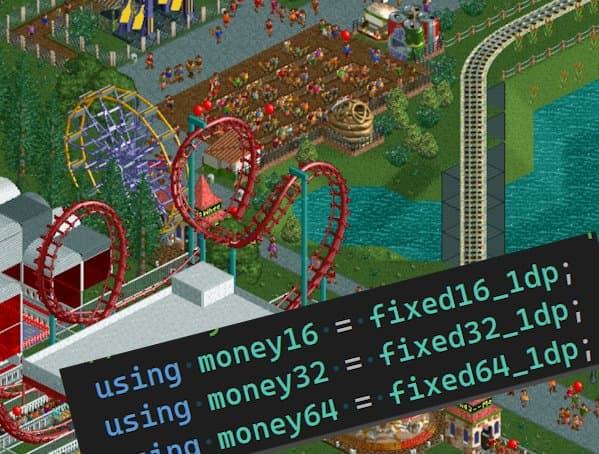
While Assembly provided a foundation for optimization, Sawyer implemented numerous clever techniques throughout the codebase. One approach was the careful selection of data types for different money values in the game. Rather than using a uniform large data type for all monetary values, Sawyer used precisely sized data types based on the expected range of values. For instance, the overall park value used 4 bytes, while the price of a shop item used only 1 byte, since it required a much smaller numerical range.
Another optimization technique was the replacement of multiplication and division operations with bitshifting operations. Throughout the code, one can find lines like NewValue = OldValue << 2; which effectively performs multiplication by 4. This works because shifting binary digits to the left by one position doubles the value, making bitshifting an efficient alternative to multiplication for powers of two.
"The fact that it is done that often indicates that the in-game formulas were specifically designed to stick to those numbers wherever possible, which in most modern development workflows is basically an impossibility," explains the technical analysis. "Imagine a programmer asking a game designer if they could change their formula to use an 8 instead of a 9.5 because it is a number that the CPU prefers to calculate with."
Perhaps the most significant optimization, however, was Sawyer's approach to game design itself. As both the sole game designer and primary programmer, Sawyer could make design decisions informed by performance considerations. This is evident in the game's pathfinding system.
Rather than having guests intelligently navigate to their desired attractions—a computationally expensive approach—RCT's guests wander the park almost randomly, following paths and only making simple decisions at junctions. This "blind wandering" approach dramatically reduces the computational cost of pathfinding while still creating believable guest behavior.
When traditional pathfinding is required—such as when a mechanic needs to reach a broken ride or a guest wants to exit the park—the game implements clever safeguards. The pathfinder has a built-in limit on how far it can traverse the path network, preventing expensive searches that could cause frame drops. This limitation even becomes a gameplay element, with guests occasionally complaining about being unable to find the exit, indicating the pathfinder has reached its search limit.
"This part is especially fascinating since it turns an optimization done out of technical necessity into a gameplay feature," notes the analysis. "Something that can barely happen in 'modern' game development, where the roles of coders and game designers are strictly separated."
Another example of performance-through-design is how RCT handles crowd congestion. Rather than implementing complex collision detection or avoidance systems between guests, the game simply allows guests to occupy the same path tile without interaction. While this might seem like a shortcut, it actually serves gameplay purposes by tracking nearby guests and affecting guest happiness based on crowd density, creating similar player incentives without the computational cost.
The legacy of RCT's optimization continues through OpenRCT2, a community-driven reimplementation of the game that has become a reference for understanding the original's techniques. "Written by (very) dedicated fans, OpenRCT2 manages to reimplement the entirety of RollerCoaster 1&2, using the original assets," explains the article. "Even though this is NOT the original source code, especially in its earlier versions, this re-implementation is a very, very close match to the original, being based on years of reverse engineering."
OpenRCT2 has preserved many of the original optimizations while adding improvements of its own. The project demonstrates that RCT's approach to optimization remains relevant, even as hardware capabilities have advanced dramatically.
"RCT might have been the 'perfect storm' for this specific approach to optimization, but this doesn't mean that it can't be done anymore, nowadays," concludes the analysis. "It just means more dialogue between coders and game designers is needed, and often, the courage to say 'No' to technical challenges. No matter how much you'd wish to solve them."
The enduring fascination with RCT's optimization techniques speaks to their brilliance and the unique circumstances that made them possible—primarily the rare combination of a programmer who was also the game designer, working within the constraints of 1999 hardware. As game development has become increasingly specialized, RCT stands as a reminder of the power of holistic thinking about performance and design.
Comments
Please log in or register to join the discussion