
The Python ecosystem gets a performance earthquake as Astral's uv package manager emerges as a unified, Rust-based alternative to fragmented tools like pip, venv, and pyenv. Benchmarks show 10-100x speed improvements while introducing modern dependency workflows that could redefine developer experiences.
The Speed Revolution in Python Tooling
For decades, Python developers have navigated a fragmented landscape of package management tools: pip for installations, venv for environments, pip-tools for locking dependencies, and pyenv for version management. This patchwork solution—functional but slow and complex—has finally met its match. Enter uv, a Rust-powered toolkit from Astral (creators of Ruff) that consolidates these workflows while delivering staggering performance gains.

Why uv Changes Everything
At its core, uv isn't just "pip but faster." It's a paradigm shift:
- Blazing Speed: Written in Rust, uv performs operations 10-100x faster than traditional Python tools. Environment creation is ~200x quicker than venv, while dependency resolution outpaces pip-compile by ~150x.
- Unified Workflow: Replaces 7+ tools (pip, venv, pyenv, pipx, poetry, pip-tools, twine) with a single binary
- Modern Standards: Native
pyproject.tomlsupport and deterministicuv.lockfiles - Zero-Config Intelligence: Automatically detects Python versions and environments
# Traditional workflow (multiple tools)
python -m venv .venv
source .venv/bin/activate
pip install -r requirements.txt

# uv equivalent (single tool)
uv venv
uv pip install -r requirements.txt
Performance Benchmarks That Speak Volumes
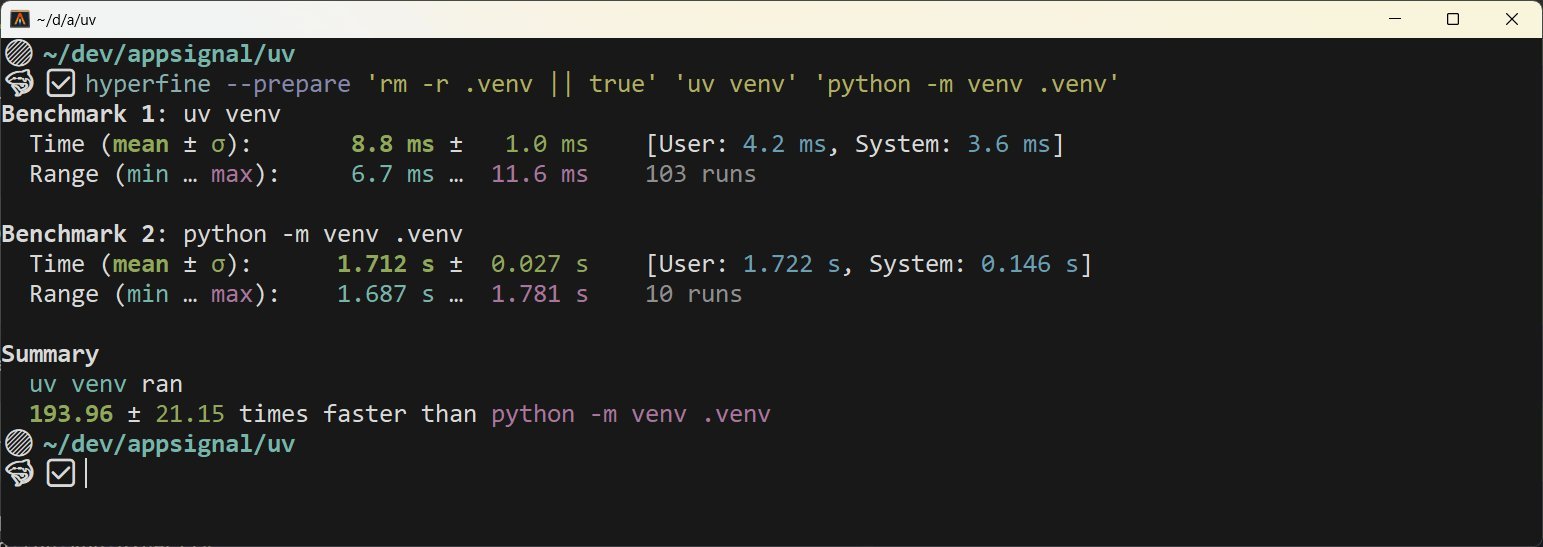 Creating virtual environments with uv is 200x faster than venv
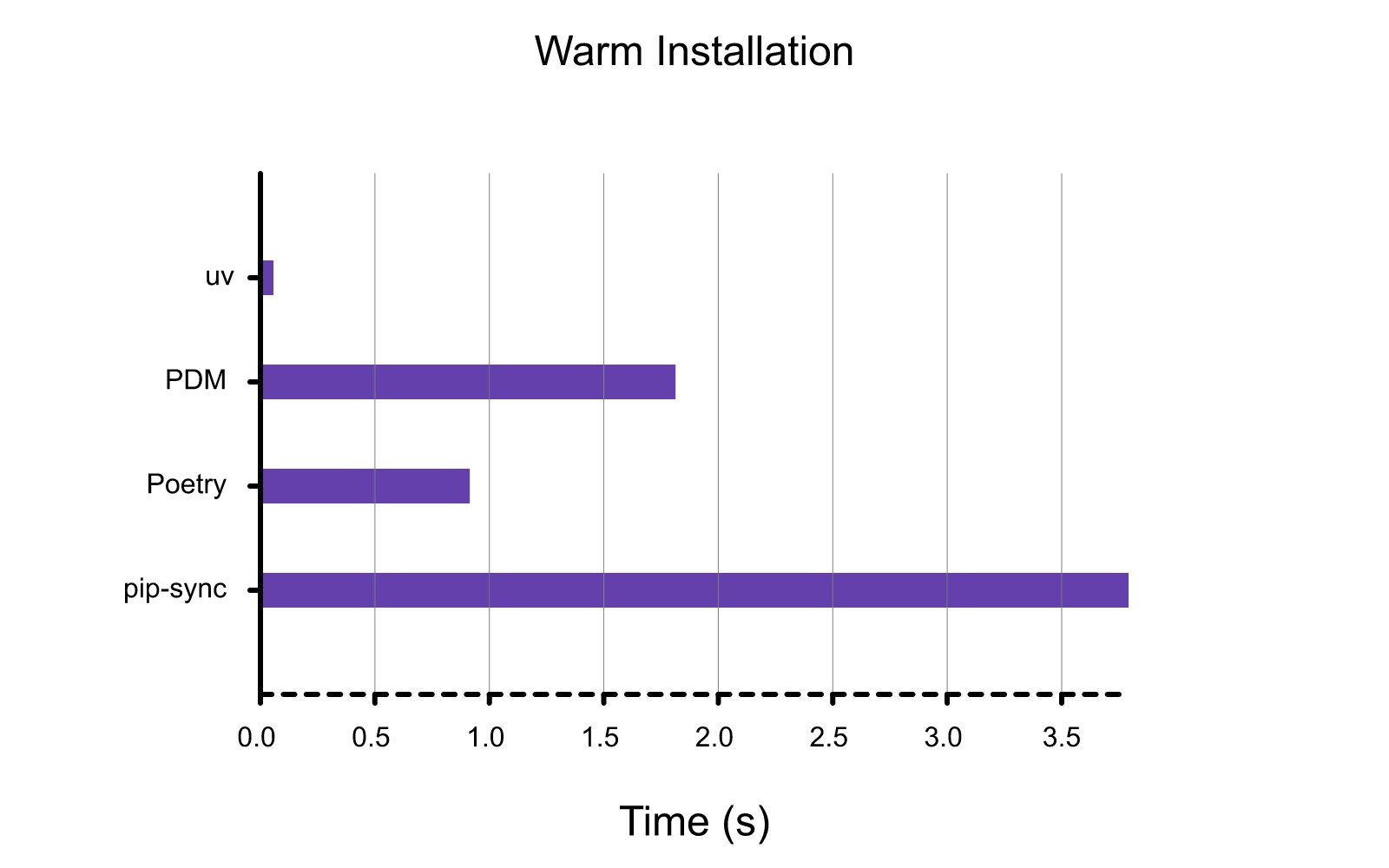 Dependency resolution speed comparison: uv leaves pip-compile in the dust
These aren't marginal improvements—they fundamentally alter developer workflows. What took minutes now happens in seconds, transforming dependency management from a coffee-break task to near-instant operation.
The uv Toolbox: Beyond Speed
Environment Management Made Simple
uv venv  # Creates .venv in 0.1s
uv venv --python 3.11  # Auto-installs missing Python versions
Dependency Resolution Revolution
uv pip install flask  # 10x faster pip replacement
uv pip compile requirements.in  # Lightning-fast lockfiles
Project Lifecycle Mastery
uv init my-project  # Scaffolds app/library with pyproject.toml
uv add requests  # Installs + updates lockfile
uv run main.py  # Executes in managed environment
Unified Dependency Groups
# pyproject.toml
[dependency-groups]
dev = ["pytest"]
prod = ["gunicorn"]
tools = ["black"]
uv sync --group prod # Install production-only dependencies
Migration Guide: From Fragmentation to Unity
Transitioning existing projects is straightforward:
uv init .  # Convert existing project
rm -rf .venv  # Purge old environment
uv add -r requirements.txt  # Import dependencies
uv run manage.py migrate  # Verify functionality
| Legacy Command | uv Equivalent |
|---|---|
python -m venv |
uv venv |
pip install |
uv add |
pip freeze |
uv export |
pyenv install |
uv python install |
The Future of Python Tooling
uv represents more than technical optimization—it signals an ecosystem evolution. By consolidating fragmented workflows with Rust's performance, Astral addresses Python's longstanding tooling pain points. For teams battling slow CI pipelines or dependency hell, uv offers immediate productivity returns. More significantly, its lockfile-first approach and project-centric design align Python with modern packaging practices seen in ecosystems like Rust and JavaScript.
While still evolving (currently v0.7.3), uv's trajectory suggests it could become Python's default packaging solution. As dependency management shifts from necessary chore to seamless background process, developers regain precious cognitive bandwidth—the ultimate performance optimization.
Source: AppSignal Blog
Comments
Please log in or register to join the discussion