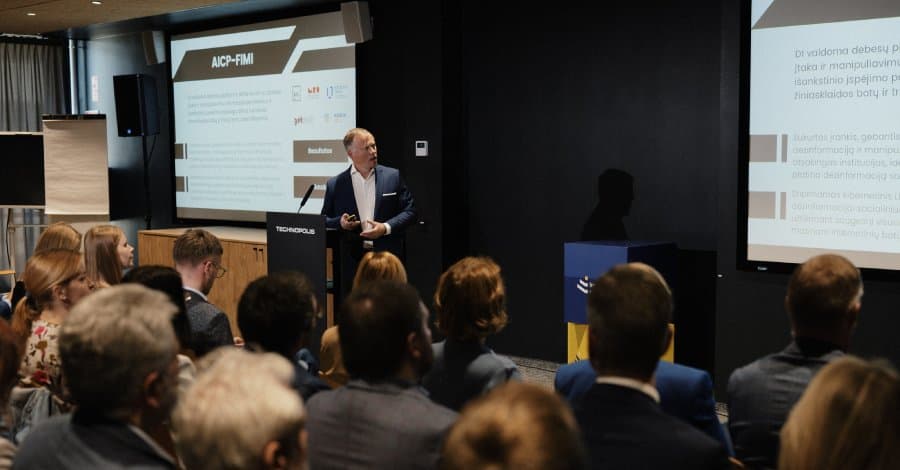
Lithuania launches a national mission to combat AI-powered cyber fraud, bringing together universities, cybersecurity firms, and government agencies to develop advanced defenses against increasingly sophisticated AI-driven attacks on e-services.
Lithuania is taking bold steps to secure its digital future as artificial intelligence transforms both the opportunities and threats in cyberspace. The Baltic nation has launched a national mission called "Safe and Inclusive E-Society," coordinated by Kaunas University of Technology (KTU), to combat the rising tide of AI-driven cyber fraud that's making traditional security measures obsolete.
The AI Fraud Revolution
The emergence of Generative Artificial Intelligence (GenAI) and Large Language Models (LLMs) has fundamentally altered the landscape of cybercrime. According to Dr. Rasa Brūgžienė, Associate Professor at KTU's Department of Computer Sciences, the old paradigm of pattern-based fraud detection has been shattered.
"Until now, the main defense relied on pattern-based detection – for example, automated filters and firewalls could recognize recurring fraud patterns, typical phrases or structures," Dr. Brūgžienė explains. "However, GenAI has eliminated that 'pattern' boundary. Today, criminals can use generative models to create contextually accurate messages."
This shift means modern phishing emails no longer resemble traditional fraud attempts. They're crafted to appear as legitimate institutional communications, making them nearly indistinguishable from authentic messages even to human recipients.
The Scale and Sophistication of Modern Attacks The threat landscape has evolved dramatically. Criminals now leverage AI tools that can:
- Generate thousands of unique, non-repeating fraudulent messages
- Create personalized, multilingual communications based on victim data
- Clone voices from just seconds of audio using tools like ElevenLabs and Microsoft's VALL-E
- Produce photorealistic fake faces and deepfake videos using StyleGAN, Stable Diffusion, and DeepFaceLab
- Orchestrate multimodal attacks combining text, voice, and video
"The scary part is how accessible all of this has become," Dr. Brūgžienė warns. "Commercial TTS solutions like ElevenLabs and open-source implementations of VALL-E provide high-quality voice cloning to anyone. Stable Diffusion, DeepFaceLab, and similar tools make it easy to generate photorealistic images or deepfakes quickly."
Adaptive AI-Driven Social Engineering Perhaps most concerning is the rise of adaptive AI-driven social engineering. Attackers no longer rely on static scripts but deploy LLMs that adapt to victims' reactions in real-time.
These systems conduct automated reconnaissance, scraping social media and professional directories to build detailed profiles. They then craft initial messages that mirror the target's professional tone, switching communication channels and adjusting their approach based on responses.
"Social engineering has become scalable, intelligent, and deeply personal," Dr. Brūgžienė describes. "Each victim experiences a unique, evolving deception designed to exploit their psychological and behavioral weak points."
Lithuania's Comprehensive Defense Strategy The national mission brings together a powerful consortium including Vilnius Tech, Mykolas Romeris University, cybersecurity firms like NRD Cyber Security and Elsis PRO, and the Baltic Institute of Advanced Technology. With funding exceeding €24.1 million, the initiative targets multiple fronts:
- Smart Building Security: Developing adaptive, self-learning building systems
- Financial Sector Protection: AI-driven defenses for FinTech companies
- Critical Infrastructure: Threat-detection sensors for essential services
- Disinformation Combat: AI models detecting coordinated bot and troll activity
- Cyber Threat Intelligence: Automated platforms for real-time analysis
National Leadership in Cyber Defense Lithuania's digital ecosystem, known for its advanced e-government architecture and centralized electronic identity (eID) systems, has become a model for digital resilience. The country ranks 25th globally in the Chandler Good Government Index and 33rd in the Government AI Readiness Index (2025).
Key achievements include:
- AI integration into the National Cyber Security Centre (NKSC)
- Fivefold reduction in ransomware incidents between 2023-2024
- Strong collaboration with NATO, ENISA, and EU partners
- Comprehensive AI strategy (2021-2030) updated in 2025
The Path Forward As Martynas Survilas, Director of the Innovation Development Department at the Innovation Agency Lithuania, emphasizes: "Our goal is to turn Lithuania's scientific potential into real impact – solutions that protect citizens, reinforce trust in digital services, and help build an inclusive, innovative economy."
The mission represents a fundamental shift in cybersecurity thinking. Rather than relying solely on technical solutions, Lithuania is building a comprehensive ecosystem where science, business, and government work together to address complex, multilayered threats.
"AI will inevitably be used for malicious purposes, but we can also use AI to defend," Survilas notes. "The key is collaboration across sectors and continuous education."
This collaborative approach positions Lithuania not just as a defender against AI-driven threats, but as a leader in developing the next generation of cybersecurity solutions that will be essential as digital transformation accelerates globally.
Comments
Please log in or register to join the discussion