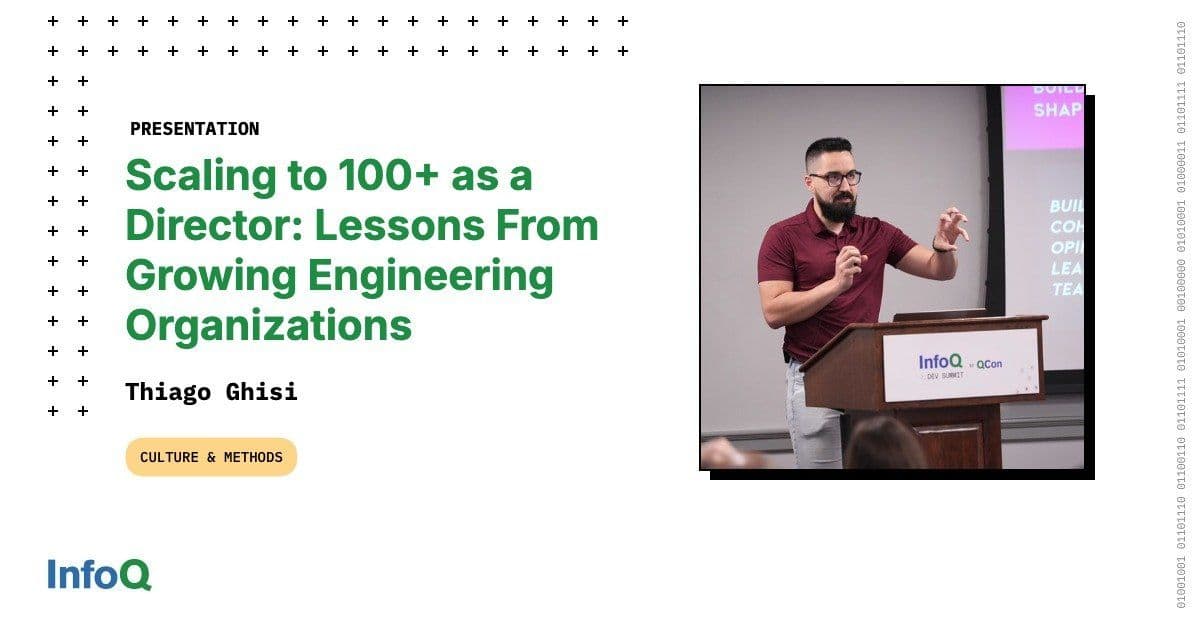
Thiago Ghisi shares his journey from managing 30 engineers to leading 100+ people, revealing the strategic frameworks and practical lessons that made sustainable scaling possible.
The Challenge of Scaling Engineering Organizations
How do we scale to 100-plus engineers without breaking ourselves and our organizations? This question lies at the heart of engineering leadership, particularly as teams grow beyond what any single person can directly manage.
Thiago Ghisi, former Director of Engineering at Nubank, has lived this challenge. Over eight years, he grew from managing his first team of managers to leading an organization of over 100 engineers. His journey offers valuable insights for engineering leaders navigating similar growth trajectories.
The Three Levels of Impact Framework
The core of Ghisi's approach is what he calls the "Three Levels of Impact" framework. This mental model helps leaders think systematically about their influence across different organizational layers:
- Your Org: Direct influence over your immediate teams
- Boss Org: Indirect influence through your leadership chain
- Entire Company: Company-wide influence and visibility
This framework operates on a crucial principle: you must understand things outside-in first, but you must act inside-out. In other words, you need to grasp company priorities and how your department fits into them, but your actual work happens within your sphere of direct control.
The Journey: From 30 to 100+ Engineers
2019-2020: Establishing the Foundation
When Ghisi first became a director, he managed just one manager. His initial focus was on establishing operational cadence—setting up meeting structures, rituals, and consistent execution patterns across teams. A critical insight emerged: as a manager of managers, you're responsible for managing throughout the organization, not just your direct reports.
The most powerful lever for organizational success? Decision-making speed. Ghisi discovered that a bad decision is often better than no decision at all because it provides feedback for iteration.
2021: The Strategic Retreat
In a counterintuitive move, Ghisi left his director role to join Apple as an individual contributor managing a small team of seven engineers. This scope reduction proved invaluable, providing fresh perspective on leadership challenges from the ground up.
2022: Hypergrowth at Nubank
Joining Nubank during its IPO year, Ghisi inherited a mobile platform team of about 30 engineers. The company was experiencing explosive growth—60 million customers with 5 million new ones monthly. By year's end, his team had grown to 49 people.
His first priority: establishing order to chaos through operational cadence and decision-making frameworks.
2023: Building Leadership Infrastructure
As the organization passed 50 engineers, Ghisi recognized that sustainable scaling required a leadership team. He focused on three critical areas:
- Creating a leveled leadership group where managers operated at similar levels of seniority
- Cultivating organizational culture through knowledge sharing, on-call practices, and identity formation
- Developing long-term vision by clustering problems, benchmarking externally, and planning beyond the current year
2024: Continuous Reorganization
With 88 people by year's end, Ghisi embraced what many fear: reorganization. But he reframed it entirely. Rather than seeing reorgs as traumatic events, he treated them as continuous deployment features—small, iterative changes that optimize the organization without disruption.
Key practices included:
- Distributing leadership and expertise evenly across teams
- Making small, reversible organizational changes
- Operating as a "driving bar raiser" for company-wide improvements
Practical Lessons for Engineering Leaders
1. Execution is Everything
In large organizations, business units that deliver consistently receive more attention, resources, and people. Execution isn't just important—it's the foundation of organizational success.
2. Decision-Making Speed Trumps Perfection
Speed of decision-making is the most powerful lever a leader has. Being decisive, even when uncertain, creates momentum and learning opportunities.
3. Manage Low and High Performers Strategically
Low performers typically struggle for one of about ten common reasons—their patterns are predictable. High performers, however, are unique individuals with specific strengths. The key is identifying and doubling down on what makes each high performer exceptional.
4. Build a True Leadership Team
Your leadership group must see themselves as a first-level team, not a second-level afterthought. They need to prioritize organizational success over "kingdom protection" and develop opinions about the broader org, not just their slice.
5. Cultural Levers Matter More Than You Think
Culture is defined most powerfully by who you promote and who you let go. Your actions—how you handle incidents, treat people, and respond to problems—shape culture more than any stated values.
6. Engineering Cost is Real
Splitting engineering managers and product managers across multiple teams doesn't work at scale. Full attention on fewer teams beats divided attention on more teams every time.
7. Write It Down
Documenting decisions prevents distortion as information flows through organizational layers. Simple one-pagers explaining reorg rationales prevent confusion and build trust.
8. Consensus is Expensive
While consensus is valuable 99% of the time, it's too slow for critical decisions. Define accountability explicitly and trust your leaders to make tough calls when needed.
9. Dry Run Reorganizations
Test organizational changes through temporary taskforces or project-based team arrangements before making them permanent. This reduces risk and builds confidence in the new structure.
10. Manage Skip Levels Personally
Executive relationships benefit from personal connection as much as professional updates. Building rapport with senior leaders creates goodwill that facilitates organizational change.
The Hidden Dimension: Your Career
Beyond the three levels of impact lies a fourth dimension: yourself and your career. Ghisi learned that at senior levels, impact and influence aren't enough—relationships and goodwill are crucial.
Key career insights include:
- The 10-30-50 Rule: Be top 10% in something, top 30% in others, and never below top 50% in any critical skill
- Set Clear Expectations: Tie goals to specific outcomes and ratings, then stay calibrated monthly
- Be a Driving Bar Raiser: Move beyond implementing and solving to finding problems and driving organizational change
Conclusion: The Path to Sustainable Scaling
Great leadership distills complexity, establishes cadence, and drives accountable execution. It's about sharing vision, being vision, and driving vision. Ultimately, it's about organizational resilience—the ability to function smoothly even when leaders are absent.
Ghisi's journey from 30 to 100+ engineers wasn't about overnight transformation. It was about consistent application of frameworks, learning from failures, and building organizational infrastructure that could scale sustainably.
The most powerful insight? Reorganizations aren't bugs to be avoided—they're features to be embraced as continuous optimization tools. When done iteratively and transparently, they become the mechanism by which organizations evolve rather than the trauma they fear.
For engineering leaders facing growth challenges, the path forward is clear: establish operational cadence, build leadership infrastructure, cultivate culture, embrace continuous reorganization, and always keep the three levels of impact framework in mind. The journey is long, but with the right approach, scaling to 100+ engineers becomes not just possible, but sustainable.
Comments
Please log in or register to join the discussion