
Global semiconductor sales hit $791.7 billion in 2025, up 25.6% year-over-year, with projections showing the industry will surpass $1 trillion in 2026 driven by AI infrastructure demand and elevated component prices.
The global semiconductor industry has shattered previous records, generating $791.7 billion in revenue during 2025, marking a staggering 25.6% increase from the prior year, according to data released by the Semiconductor Industry Association (SIA) based on World Semiconductor Trade Statistics (WSTS). This explosive growth trajectory positions the industry to cross the $1 trillion sales threshold in 2026, representing a watershed moment for the sector.
"The global semiconductor industry posted its highest-ever annual sales in 2025, nearly hitting $800 billion, and global sales in 2026 are projected to reach roughly $1 trillion," said John Neuffer, SIA president and CEO. "Semiconductors are the foundation of nearly all modern technology, and emerging technologies like AI, IoT, 6G, autonomous driving, and others will continue to drive robust demand for chips."
AI Infrastructure Fuels Unprecedented Demand
The remarkable growth is being driven primarily by insatiable demand for artificial intelligence infrastructure. The market's performance in 2025 was dominated by AI accelerators—predominantly Nvidia GPUs—alongside high-bandwidth memory (HBM), networking equipment, and storage solutions. This AI-driven demand has created a perfect storm of volume growth and pricing power across virtually all semiconductor segments.
From a product category perspective, logic devices emerged as the largest revenue generator, producing $301.9 billion in sales after expanding by 39.9% year-over-year. Memory products, encompassing DRAM, NAND, and other memory technologies, followed as the second-largest category with $223.1 billion in sales, up 34.8% YoY.
Pricing Power Amplifies Growth
A closer examination of the 2025 results reveals that the industry's momentum accelerated significantly toward year-end. Sales in Q4 2025 reached $236.6 billion, representing a 37.1% year-over-year increase—substantially higher than the 25.6% average annual growth rate. This sequential growth of 13.6% from the previous quarter suggests that price increases played a meaningful role in driving the industry's record performance.
This pricing dynamic reflects the fundamental supply-demand imbalance in the semiconductor market, where AI infrastructure requirements have created unprecedented pressure on production capacity across multiple technology nodes and product categories.
Regional Growth Patterns Reveal Supply Chain Shifts
Regional analysis of semiconductor sales reveals significant geographic shifts in the global supply chain. Asia Pacific markets, including Taiwan's advanced AI processor production and South Korea and Singapore's HBM memory assembly concentration, experienced the most dramatic growth at 45%. This surge reflects the region's central role in AI supply chain clustering.
The Americas followed with 30.5% growth, while China saw a 17.3% increase. Europe posted modest gains of 6.3%, and Japan was the only major region to decline, with sales falling 4.7% year-over-year.
Market Implications and Future Outlook
The projected $1 trillion milestone represents more than just numerical achievement—it signals the semiconductor industry's evolution into a truly trillion-dollar sector. This growth is underpinned by multiple converging technological trends beyond AI, including 6G deployment, autonomous vehicle development, and continued IoT expansion.
Industry analysts note that this growth trajectory may face challenges, including potential supply chain constraints, geopolitical tensions affecting technology trade, and the cyclical nature of semiconductor markets. However, the fundamental drivers of AI infrastructure investment appear robust enough to sustain growth through the forecast period.
The SIA's projections suggest that the semiconductor industry's role as the foundation of modern technology will only strengthen in the coming years, with AI serving as the primary catalyst for this historic expansion. As the industry approaches the $1 trillion threshold, questions about sustainability, supply chain resilience, and the balance between volume growth and pricing power will become increasingly central to market analysis.
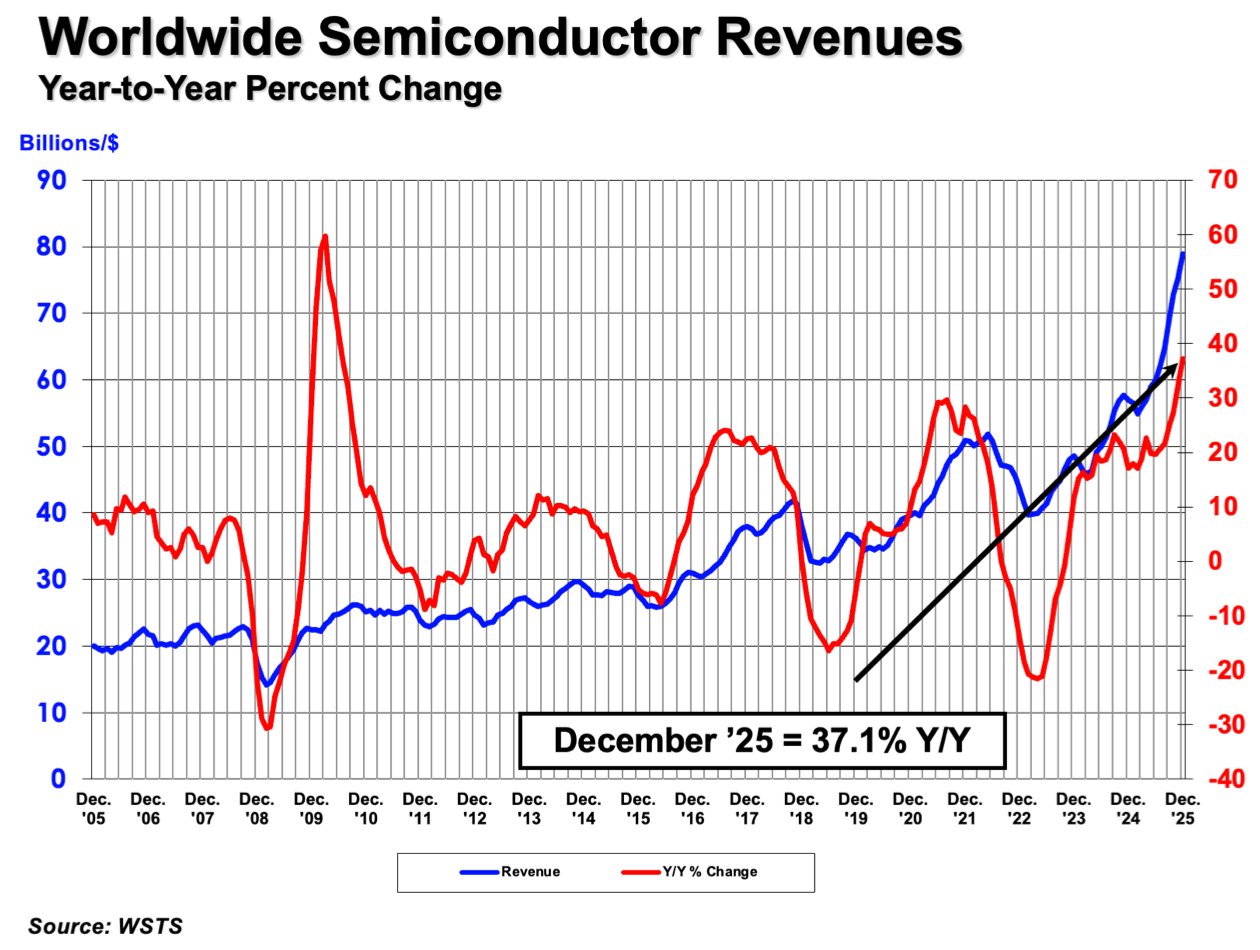
Worldwide Semiconductor Revenues - The projected growth trajectory shows the industry approaching the $1 trillion milestone in 2026.
This unprecedented growth cycle represents a fundamental reshaping of the global technology landscape, with semiconductors emerging as not just essential components but as the primary drivers of economic value creation in the digital age.
Comments
Please log in or register to join the discussion