
The latest National Assessment of Educational Progress scores reveal a decade-long decline in student achievement, with troubling implications for American education.
The National Assessment of Educational Progress (NAEP) scores released on January 29 paint a sobering picture of American education. Headlines called the results "disheartening," "new low," and "even worse"—and they weren't exaggerating.
Average performance dropped in reading and barely improved in math, confirming what many educators have suspected: we're experiencing an education depression that has persisted for over a decade.
The Education Depression Continues
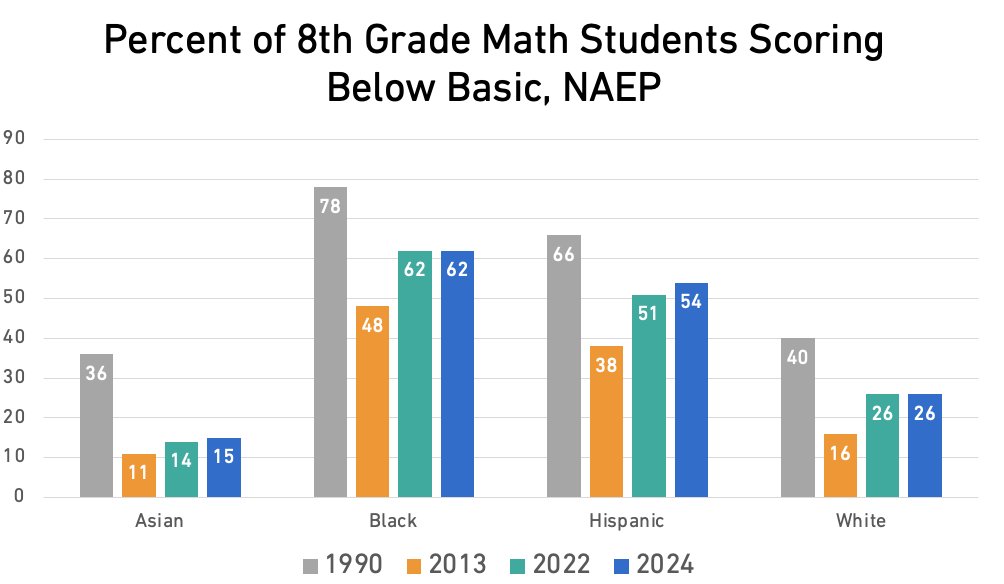
The data shows that from 1990 to 2013, American education made massive progress, particularly in reducing the number of students performing at very low levels. But by 2022, most of those gains had disappeared. The latest scores confirm this troubling trend continues unabated.
For each racial group, we now have just as many 8th graders scoring below basic as we did in 2022, and far more than in 2013. Five years after the pandemic began, there has been virtually zero recovery. This pattern appears across multiple assessments—it's not an anomaly.
The New Normal of Mediocrity
Massachusetts and Wisconsin tied for the top score in 8th grade math at 283. While these states deserve credit, the context is alarming: that same score of 283 would have placed 30th in 2013.
Reading shows similar patterns. The 2024 4th-grade leader—Massachusetts again—would have tied for 14th place in 2013 with Indiana, Washington, and Maine.
The lack of positive outliers is equally concerning. In 2013, only five states were within 10 points (approximately one year's learning) of Massachusetts in 8th-grade math. This year, 24 states fall within that range. The once-clear leader now has company at the top, suggesting widespread stagnation rather than isolated excellence.
When Results Seem Too Good to Be True
Two years ago, Los Angeles Unified posted a shocking nine-point gain on the 8th-grade reading test. This was particularly surprising given that Los Angeles had some of the longest pandemic school closures and reading scores nationally dropped by three points in 2022.
Superintendent Alberto Carvalho dismissed skeptics as "flat-earthers" and attributed the gains to technology distribution, tutoring, and teacher training. However, the 2024 results showed LAUSD's 8th-grade reading score dropped by eight points, essentially wiping out the previous improvement.
Carvalho now suggests "sampling methods can lead to anomalies"—a dramatic shift from his earlier certainty.
Money Isn't Solving the Problem
While research generally shows that increased school funding leads to better outcomes, the massive $190 billion federal Covid recovery investment hasn't translated into improved NAEP results.
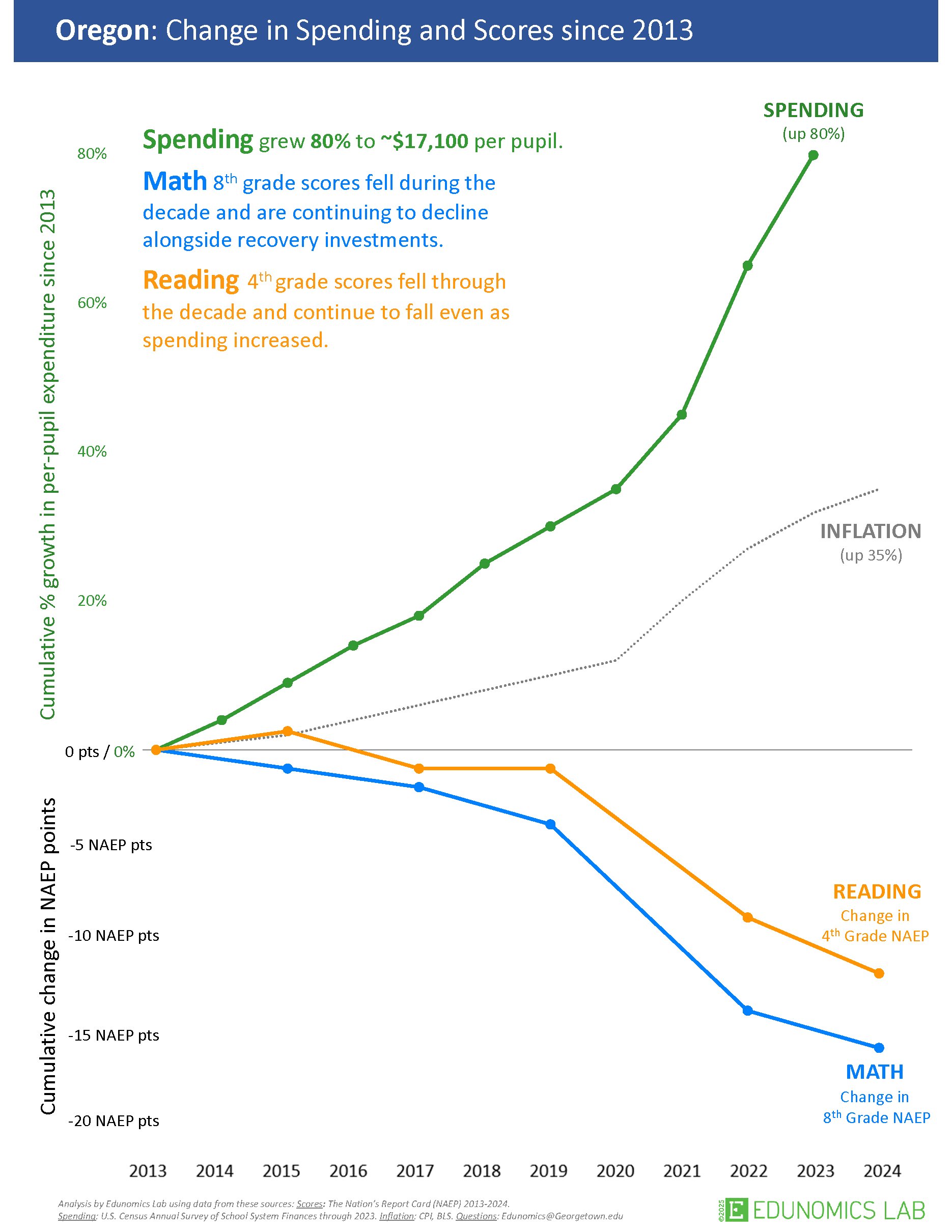
Georgetown University's Edunomics Lab examined each state's return on investment by comparing spending increases since 2013 to academic outcomes. The results are troubling.
Oregon, for example, increased school spending by 80 percent from 2013 to 2023 (compared to about 35 percent if it had merely kept pace with inflation). During the same period, math scores declined by 16 points—the equivalent of 1.5 grade levels.
Oregon isn't alone. Washington and Vermont show similarly discouraging patterns, while Mississippi has bucked the trend with smaller spending increases and real gains in reading.
The bottom line: the case for investing more in schools is very weak right now because it's not clear that new resources will yield better results.
State Responses Range from Denial to Delusion
In the face of dismal national results, almost every state claimed victory with unconvincing spin. Wyoming's performance dropped on three of four NAEP tests and was flat on the fourth, yet its official statement says Wyoming "continues to stand out nationally."
Florida, which had particularly bad reading results, went further by having its state chief Manny Diaz write a letter saying NAEP's methodology is wrong and calling for the Department of Education to be abolished.
These responses represent a low point for the education sector—hiding from the truth about what we're providing for our students.
Demographic Adjustments Tell Another Story
Researchers Matt Chingos and Kristin Blagg from the Urban Institute published demographically adjusted NAEP results that compare states' actual scores to what would be expected given their student populations.
Factors considered include gender, age, race and ethnicity, and status for free lunch, special education, and English language learner services.
Mississippi, for example, finished 13th in 4th-grade math and 7th in 4th-grade reading in the official rankings. After demographic adjustment, they finished first in both categories.
Conversely, New Hampshire's 4th-grade reading score was the fourth highest in the country but dropped to 18th after adjustment.
These adjustments suggest some states are facing and meeting greater challenges while others might be achieving less than meets the eye.
What Now?
The new test results suggest we've been chasing the wrong ghost for years. This isn't about recovery from deficits that festered during Covid remote learning. The bigger picture is a prolonged slide dating to 2013—especially among lower-performing students.
The achievement gap has always existed, but it was getting worse before the pandemic. Since 2019, it has exploded, and we can't tell yet if it's done growing.
Some districts and states have no plan to reverse these patterns because they barely acknowledge they exist. Patience is waning, but fixing this can't fall on system leaders alone. They need help—better insights on what caused our depression and better ideas for reinvigorating instruction.
For now, our shared job is to be honest: This isn't good enough.


Tim Daly is the co-founder of EdNavigator. This post originally appeared on his substack, The Education Daly.
Comments
Please log in or register to join the discussion