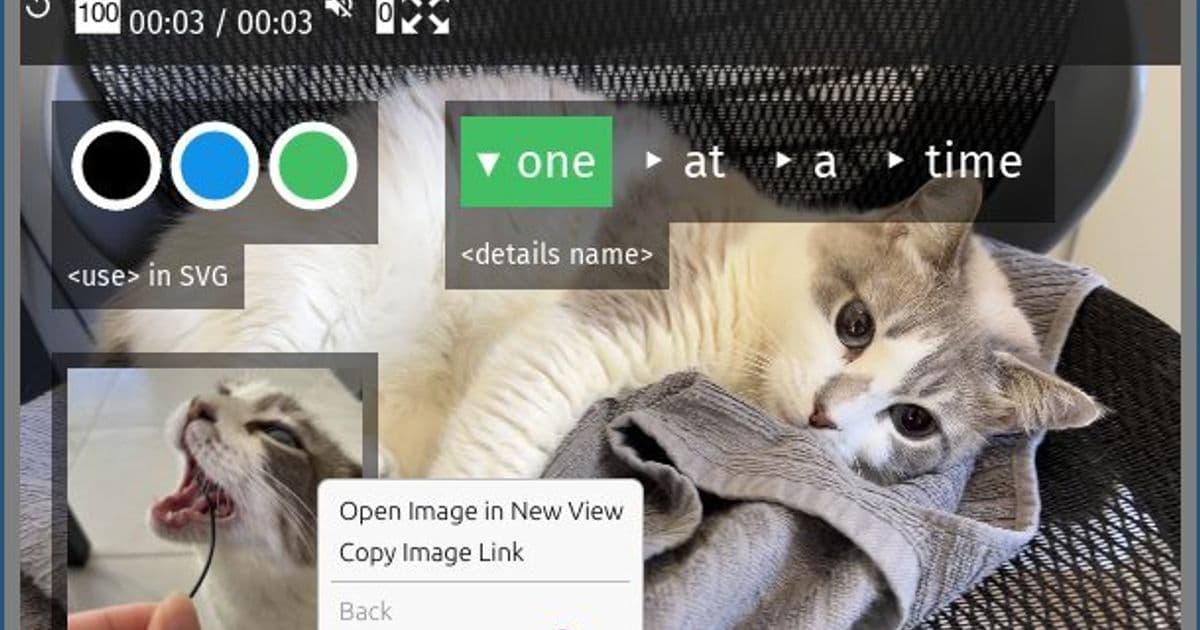
Servo's November update introduces parallel CSS parsing, expanded cryptographic algorithm support, and multi-window capabilities. Version 0.0.3 brings significant performance improvements and new web platform features while stabilizing the experimental browser engine.
Servo, the experimental browser engine built with Rust, has shipped its 0.0.3 release with substantial performance enhancements and expanded web platform capabilities. The November update brings architectural improvements that could reshape how developers approach browser engine design, particularly around parallelism and security.
Core Technical Advancements
Parallel CSS Parsing (#40639) now executes concurrently with script evaluation and layout computation, significantly reducing rendering bottlenecks. This architectural shift demonstrates Servo's advantage in leveraging Rust's concurrency safety for performance gains where traditional browsers face limitations.
{{IMAGE:2}}
The engine now supports modern cryptographic primitives critical for next-generation web applications:
- Full SHA3 family support (#40765)
- Argon2 password hashing algorithms (#40932, #40936)
- ChaCha20-Poly1305 encryption (#40948)
- ECDSA signatures and X25519 key exchange
This cryptographic expansion positions Servo as a testbed for secure web applications, implementing even draft WICG specifications like cSHAKE (#40832).
Embedding API Revolution
Servo's embedding layer underwent major rework enabling per-webview rendering contexts (#40794). This foundational change:
- Enables true multi-window browsing experiences
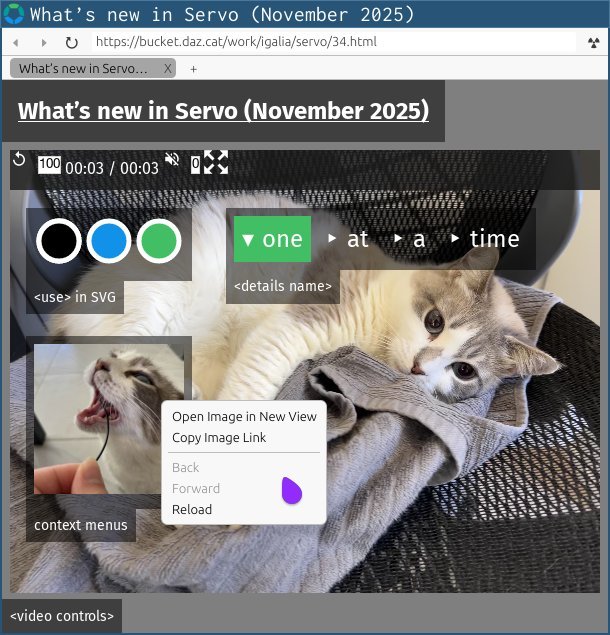
- Replaces legacy context menus with content-aware actions (#40402)
- Adds navigation state tracking via
can_go_back()/can_go_forward()(#40598)
The API simplifications (#40951) reduce embedding friction while maintaining flexibility—critical for integration into applications beyond traditional browsers.
Performance Optimizations
Beyond parallel parsing, engineers achieved:
- Optional JIT compilation (#37972) for restricted environments
- 20-40% faster incremental layout computations (#40795)
- Improved touch input responsiveness (#40637)
- Efficient animated GIF rendering (#40158)
The team also resolved stability issues affecting major sites including NYTimes.com (#40811) and Speedometer 3.1 (#40459), while implementing Largest Contentful Paint metrics (#39714) for performance monitoring.
Sustainable Development
Servo's funding model shows promising traction with $6,433 in monthly recurring donations (+11.8% MoM), supporting infrastructure and Outreachy internships. The project now offers formal sponsorship tiers for organizations leveraging Servo components like html5ever or cssparser.
As Servo approaches its 10-year anniversary, these updates demonstrate how experimental browser technology can drive innovation in web standards implementation—particularly in security, parallelism, and embeddability. The 0.0.3 release sets foundations for exploring Chromium-independent web engine approaches.
Source: Servo Blog
Comments
Please log in or register to join the discussion