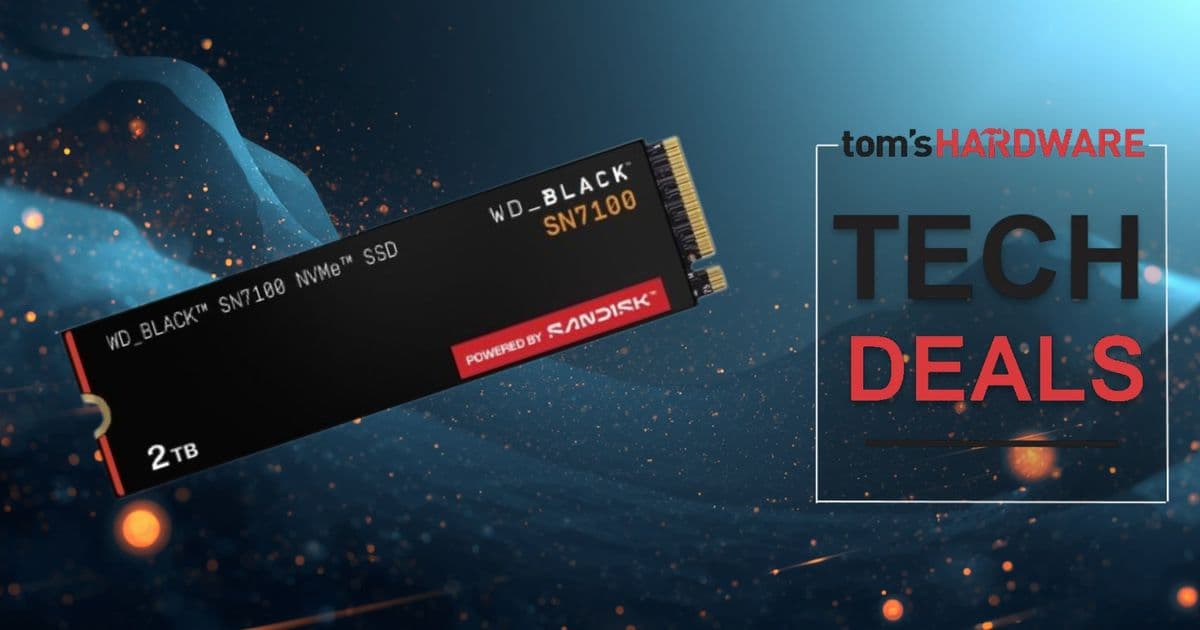
This article examines the current state of SSD chip architecture, manufacturing processes, and market dynamics, focusing on how manufacturers like Western Digital are balancing performance, power efficiency, and cost in a supply-constrained environment.
SSD Architecture Evolution: From NAND Flash to PCIe 4.0 Dominance in a Constrained Market
The solid-state drive market has undergone significant transformation in recent years, with manufacturers pushing the boundaries of performance while navigating supply chain constraints and evolving consumer demands. The Western Digital Black SN7100 exemplifies the current state of SSD technology, incorporating advanced NAND flash architecture and PCIe 4.0 interfaces while addressing power efficiency concerns that are particularly critical for mobile devices.
Current NAND Flash Architecture and Manufacturing Processes
Modern SSDs like the WD Black SN7100 utilize 218-layer TLC (Triple-Level Cell) NAND flash technology, specifically SanDisk's proprietary BiCS8 (Bit Cost Scaling 8) architecture. This represents a significant evolution from earlier generations, with layer counts doubling from approximately 100-128 layers just a few years ago. The increased layer density allows for higher storage capacity within the same physical footprint while maintaining cost efficiency.
The manufacturing of these high-density NAND chips requires extreme ultraviolet (EUV) lithography, which has become essential for producing the intricate patterns necessary at such small geometries. EUV technology, developed by ASML, has been crucial in enabling the continued scaling of NAND flash beyond what was possible with conventional deep ultraviolet (DUV) lithography alone.
The transition to 218-layer NAND has not been without challenges. As manufacturers add more layers, they must contend with increased process complexity, potential defects, and thermal management issues. These challenges directly impact yield rates, which in turn affect pricing and availability in the market.
Controller Architecture and Design Trade-offs
The WD Black SN7100 utilizes SanDisk's proprietary Polaris 3 controller, which represents a sophisticated approach to balancing performance, power efficiency, and cost. One notable design decision is the use of a DRAM-less architecture, which eliminates the traditional DRAM cache found in many high-performance SSDs.
This design choice reflects several market realities:
- Cost reduction: DRAM can constitute 15-20% of the total bill of materials for an SSD
- Power efficiency: Removing DRAM reduces idle and active power consumption
- Form factor constraints: The 2280 M.2 form factor has limited space components
To compensate for the lack of DRAM, the SN7100 implements Host Memory Buffer (HMB) technology, which leverages a portion of the system's RAM as a cache. This approach requires NVMe 1.3 support and can provide most of the benefits of dedicated DRAM without the additional cost and power requirements.
The controller also incorporates advanced wear-leveling algorithms and error correction code (ECC) to ensure data integrity and longevity. With a TBW (Terabytes Written) rating of 1,400 TBW for the 2TB model, the drive offers substantial endurance for most consumer workloads.
PCIe 4.0 Performance and Interface Evolution
The SN7100 delivers sequential read speeds of up to 7,250MB/s and write speeds of up to 6,900MB/s, representing a significant improvement over previous generations. This performance is enabled by the PCIe 4.0 interface, which doubles the bandwidth of PCIe 3.0 from 1GB/s per lane to 2GB/s per lane.
The transition to PCIe 4.0 has been gradual, with adoption initially limited by the availability of compatible platforms and the diminishing returns for many consumer workloads. However, as platforms have become more widespread and the cost differential has decreased, PCIe 4.0 has become the standard for high-performance consumer SSDs.
Looking ahead, PCIe 5.0 SSDs are beginning to emerge, offering theoretical bandwidth of up to 14GB/s per lane. However, the practical benefits for most users remain limited, and the power requirements are significantly higher. The SN7100's focus on efficiency within the PCIe 4.0 ecosystem represents a pragmatic approach to balancing performance and power consumption.
Power Efficiency and Thermal Management
One of the most significant advancements in modern SSDs like the SN7100 is power efficiency. The drive achieves excellent performance while minimizing power consumption, making it particularly suitable for laptops and other battery-powered devices.
This efficiency is achieved through several design strategies:
- Advanced process nodes for the controller and NAND chips
- Intelligent power management that reduces power consumption during idle periods
- Optimized firmware that minimizes unnecessary operations
- Thermal throttling algorithms that prevent performance degradation due to overheating
The power efficiency of modern SSDs has improved dramatically, with idle power consumption now measured in milliwatts rather than watts. This improvement has been crucial for extending battery life in mobile devices while still providing the performance benefits of solid-state storage.
Supply Chain Dynamics and Market Pressures
The SSD market has been significantly impacted by global supply chain constraints, particularly affecting NAND flash and DRAM production. The COVID-19 pandemic disrupted manufacturing facilities, shipping logistics, and semiconductor production, leading to shortages and price increases.
These market pressures have been exacerbated by:
- Increased demand for data center storage
- Growth in consumer electronics requiring high-capacity storage
- Expansion of AI and machine learning workloads requiring fast storage
- Geopolitical tensions affecting production in key regions
The result has been a volatile pricing environment, with the 2TB WD Black SN7100 fluctuating from approximately $120 in 2022 to over $400 in 2023, before settling around $299.99 at present. This volatility has made it challenging for both manufacturers and consumers to plan and budget effectively.
Manufacturing Economics and Cost Structure
The cost structure of modern SSDs is complex, with several key components contributing to the final price:
- NAND flash: Typically constitutes 40-50% of the total cost
- Controller: Accounts for 15-20% of the bill of materials
- DRAM (when included): Contributes 10-15% to the cost
- PCB and other components: Make up the remaining 20-25%
Manufacturers face significant challenges in reducing costs while maintaining performance and reliability. The transition to more advanced NAND nodes requires substantial capital investment, with new fabrication facilities costing billions of dollars. These investments must be amortized across production volumes, creating economies of scale that favor larger manufacturers.
The DRAM-less approach exemplified by the SN7100 represents one strategy for cost reduction, but it comes with trade-offs in performance consistency. For workloads involving frequent large file transfers, a DRAM-equipped SSD may provide more consistent performance, albeit at a higher price point.
Performance Benchmarks and Real-World Usage
Benchmarks indicate that the SN7100 delivers excellent random read performance and competitive sequential speeds, making it suitable for a wide range of applications. However, real-world performance can vary significantly depending on the workload and system configuration.
For gaming applications, the drive's fast load times can reduce waiting periods and improve the overall experience. In content creation workflows, the high sequential speeds can significantly reduce file transfer times. For use in a PlayStation 5, the drive's performance can help reduce loading times for games and improve overall system responsiveness.
However, the DRAM-less architecture may lead to performance degradation during sustained heavy workloads, such as large file transfers or database operations. The HMB technology helps mitigate this issue, but users with intensive storage workloads may still benefit from a DRAM-equipped SSD.
Future Trends in SSD Technology
Looking ahead, several trends are likely to shape the evolution of SSD technology:
NAND Flash Evolution: Beyond 218-layer NAND, manufacturers are developing 300+ layer technologies that will further increase density and reduce cost per gigabyte. New cell architectures, such as PLC (Penta-Level Cell) and QLC (Quad-Level Cell), continue to improve, offering higher capacities at lower costs, albeit with some trade-offs in endurance and performance.
PCIe 5.0 and Beyond: While PCIe 5.0 SSDs are now available, the performance benefits for most users remain limited. PCIe 6.0 is on the horizon, with bandwidth up to 4GB/s per lane, but widespread adoption will require platform support and may be limited by diminishing returns.
Computing Storage: The convergence of storage and processing continues, with technologies like CXL (Compute Express Link) enabling more direct access to storage resources. This architecture could reduce latency and improve efficiency for certain workloads.
ZNS SSDs: Zoned Namespace SSDs are gaining traction in data center applications, offering improved endurance and efficiency by allowing more fine-grained control over data placement.
Advanced Error Correction: As NAND geometries continue to shrink, error correction becomes increasingly critical. New ECC algorithms and forward error correction techniques will be essential to maintain data integrity.
Market Implications and Consumer Considerations
The current state of the SSD market presents both challenges and opportunities for consumers. While prices have come down from their peaks, they remain higher than historical lows. However, the performance and efficiency improvements of modern drives like the SN7100 offer significant benefits over previous generations.
For consumers considering an SSD upgrade, several factors should be considered:
Use Case: Gaming, content creation, and general computing have different performance requirements. For most users, a high-quality PCIe 4.0 drive like the SN7100 provides an excellent balance of performance and value.
Capacity Needs: Storage requirements continue to grow, with 2TB becoming the sweet spot for many users. The price per gigabyte has decreased significantly, making higher capacities more accessible.
Power Efficiency: For laptop users, power efficiency can directly impact battery life, making drives like the SN7100 particularly attractive.
Endurance Requirements: Most users will never approach the TBW rating of modern SSDs, but those with intensive workloads should consider drives with higher endurance ratings.
Future-Proofing: With PCIe 5.0 becoming more common, consumers may want to consider whether the additional cost is justified by their specific needs.
Conclusion
The Western Digital Black SN7100 exemplifies the current state of SSD technology, balancing advanced NAND architecture, efficient controller design, and competitive pricing. As the industry continues to evolve, we can expect further improvements in density, performance, and efficiency, though the pace of innovation may be tempered by economic realities and supply chain constraints.
For consumers, the current market offers an opportune time to upgrade to high-performance SSDs, with prices becoming more reasonable while still benefiting from significant technological advancements. The SN7100's combination of speed, efficiency, and value makes it an attractive option for a wide range of applications, from gaming systems to content creation workstations.
As we look to the future, the continued convergence of storage and processing technologies will likely reshape the SSD landscape, creating new opportunities for innovation while presenting new challenges for manufacturers and consumers alike.
Comments
Please log in or register to join the discussion