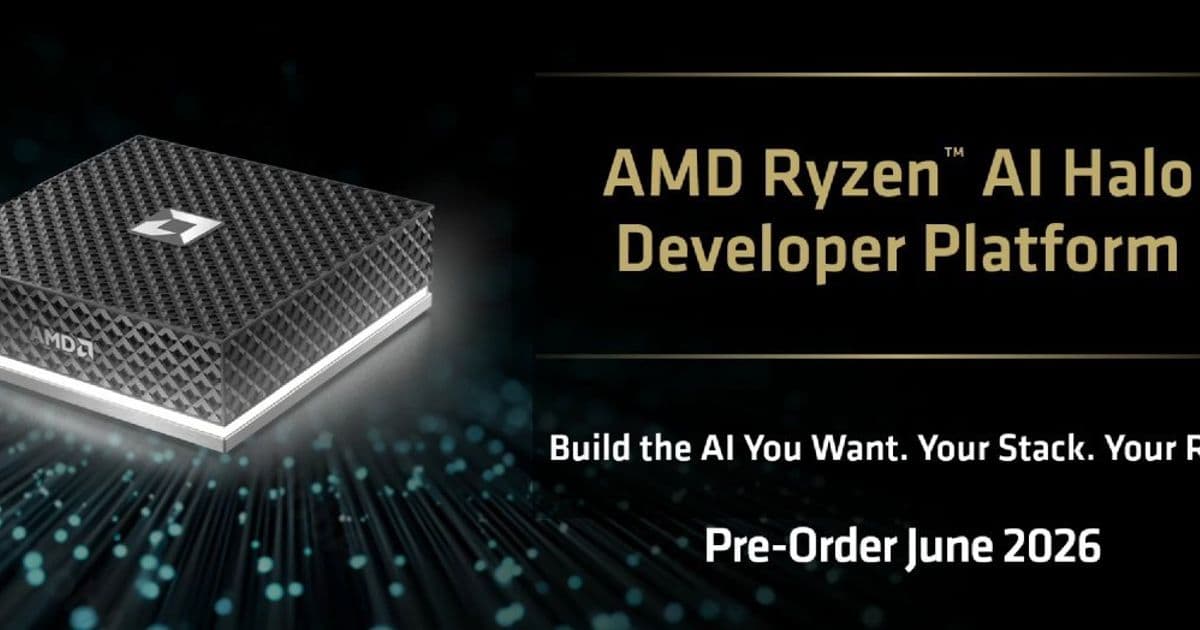
AMD's new Ryzen AI Halo mini PC brings significant AI processing power to developers, particularly those working on mobile AI applications and cross-platform solutions.
The AMD Ryzen AI Halo mini PC represents a new approach to AI development hardware, offering a compact yet powerful solution for mobile AI developers. With its Ryzen AI Max+ 395 processor featuring Radeon 8060S integrated graphics and 128GB of unified memory, this tiny computer (5.9" x 5.9" x 1.7") packs enough performance to handle complex AI workloads while maintaining the portability developers need.
For mobile developers working on AI features for iOS and Android applications, the Ryzen AI Halo offers several advantages. Its support for both Windows and Linux operating systems provides flexibility for development environments, while its 40-core integrated GPU with RDNA 3.5 architecture delivers the computational power needed for training and testing AI models that will eventually run on mobile devices.
The device's price point of $3,999 and up positions it as a professional tool rather than consumer hardware, making it particularly relevant for development teams focused on mobile AI. When compared to NVIDIA's DGX Spark, the Ryzen AI Halo offers similar AI performance with the added benefit of Windows support, which can be crucial for developers working with certain mobile SDKs that are Windows-dependent.
For mobile developers, the Ryzen AI Halo's compact form factor is particularly noteworthy. Many mobile development teams work in spaces where traditional workstations aren't practical, and the ability to have a powerful AI development machine that doesn't require a dedicated desk space could significantly improve workflow flexibility.
The device's specifications make it well-suited for mobile AI development:
- 16-core, 32-thread Zen 5 processor provides ample CPU power for compiling mobile applications
- 128GB of LPDDR5x-8000 unified memory allows for handling large mobile AI models
- 10 Gbps Ethernet ensures fast data transfer for model training datasets
- WiFi 7 and Bluetooth 5.4 support aligns with modern mobile connectivity standards
- Multiple USB-C ports facilitate connection to mobile devices for testing
For developers working on cross-platform mobile applications, the Ryzen AI Halo's dual OS support is particularly valuable. Many mobile development frameworks like React Native, Flutter, and Xamarin benefit from the ability to test on both Windows and Linux environments, and the Ryzen AI Halo provides this flexibility in a single, compact device. The official documentation for AMD's AI software stack provides additional guidance on optimizing these frameworks for Ryzen AI processors.
The upcoming Ryzen AI Max+ PRO 495 model, with support for up to 192GB of memory (up to 160GB as VRAM), will further enhance the device's appeal for mobile AI developers working with increasingly large models. This additional memory capacity will be particularly valuable for developers creating AI features for mobile devices with more advanced capabilities.
For mobile developers considering the Ryzen AI Halo, there are several migration considerations. The device's compact size means it can replace larger workstations without sacrificing performance, potentially freeing up valuable workspace in development environments. The support for both Windows and Linux also means teams can transition between development environments as needed without hardware changes.
The Ryzen AI Halo's introduction comes at a time when mobile AI capabilities are rapidly expanding. Developers are increasingly expected to implement AI features in mobile applications, from image recognition to natural language processing. The Ryzen AI Halo provides the necessary hardware to develop these features efficiently, with the compact form factor making it suitable for mobile development teams of all sizes.
For mobile development teams already invested in AMD's ecosystem, the Ryzen AI Halo offers seamless integration with existing tools and workflows. The device's support for common mobile development SDKs and frameworks ensures compatibility with established mobile development practices. Mobile developers can leverage AMD's AI SDK to optimize their applications for the Ryzen AI architecture, potentially gaining performance benefits when deploying to devices with similar AMD silicon.
As mobile devices continue to become more powerful, the line between mobile and desktop development continues to blur. The Ryzen AI Halo represents this convergence, providing developers with a powerful yet compact tool that can handle the demands of modern mobile AI development while maintaining the portability needed for today's development teams.
With its June release date approaching, mobile development teams should consider how the Ryzen AI Halo might fit into their development workflow. For teams focused on AI features in mobile applications, the device's combination of power, compact size, and dual OS support could provide a significant advantage in development efficiency and capability. The AMD Ryzen AI Halo product page will provide additional details on specifications and availability as the launch date approaches.
Comments
Please log in or register to join the discussion