
Stack Overflow has eliminated the 20-reputation requirement for chat access, allowing all registered users to participate in public chat rooms immediately. The move follows a successful pilot program with Stack Exchange Lobbies that showed 60% of participants had less than 20 reputation, proving novice users would engage when given a safe entry point. The platform is also launching new onboarding tools and enhanced moderation to manage the influx.
Stack Overflow has removed the reputation barrier that previously prevented new users from accessing its chat rooms. As of today, all registered users can join and participate in public chat rooms immediately, regardless of their reputation score.
This change represents a fundamental shift in how Stack Overflow approaches community entry points. For years, the platform required users to earn 20 reputation points before they could access chat—a gate that served as both quality filter and community protection mechanism. But that same gate also created a cold start problem for newcomers trying to find their footing in the Stack Overflow ecosystem.
The Problem with Reputation-Gated Access
The 20-reputation requirement made sense in theory. Chat rooms are real-time spaces where conversations move quickly, and without some vetting, they could become overwhelmed with spam, low-quality questions, or users who hadn't yet learned community norms. Reputation acts as a proxy for engagement quality—users who've earned 20 points have typically asked a good question, provided a helpful answer, or had an edit approved.
But this created a chicken-and-egg problem. New users couldn't chat until they earned reputation, but one of the best ways to learn community norms and build confidence is through real-time interaction with experienced members. Without chat access, newcomers were limited to asynchronous Q&A, which can feel intimidating and isolating.
The reputation threshold also disproportionately affected users from underrepresented communities, non-native English speakers, and those entering technology from non-traditional backgrounds. These users often need more support, not less, but the system made them wait to receive it.
The Lobbies Pilot: Proof of Concept
In May 2025, Stack Overflow launched the Stack Overflow and Stack Exchange Lobbies as an experiment. These were designated safe spaces where users with 1 reputation could chat about projects, ask support questions, and connect with others. The goal was to test whether novice users would engage responsibly if given the opportunity.
The results were compelling. Stack Overflow verified that 60% of all Lobby room participants currently have fewer than 20 reputation points. This wasn't just casual lurking—these users were actively participating, asking questions, and learning from the community. The Lobbies demonstrated that reputation isn't the only predictor of good chat behavior; clear guidelines, good moderation, and intentional community design matter more.
This data gave Stack Overflow confidence that opening all public chat rooms wouldn't result in chaos. The pilot showed that when you provide structure and expectations, users will rise to meet them.
Scaling Infrastructure for Real-Time Communication
Opening chat to all registered users requires significant backend scaling considerations. Chat rooms are fundamentally different from Stack Overflow's core Q&A model:
Q&A is write-once, read-many: A question gets posted, receives answers, and then serves as a static reference. The database can optimize for eventual consistency—answers can appear seconds or minutes later without breaking the user experience.
Chat is real-time, ephemeral, and collaborative: Messages appear instantly, conversations flow organically, and the value is in the immediate back-and-forth. This requires:
- Lower latency requirements: WebSocket connections must stay open and responsive
- Higher write throughput: Every message is a database write, and rooms can see bursts of activity
- Different consistency models: Users expect to see messages in the same order, across all clients
- Connection management: Scaling WebSocket servers to handle potentially thousands of concurrent connections from new users
Stack Overflow's chat infrastructure likely uses a message queue (like RabbitMQ or Kafka) to handle the real-time distribution of messages, with Redis for ephemeral state management and a relational database for persistence. Opening access to all users means planning for connection spikes, especially during peak hours or when popular rooms get mentioned in other contexts.
New Onboarding and Community Management Tools
To support this influx, Stack Overflow is introducing chat room onboarding cards. Chat Room Owners can now create custom welcome messages that appear to new users joining their room. These cards explain:
- What the room is for
- Expected behavior and norms
- How to ask good questions
- What topics are off-limits
This is a smart approach because it distributes community management. Instead of Stack Overflow's central team trying to create one-size-fits-all rules, room owners—who know their specific communities best—can set appropriate expectations.
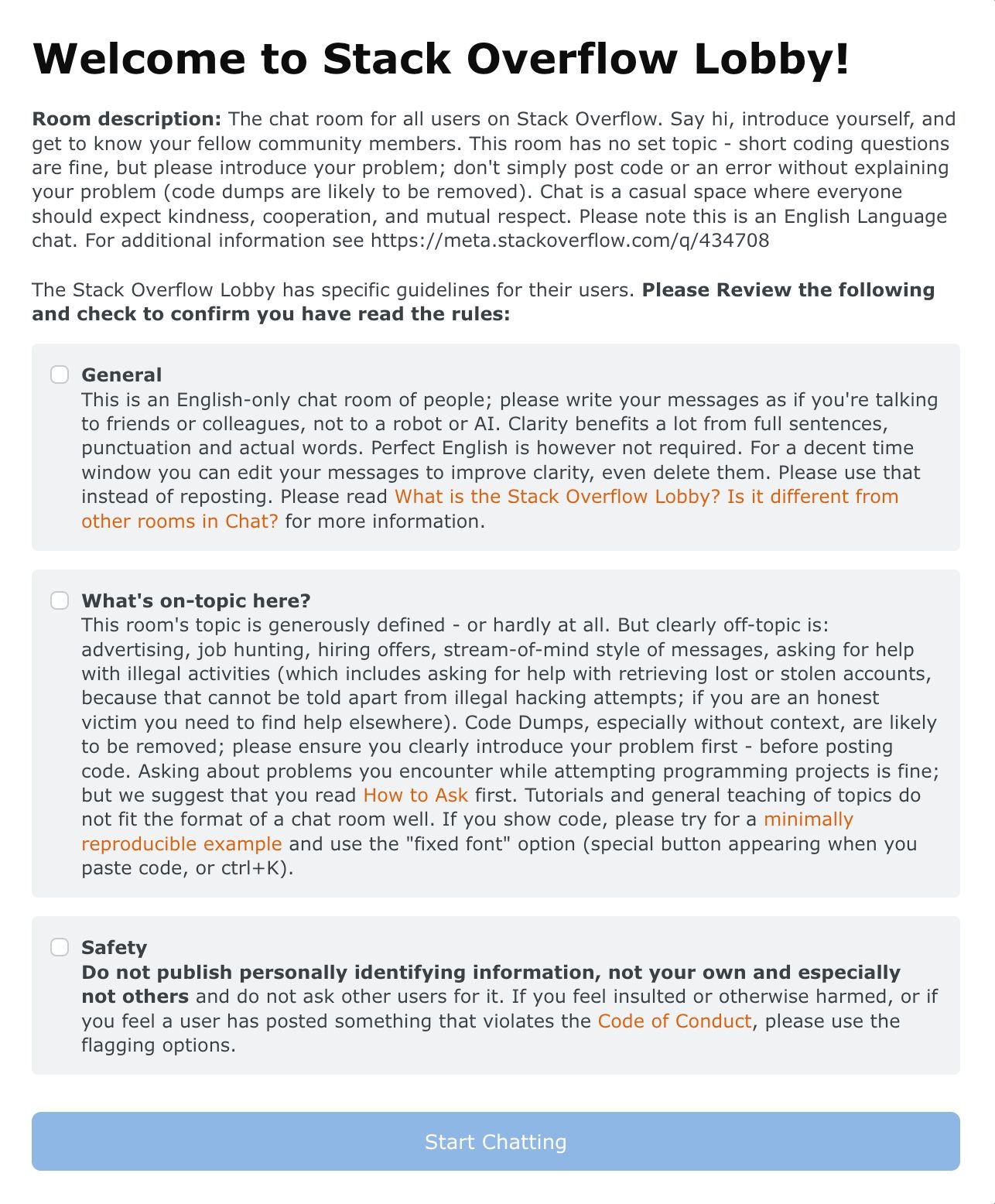
For example, a Python beginner's room might have different norms than a Rust performance optimization room. The former might encourage "stupid questions" and be very patient, while the latter might expect some baseline knowledge and focus on technical depth.
Enhanced Moderation and Security
The announcement mentions "human identity validation" to prevent spam bots. This likely refers to CAPTCHA challenges or email verification requirements before chat access, but the details matter for implementation:
Rate limiting: New accounts can't immediately join dozens of rooms and post spam. There's probably a cooldown or room-join limit.
Reputation-based throttling: While 1-rep users can join, their ability to post might be limited initially (e.g., one message per minute until they build trust).
Automated detection: Machine learning models that detect spam patterns, harassment, or coordinated bad behavior across rooms.
Human moderators: Stack Overflow's community team can now see patterns across chat rooms and intervene when necessary.
The challenge here is balancing safety with accessibility. Overly aggressive moderation creates friction for legitimate users. Too lax, and rooms become unusable. The "human identity validation" suggests they're focusing on preventing bot armies rather than policing human behavior, which is the right priority.
Trade-offs and Unintended Consequences
Opening chat to all users involves several trade-offs:
Quality vs. quantity: More participants means more diverse perspectives, but also more noise. Experienced users might leave rooms that become flooded with basic questions.
Moderation burden: Chat room owners now need to be more vigilant. Stack Overflow is essentially outsourcing community management to volunteers, which works but requires good tools.
Server costs: More users in chat means more WebSocket connections, more server time, higher infrastructure bills. Stack Overflow must have calculated that the engagement benefits outweigh these costs.
Fragmentation: With more users, rooms might splinter into increasingly niche topics. This could be good (better specialization) or bad (harder to find the right room).
Harassment risk: Real-time spaces can be abused for harassment more easily than asynchronous Q&A. The enhanced moderation tools will be critical here.
What This Means for Stack Overflow's Future
This change signals Stack Overflow's evolution from a pure Q&A repository to a comprehensive community platform. The company recognizes that:
Learning happens in conversation: Static answers are valuable, but real-time discussion accelerates understanding.
Community is sticky: Users who form connections in chat are more likely to stay engaged with the platform long-term.
The next generation of experts needs support: By lowering barriers, Stack Overflow is investing in its future contributor base.
Competition is changing: Platforms like Discord, Slack, and GitHub Discussions offer real-time community features. Stack Overflow needs to compete.
Getting Started
For users who've been waiting to explore Stack Overflow's chat features:
- Visit the chat rooms landing page to see all available rooms
- Read room descriptions and onboarding cards to find the right fit
- Start with the Lobby rooms if you're new—they're designed for your experience level
- Remember that chat is searchable and persistent, so your contributions become part of the community record
For room owners:
- Set up your onboarding cards immediately
- Review the updated chat room guidelines
- Consider appointing additional room moderators if you expect growth
- Use the new moderation tools to maintain your room's culture
The Broader Pattern
This move reflects a broader trend in developer tools: the recognition that community and collaboration are as important as raw technical capability. GitHub added Discussions and improved real-time features. Dev.to built community features. Stack Overflow's chat expansion is part of this evolution.
The key insight is that technical knowledge isn't just about having the right answer—it's about learning how to ask, how to debug, how to think through problems. Real-time chat excels at teaching these meta-skills.
Stack Overflow's challenge now is scaling this community infrastructure while maintaining the quality that made the platform valuable in the first place. The Lobbies pilot suggests they've found a workable model, but scaling from pilot to production always reveals edge cases.
For the distributed systems engineer watching this unfold, it's a fascinating case study in scaling community infrastructure: managing connection state, implementing effective rate limiting, designing moderation systems that work at scale, and balancing openness with quality. The technical decisions behind this rollout will be worth watching as the user base grows.
The real test comes in the months ahead. If Stack Overflow can maintain room quality and user safety while dramatically expanding access, they'll have proven that reputation isn't the only path to community trust—and that might reshape how we think about onboarding in online communities everywhere.
Comments
Please log in or register to join the discussion