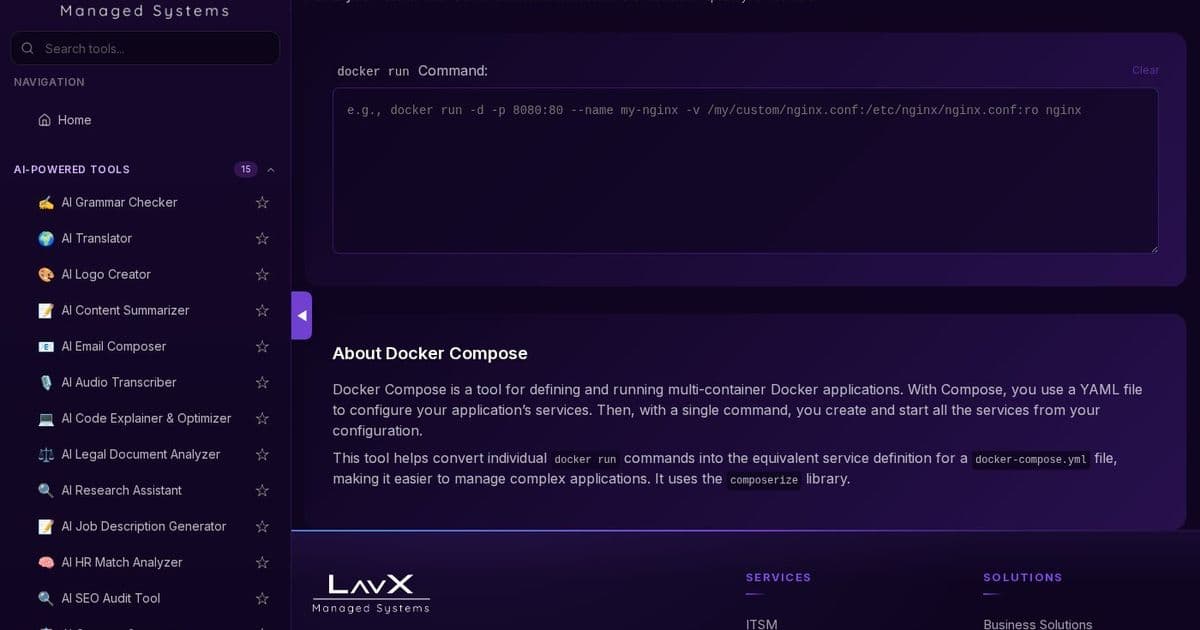
For developers managing containerized applications, converting complex Docker run commands to Docker Compose format can be time-consuming and error-prone. LavX's Docker Run to Compose tool automates this process, enabling teams to standardize their deployments and improve maintainability.
The Challenge of Docker Run Commands
Docker has revolutionized how we deploy and manage applications, but as projects grow, managing individual docker run commands becomes increasingly complex. Each command might include numerous flags, environment variables, volume mounts, and network configurations that are difficult to track and reproduce.
When teams need to scale or collaborate, maintaining consistency across environments becomes a significant challenge. This is where Docker Compose shines, but the migration from individual run commands to a structured Compose file often involves manual translation that's prone to errors.
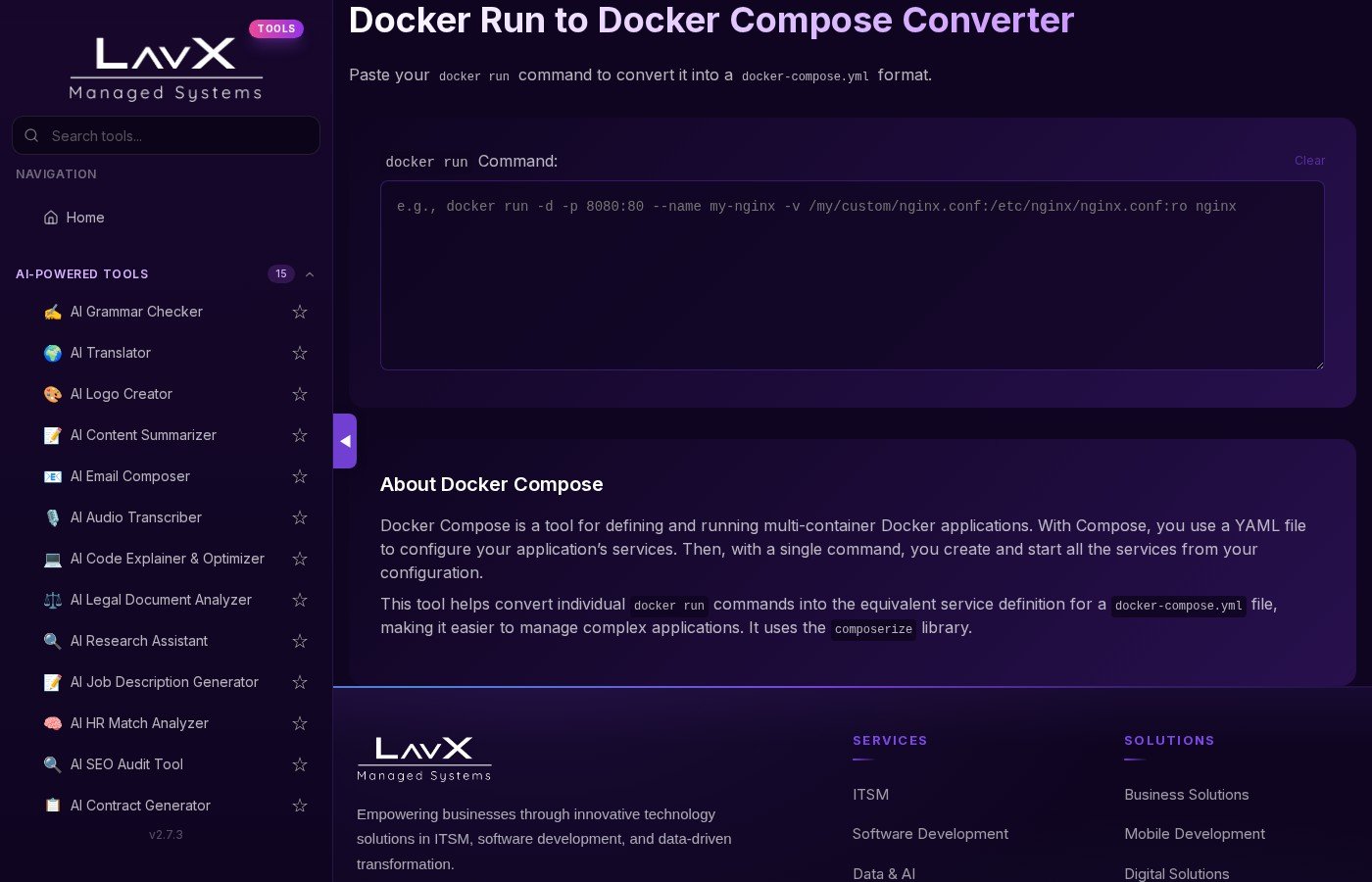
Introducing LavX's Docker Run to Compose Converter
LavX's Docker Run to Compose tool addresses this exact pain point by automatically converting complex docker run commands into properly formatted Docker Compose YAML files. This automation eliminates the tedious manual process of parsing flags and translating them to Compose syntax.
The tool leverages the powerful composerize library to ensure accurate conversion, maintaining all the original command's functionality while presenting it in the standardized Compose format. This means developers can quickly transform commands like:
docker run -d --name myapp -p 8080:80 -e ENV_VAR=value -v /host/path:/container/path myimage:latest
Into a clean, maintainable Compose file:
version: '3'
services:
  myapp:
    image: myimage:latest
    container_name: myapp
    ports:
      - "8080:80"
    environment:
      - ENV_VAR=value
    volumes:
      - /host/path:/container/path
    restart: unless-stopped
Why This Matters for Modern Development Teams
Standardization and Consistency
By converting run commands to Compose files, teams establish a standardized approach to deployment. This consistency reduces configuration drift between development, staging, and production environments, minimizing the "it works on my machine" problem.
Enhanced Collaboration
Compose files serve as documentation that the entire team can understand and modify. When new developers join the project, they can quickly grasp the application's architecture and dependencies without deciphering complex command-line arguments.
Infrastructure as Code
The conversion process encourages treating infrastructure as code, allowing teams to version control their deployment configurations alongside application code. This practice enables better tracking of changes, easier rollbacks, and improved compliance with DevOps best practices.
Scalability and Orchestration
As applications grow, Compose files provide a foundation for more advanced orchestration. Teams can easily extend their configuration to include services, networks, and volumes that support scaling, load balancing, and microservices architectures.
Integration with LavX's Development Ecosystem
This tool is part of LavX's broader commitment to empowering development teams with practical, time-saving utilities. It complements our other development tools like the AI Code Explainer & Optimizer, JSON Formatter & Validator, and Git Cheatsheet, forming a comprehensive toolkit for modern software development.
At LavX, we understand that developers need reliable, efficient tools that integrate seamlessly into their workflows. Our Docker Run to Compose converter exemplifies this philosophy by automating a common but tedious task, allowing teams to focus on building great applications rather than wrestling with configuration syntax.
Getting Started with Docker Compose
For teams new to Docker Compose, the tool provides immediate value by lowering the barrier to entry. Even experienced developers benefit from the time savings when converting legacy deployments or experimenting with new application architectures.
The generated Compose files follow best practices, including proper versioning, service naming conventions, and recommended restart policies. This ensures that teams not only save time but also produce higher-quality configuration files.
Beyond the Tool: LavX's Commitment to Developer Productivity
While the Docker Run to Compose tool solves a specific problem, it represents LavX's broader mission to streamline the development lifecycle. Our platform offers a curated collection of utilities that address common pain points across the software development spectrum.
From code formatting and validation to security scanning and deployment automation, LavX's tools are designed to work together, creating a cohesive ecosystem that enhances productivity without compromising on quality or security.
In an era where containerized applications are the norm, efficient management of Docker configurations is essential. LavX's Docker Run to Compose converter bridges the gap between individual container deployments and orchestrated multi-container applications, empowering teams to standardize, collaborate, and scale with confidence. By automating the conversion process, we're not just saving developers time—we're helping them build more maintainable, production-ready applications that follow DevOps best practices.
Explore more of LavX's developer tools at https://tools.lavx.hu and discover how our comprehensive platform can enhance your team's productivity and deployment reliability.
Comments
Please log in or register to join the discussion