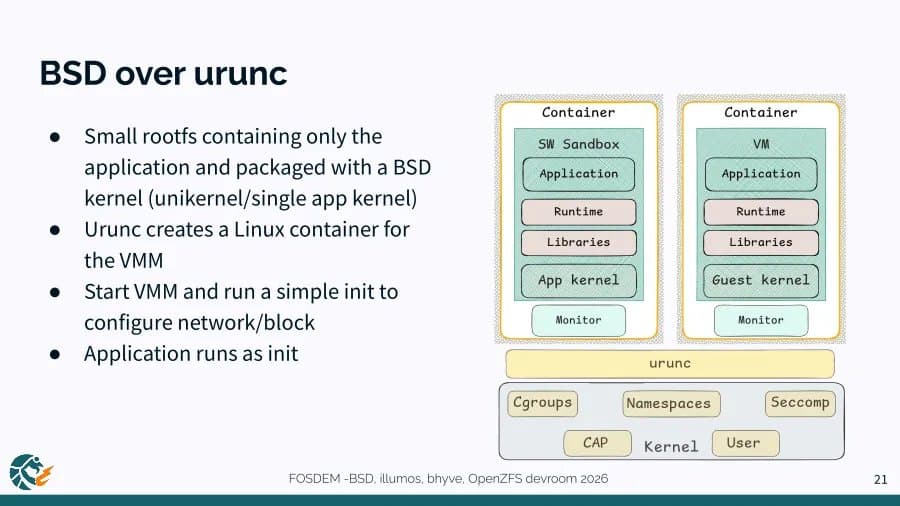
Developers have found a way to efficiently run BSD applications on Linux using urunc containers, offering faster startup times and better performance than traditional virtualization approaches.
Developers have found a way to efficiently run BSD applications on Linux using urunc containers, offering faster startup times and better performance than traditional virtualization approaches.
While Linuxulator on FreeBSD has long allowed running Linux binaries on BSD, the reverse scenario hasn't received as much attention. That's changing with urunc, a lightweight container runtime that's proving effective for running BSD applications in Linux environments.
The BSD-on-Linux Challenge
For organizations with software specifically tailored to BSD systems, or for network workloads that perform better under BSD, running these applications on Linux hosts has traditionally meant either maintaining separate BSD infrastructure or dealing with the overhead of full virtualization. Neither option is ideal for efficiency or resource utilization.
How urunc Solves This
The urunc container runtime, combined with Bunny for building unikernels as easily as containers, provides a compelling alternative. This approach offers several advantages:
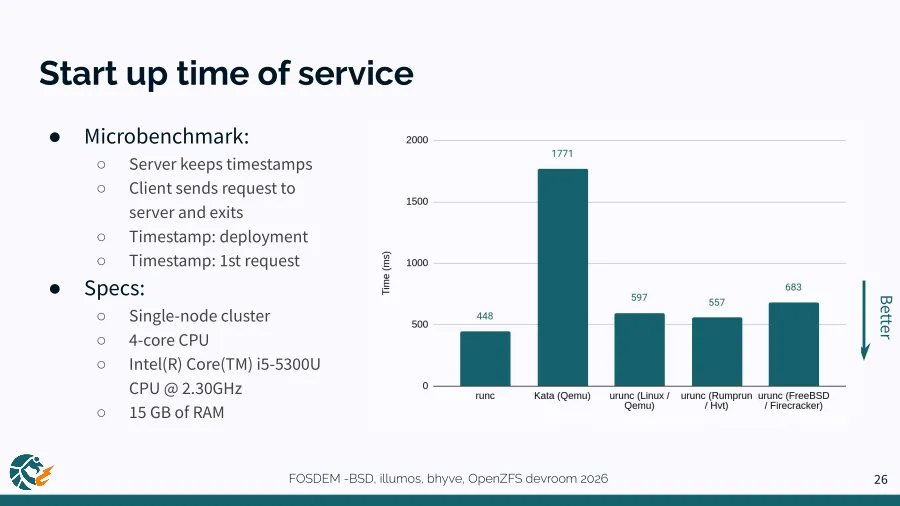
- Lower startup times compared to Kata Containers with QEMU
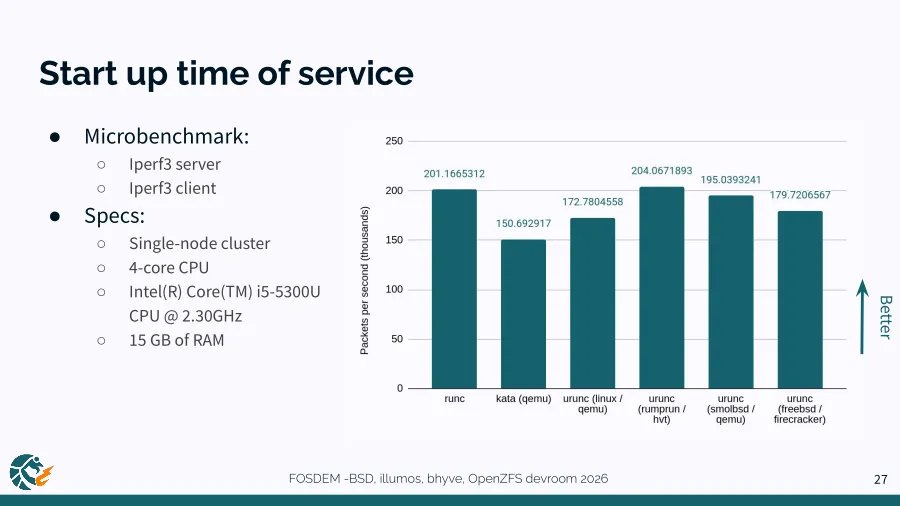
- Higher performance for BSD workloads
- Kubernetes compatibility for orchestration
- Resource efficiency through containerization rather than full virtualization
The solution works by creating minimal BSD environments that can run on Linux hosts, leveraging the efficiency of container technology while maintaining the BSD application compatibility needed.
Technical Implementation
The urunc-based approach involves several components working together:
- urunc runtime - The core container runtime optimized for this use case
- Bunny - A tool for building unikernels with container-like simplicity
- Stripped-down kernels - Custom kernels optimized for the specific workload
- Minimal root file-systems - Reduced attack surface and resource usage
Future Development Directions
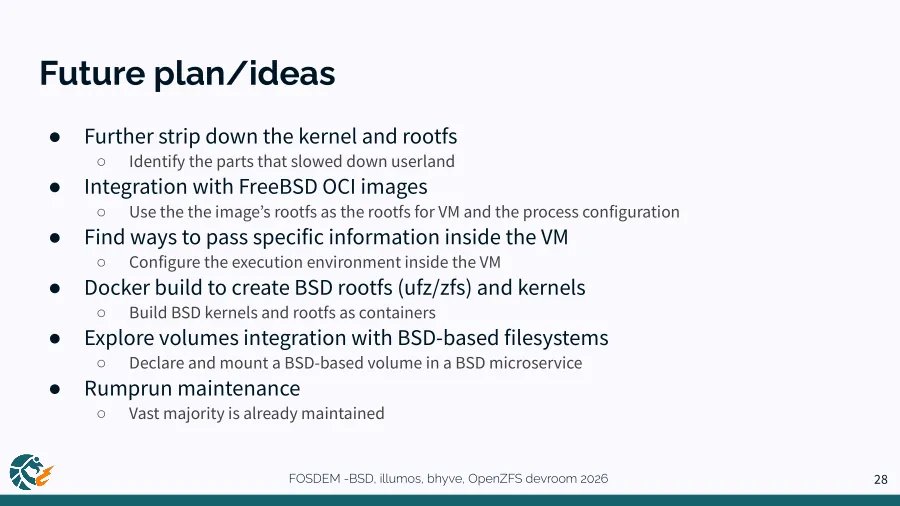
The developers have outlined several areas for further improvement:
- Kernel optimization - Further stripping down the kernel for specific use cases
- FreeBSD OCI integration - Better integration with existing FreeBSD container images
- Docker builds with BSD rootfs - Using ZFS for the root file system in Docker builds
- Performance tuning - Continued optimization for specific workload types
Real-World Applications
This technology has practical applications for organizations that:
- Have legacy BSD applications they need to modernize or migrate
- Run network workloads that perform better under BSD
- Want to consolidate infrastructure while maintaining BSD compatibility
- Need to test BSD applications in Linux CI/CD pipelines
Getting Started
For those interested in exploring this approach, the developers presented their work at FOSDEM 2026, and presentation assets are available on FOSDEM.org. The combination of urunc and Bunny provides a relatively straightforward path to running BSD applications on Linux infrastructure.
Performance Comparison
While specific benchmark numbers weren't provided in the initial announcement, the developers noted that their urunc-based approach shows:
- Faster startup times than Kata Containers with QEMU
- Better performance for BSD workloads
- Lower resource overhead compared to full virtualization
The exact performance gains will vary depending on the specific workload and configuration, but the container-based approach offers clear advantages over traditional virtualization for this use case.
The Bigger Picture
This development represents an interesting evolution in cross-platform compatibility. Just as Linuxulator brought Linux compatibility to FreeBSD, urunc brings BSD compatibility to Linux in an efficient, container-based manner. This kind of cross-pollination between operating systems helps organizations maintain flexibility while optimizing for performance and resource utilization.
The work also highlights the growing sophistication of container technology beyond simple application packaging, showing how containers can be used to bridge operating system differences in efficient ways.
Comments
Please log in or register to join the discussion