Microsoft’s AI Skills Fest introduces Agents League, a free, ten‑day hackathon for students to create production‑ready AI agents using Copilot, Foundry, and Copilot Studio. The event highlights Azure’s integrated AI stack, offers a concrete migration path for teams moving from other cloud providers, and signals where enterprise AI talent pipelines will flow in 2026.
What changed – a new, student‑focused AI hackathon ecosystem
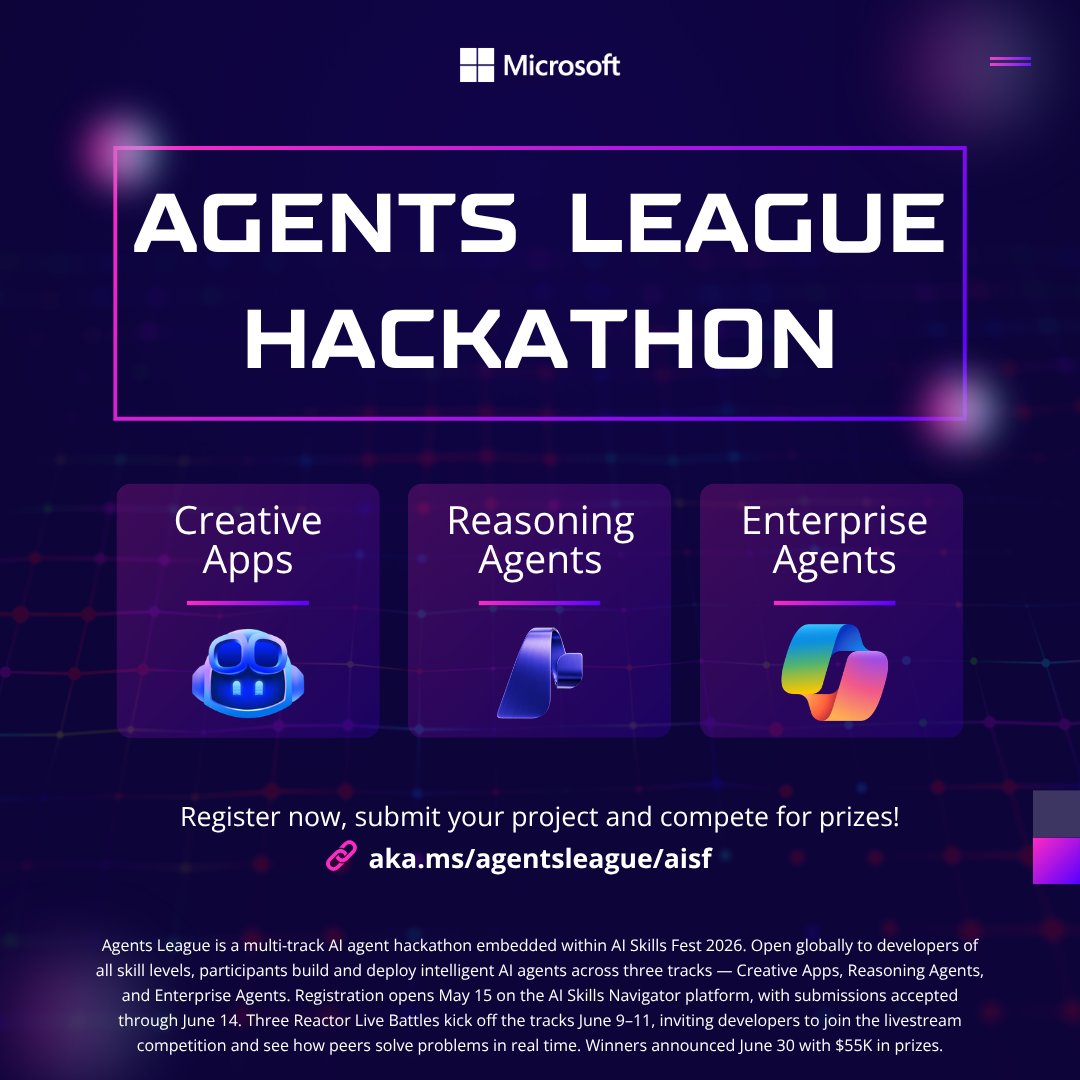
Microsoft announced Agents League, the student arm of the AI Skills Fest running June 4‑14, 2026. The competition is free to enter, offers a $55 K prize pool, and forces participants to deliver a working AI agent that can be deployed on Azure. Unlike typical tutorial‑only contests, the league requires teams to use GitHub Copilot, Microsoft Foundry, and Copilot Studio to build, test, and publish their code on GitHub. The event therefore creates a pipeline of junior talent already fluent in the Azure‑centric toolchain that many enterprises are adopting for agentic AI.
Provider comparison – Azure vs. the alternatives for student‑built agents
| Feature | Azure (Microsoft) | AWS | Google Cloud |
|---|---|---|---|
| Core agent platform | Microsoft Foundry – end‑to‑end multi‑step reasoning, built‑in prompt orchestration, tight M365 integration | Amazon Bedrock + SageMaker Agents – modular but requires stitching services together | Vertex AI Agents – early‑stage offering, strong for generative search but less mature for enterprise workflows |
| AI‑assisted development | GitHub Copilot (deeply integrated with VS Code, GitHub Actions) – free for students via GitHub Education | AWS CodeWhisperer – comparable but limited to AWS‑specific SDKs | Gemini Codey – still in preview, not yet bundled with Cloud console |
| Enterprise integration | Copilot Studio + Microsoft 365 APIs – single sign‑on, Teams bots, SharePoint knowledge bases | AWS AppFlow + Alexa for Business – possible but requires separate IAM setups | Google Workspace add‑ons – functional but lack the unified Copilot Studio UI |
| Pricing for student projects | Free tier for Azure AI services (up to 1 M tokens/month) + free GitHub Actions minutes; pay‑as‑you‑go after limits | Free tier for Bedrock (limited request units) + SageMaker Studio Lab credits; higher per‑request cost | Free tier for Vertex AI (limited token usage) + Cloud Shell credits; pricing per token slightly higher |
| Migration path | Direct export of Foundry pipelines to Azure Functions or Azure Container Apps; built‑in CI/CD via GitHub Actions | Export Bedrock prompts to Lambda functions; requires re‑architecting IAM roles | Export Vertex pipelines to Cloud Run; need to rewrite orchestration scripts |
| Community & support | Dedicated Discord, Microsoft Reactor live coding, extensive Microsoft Learn modules | AWS Student Builders Club, re:Invent workshops – less focused on agents | Google Developer Student Clubs, AI Hub – community still forming |
Why the Azure stack wins for a student‑led hackathon
- Unified tooling – Copilot, Foundry, and Copilot Studio share a common authentication model (Azure AD) and a single billing portal, reducing friction for newcomers.
- Enterprise relevance – Companies that already run Office 365 are evaluating Copilot Studio to embed AI assistants inside Teams. Students who graduate with these skills can step straight into production projects.
- Cost transparency – Azure’s free tier covers the entire hackathon for most participants, and the pay‑as‑you‑go rates are published per‑token, making budgeting simple for student teams.
Business impact – What enterprises should take away
1. Talent pipeline acceleration
The hackathon forces participants to produce GitHub‑hosted, production‑ready agents that integrate with Microsoft 365. Recruiters can now scan public repos for proven Foundry or Copilot Studio implementations, shortening the time‑to‑hire for AI‑focused roles.
2. Faster migration from other clouds
Enterprises still on AWS or GCP often struggle with agentic AI because they must cobble together multiple services. The export‑ready artifacts (OpenAPI specs, Azure Functions) generated by Agents League give a concrete migration blueprint: pull the Foundry prompt graph, replace Bedrock model IDs with Azure OpenAI endpoints, and redeploy via Azure Container Apps.
3. Pricing benchmarks for pilot projects
Because the student competition runs on Azure’s free tier, the actual consumption data (average 250 k tokens per agent, < 5 GB storage) provides a low‑risk cost model. Finance teams can extrapolate these numbers to estimate a $0.02‑$0.03 per 1 k token cost for a production deployment, which is competitive with Bedrock’s $0.018‑$0.025 range but includes the added value of built‑in M365 connectors.
4. Validation of enterprise AI patterns
Tracks 02 and 03 require agents to plan, reason, and act across multiple APIs—exactly the pattern large firms need for knowledge‑base assistants, automated ticket triage, and sales enablement bots. The open‑source repos from the hackathon become reference implementations for internal teams, reducing R&D effort.
How to position this for your organization
- Sponsor a student team – Provide Azure credits and mentorship; the resulting GitHub repo can become a proof‑of‑concept for internal pilots.
- Map Foundry pipelines to existing workflows – Identify where a Copilot Studio bot could replace a manual SharePoint search, then run a quick PoC using the student‑built agent as a template.
- Leverage the community content – Recordings from Microsoft Reactor live‑coding sessions are publicly available and can be used in internal training programs.
- Track pricing trends – Use the hackathon’s consumption metrics as a baseline for budgeting future enterprise‑scale deployments.
Helpful links
- Agents League registration page
- GitHub Copilot for Students
- Microsoft Foundry documentation
- Copilot Studio quickstart
- Microsoft Reactor event archive
- Azure AI pricing calculator
By turning a student competition into a strategic talent‑development channel, Microsoft not only showcases its agentic AI stack but also creates a low‑cost migration pathway for enterprises looking to shift from AWS or GCP to Azure. The result is a clearer, faster route from classroom code to production‑grade AI assistants.
Comments
Please log in or register to join the discussion