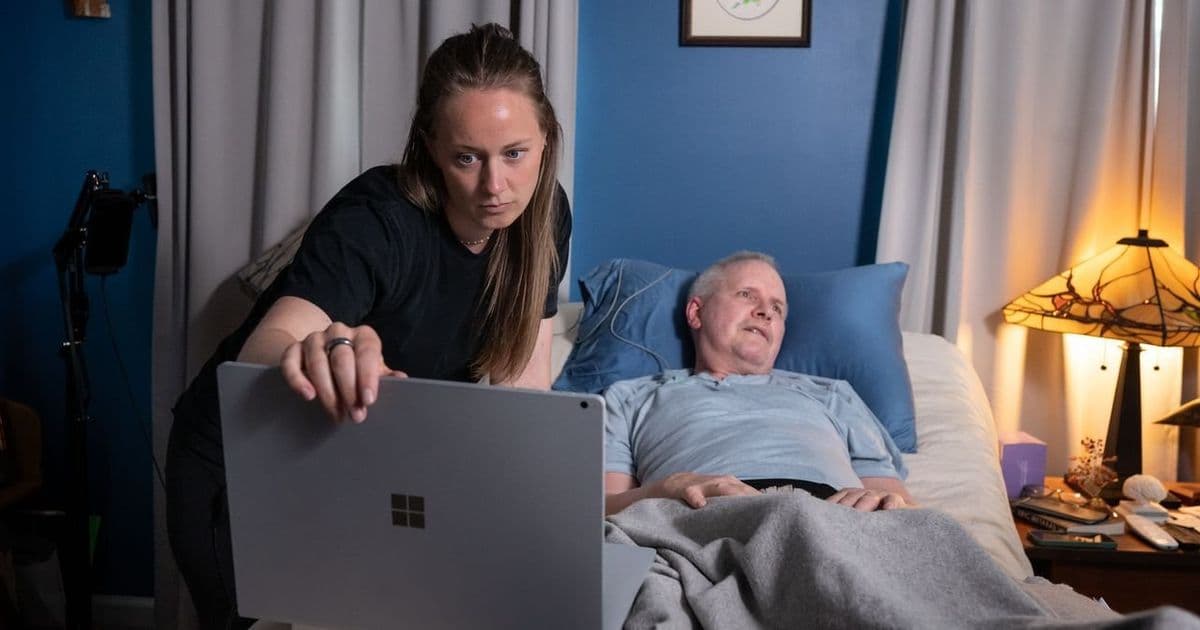
Paralyzed by ALS, Mark Jackson controls computers via a matchstick-sized brain implant threaded through his veins. His Synchron device – challenging Neuralink with a less invasive approach – could redefine assistive tech, if it can overcome signal limitations and insurer hurdles.
Mark Jackson steers a white circle into a red target on his laptop screen. He’s playing a game reminiscent of Pac-Man. The remarkable part? Jackson, paralyzed by amyotrophic lateral sclerosis (ALS), controls the cursor purely with his thoughts – imagining clenching his fist once to move left, twice to move right. This feat is enabled by a brain-computer interface (BCI) from Synchron, implanted via his jugular vein, positioning it as a pioneering, less invasive competitor to Neuralink.
Jackson is one of ten participants in Synchron's early feasibility study. Surgeons implanted the Stentrode, a wire-mesh tube studded with 16 electrodes, by threading it through his jugular vein until it rested against his motor cortex. A separate device below his collarbone processes neural signals, beaming them externally to translate intention into digital commands – enabling texting, emailing, online shopping, and even using Apple's Vision Pro headset.
"The loss of mobility, the loss of independence that goes with this disease... it’s a lot to take in," Jackson told WIRED. "I was immediately excited about [the BCI]."
The Vascular Approach: Trade-offs and Traction Synchron's method starkly contrasts with Neuralink's. Elon Musk's company requires removing a skull section to implant threads directly into brain tissue. Synchron leverages blood vessels – a technique inspired by minimally invasive cardiology – significantly reducing surgical risk (though blood clots and stroke remain concerns versus Neuralink's risks of tissue damage and bleeding). This approach allows procedures by more widely available vascular specialists, not just neurosurgeons.
However, the vascular placement comes with a fundamental trade-off: signal fidelity. Positioned inside a blood vessel, the Stentrode's electrodes sit farther from neurons than Neuralink's 1,000+ electrodes penetrating brain tissue. Researchers describe this as the "stadium effect" – hearing the roar of the crowd from outside versus individual conversations inside.
"The question is, how much do you need to hear to do something useful for the subject?" notes Kip Ludwig, a neuroengineering professor at the University of Wisconsin-Madison, unaffiliated with Synchron.
For now, Synchron focuses on core assistive functions: cursor control and selection. "The minimal viable product is the ability to navigate and select on an iPhone," states Synchron CEO Tom Oxley. Their system already integrates with OpenAI for generative chat, Amazon Alexa, and Apple devices via a new Bluetooth protocol, prioritizing practical daily utility over Neuralink's broader ambitions.
The Road to Commercialization and Unanswered Questions Backed by investors like Jeff Bezos and Bill Gates, Synchron is preparing for a pivotal 30-50 patient trial in 2026, a critical step toward FDA approval and commercialization. Key hurdles remain:
- Measuring Impact: Quantifying tangible benefits for regulators and insurers is complex. BCIs restore function but don't treat the underlying disease like ALS.
- Wireless Future: Current users like Jackson must be physically tethered during sessions. Synchron's next-gen device promises wireless connectivity.
- Voice Assist Competition: Jackson admits voice control is often easier, but BCIs offer crucial advantages when voice fails or privacy is needed. "Voice assist technology is nowhere near where it needs to be," admits Synchron co-founder Rahul Sharma.
- Longevity & Progression: ALS progression inevitably limits BCI use. Only two of Synchron's original ten participants still actively use the implant.
For Jackson, the technology, even in its current form, represents regained autonomy. He dreams of future integrations enabling robotic limbs for activities like wood carving – a hobby now lost to him. While acknowledging its limitations, he sees profound potential: "There’s a reason why this is pretty groundbreaking technology." Synchron’s success hinges on proving that its less invasive path delivers enough meaningful signal to transform lives, navigating the complex intersection of neuroscience, regulation, and real-world need.
Source: WIRED
Comments
Please log in or register to join the discussion