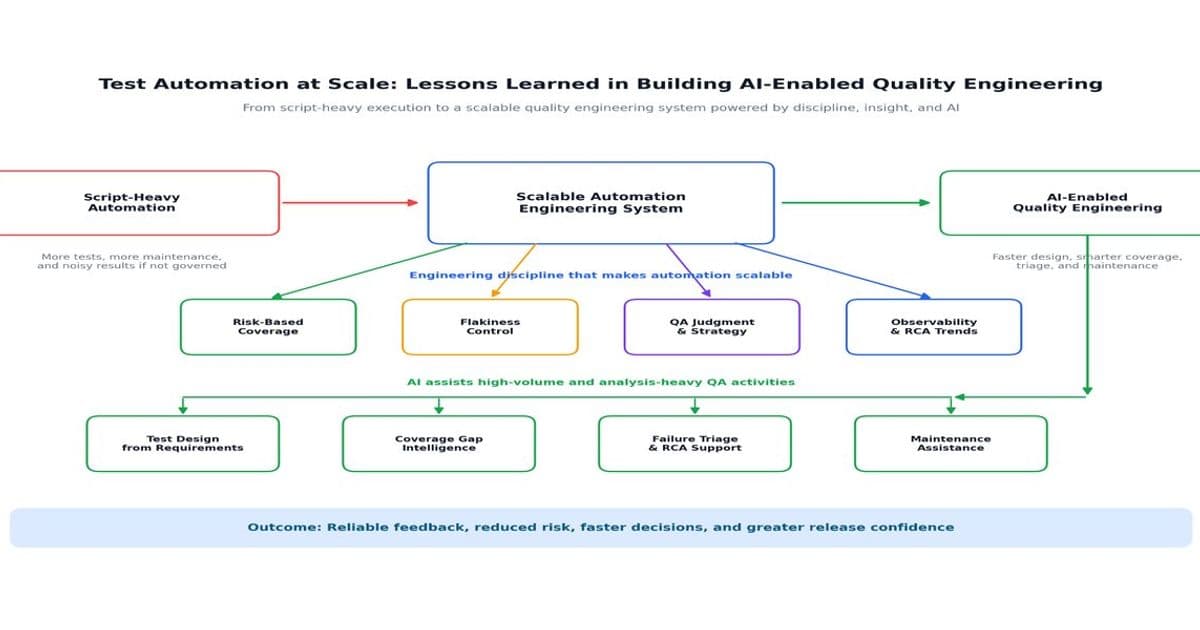
Enterprise test automation succeeds when it is treated as a disciplined engineering system rather than a collection of scripts. By focusing on risk‑based coverage, eliminating flakiness, embedding QA judgment, and adding observability—and now AI—organizations can turn automated testing into a reliable feedback loop that accelerates delivery and reduces risk.
Test Automation at Scale – What Changed, How It Compares, and the Business Impact
What changed?
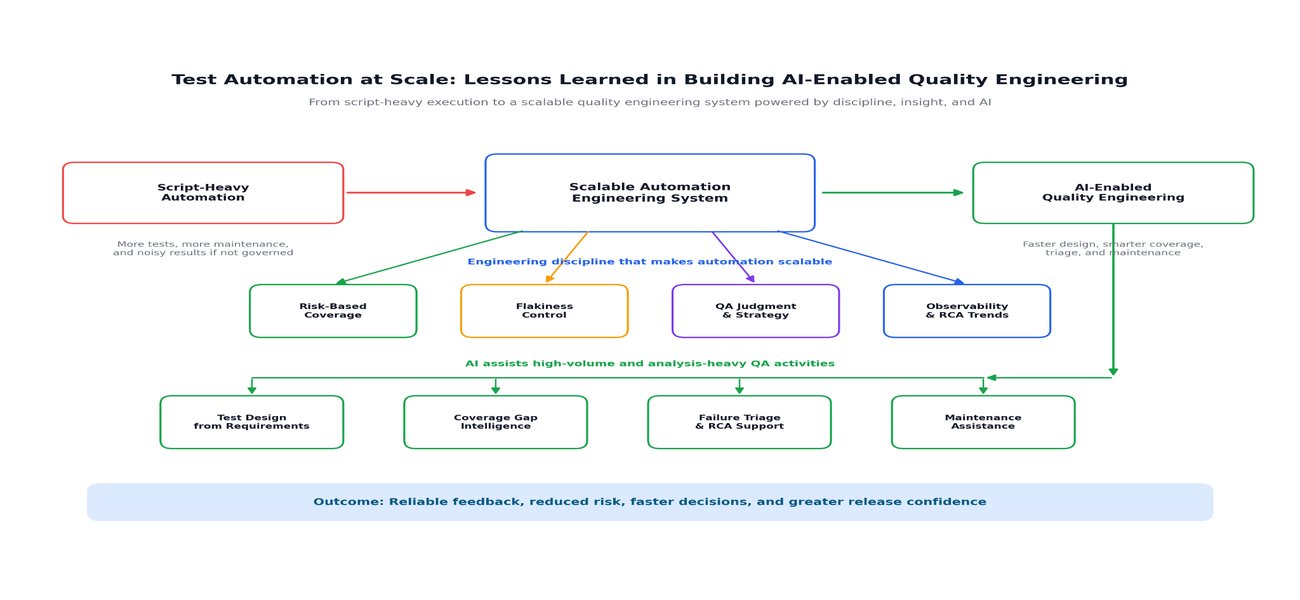
Enterprises are moving away from the old mantra "more tests = higher quality" toward a model where automation is a quality‑engineered service. The shift includes:
- Risk‑based coverage instead of blanket UI path recording.
- Flakiness management as a first‑class quality metric.
- Observability layers that turn raw pass/fail data into actionable insights.
- AI‑assisted design and triage that reduces manual effort while preserving human judgment.
These changes reflect a broader recognition that test automation must be architected, owned, and continuously improved, much like any production service.
Provider comparison – Frameworks and Tooling
| Aspect | Microsoft Playwright + Azure DevOps | Selenium Grid + Jenkins | Cypress + GitHub Actions |
|---|---|---|---|
| Scalability | Native support for parallel browsers on Azure Pipelines; auto‑scales with consumption plans. | Requires manual node provisioning; scaling can be costly. | Runs in a single‑process model; best for front‑end but limited cross‑browser scale. |
| Flakiness mitigation | Built‑in auto‑wait, network interception, and test isolation utilities. | Relies on custom retry logic; flakiness often stems from environment sharing. | Automatic retry on UI changes; however, limited for API‑level tests. |
| Observability | Azure Monitor dashboards + Application Insights provide per‑test latency, failure trends, and environment health. | Basic JUnit XML; external plugins needed for deep analytics. | Cypress Dashboard offers video replay and flake detection, but lacks enterprise‑wide aggregation. |
| AI integration | Azure AI services (e.g., Azure OpenAI) can generate test steps from requirements and suggest flaky‑test clusters. | Community‑driven ML plugins exist but are fragmented. | No native AI; third‑party tools required. |
| Cost model | Pay‑as‑you‑go on Azure; idle resources are not billed. | Fixed VM costs regardless of utilization. | Included with GitHub plans; scaling incurs additional runner fees. |
Key takeaway: Microsoft’s integrated stack offers the most cohesive approach to the four pillars—scalable execution, flakiness control, observability, and AI augmentation—while keeping operational overhead low.
Business impact
- Faster pipelines – By pruning low‑value tests and stabilizing flaky suites, regression windows shrink by 30‑45 % on average, freeing developer time for feature work.
- Higher release confidence – Risk‑based coverage aligns test effort with business impact, turning the test suite into a confidence gauge rather than a checkbox.
- Reduced maintenance spend – Observability dashboards expose hot‑spots; teams can allocate effort to the 20 % of tests that cause 80 % of failures, cutting maintenance labor by up to 25 %.
- AI‑driven efficiency – Automated requirement‑to‑test generation cuts initial script creation time by roughly half, while AI‑powered failure triage reduces mean‑time‑to‑resolution from hours to minutes.
- Cultural shift – Treating flakiness as a defect and embedding QA judgment into the automation lifecycle builds trust across development, operations, and product teams, leading to smoother cross‑functional releases.
Bottom line
Enterprise test automation is no longer a peripheral scripting effort. It is a strategic quality system that must be engineered, observed, and continuously refined. Organizations that adopt the disciplined framework outlined above—prioritizing risk, eliminating flakiness, exposing rich telemetry, and leveraging AI responsibly—see measurable gains in delivery speed, cost efficiency, and product reliability.
Comments
Please log in or register to join the discussion