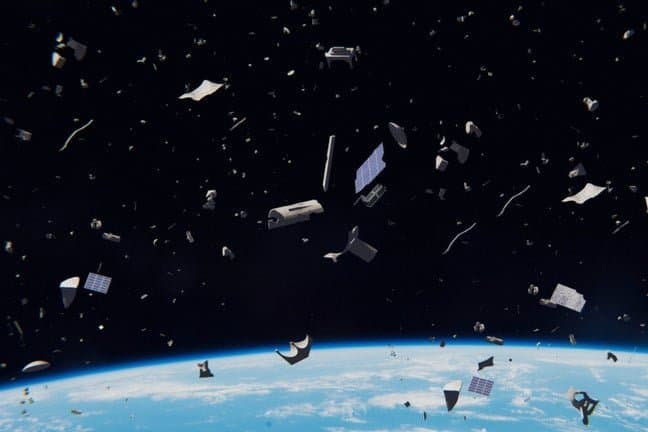
Venture capital fuels ambitious plans for orbital datacenters promising limitless solar power and natural cooling for AI workloads. But engineers face brutal realities: surviving rocket launches, cosmic radiation, space weather events, debris collisions, and the staggering cost of repairs in orbit. While niche applications show promise, massive in-space AI clusters remain a distant dream.
The vision of orbital datacenters (ODCs), immortalized in William Gibson's Neuromancer, is capturing investor imagination as a solution to Earth's AI energy crunch. Startups like Orbits Edge and Starcloud – the latter recently securing ~$21 million post-Y Combinator – aim to leverage the perceived advantages of space: abundant solar power and the vacuum for passive cooling. Their first test satellites are slated for SpaceX rideshare launches later this year. Proponents argue ODCs could bypass terrestrial constraints like soaring electricity costs and water-intensive cooling, potentially unlocking the next generation of AI models like GPT-6.
However, the path from concept to operational ODCs is fraught with formidable, often underestimated, engineering and environmental hurdles:
Surviving the Ride & The Hostile Environment:
- Launch Stress: Reaching Low Earth Orbit (LEO) subjects hardware to extreme vibrations and G-forces, transforming standard servers into potential debris. Hardware requires significant hardening just to survive the ascent on reusable rockets like Starship.
- Radiation Hardening: Cosmic rays and solar radiation cause bit flips and hardware faults. Mitigation demands specialized ruggedized components, extensive shielding, and fault-tolerant software/firmware – proven on small scales (e.g., HPE's Spaceborne Computer) but unproven for full racks expected to operate autonomously for years.
- The Maintenance Nightmare: "Remote hands" don't exist in orbit. A simple hardware fix could necessitate a crewed mission costing $40-$100+ million (minimum two astronauts). Reliability from day one is non-negotiable.
Space Weather: The Unpredictable Threat: Solar flares and coronal mass ejections pose catastrophic risks. Events like the 1989 geomagnetic storm that blacked out Québec or the massive 1859 Carrington Event could cripple or destroy satellites. Increased solar activity also expands the atmosphere, causing drag that prematurely de-orbits satellites – a fate already suffered by some Starlink units. A modern Carrington-level event could devastate the entire LEO infrastructure ODCs would rely on.
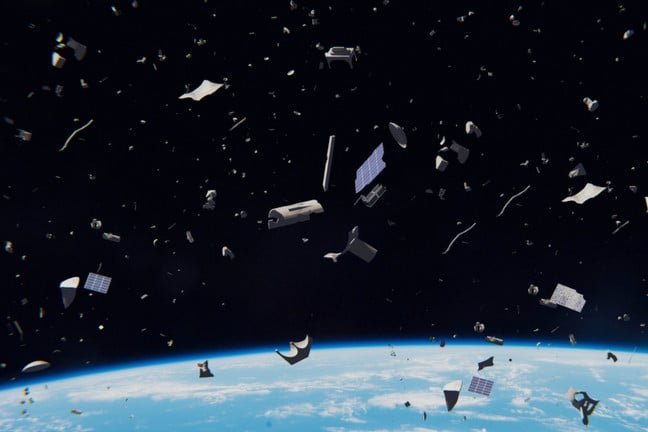 Space debris, like the fragments depicted, represents an ever-increasing collision risk for large, fragile orbital structures like proposed datacenters.
- The Orbital Junkyard: Kessler Syndrome Looms: The proliferation of satellites dramatically increases collision risks. The Kessler Syndrome – a cascading debris field triggered by a single collision – poses an existential threat to large, long-duration structures like ODCs. Proposals for active debris removal remain nascent and lack clear funding models. Protecting a massive, kilometer-scale solar array and compute cluster from impacts over a decade is a monumental challenge.
Where ODCs Might Make Sense (For Now): While massive AI training clusters in orbit face overwhelming obstacles, specialized niches offer more plausible near-term applications:
- Defense & Real-Time Control: Processing sensor data for missile defense (e.g., hypersonic intercept systems) where milliseconds matter, or controlling remote industrial processes (e.g., lunar mining).
- Edge Processing in Orbit: Attaching compute modules directly to data-gathering satellites (e.g., Synthetic Aperture Radar, hyperspectral imagers) to process vast datasets on-site before downlinking only actionable insights, reducing bandwidth needs.
The Verdict: The allure of "free" space-based power for AI is potent, but the current realities of physics, engineering economics, and the orbital environment present staggering barriers. Venture capital optimism meets the immutable harshness of space. While small, purpose-built ODCs for latency-sensitive or isolated edge applications hold promise, the vision of sprawling orbital server farms training foundational AI models remains firmly in the realm of science fiction for the foreseeable future. Success hinges not just on cheaper rockets, but on overcoming fundamental survivability challenges in one of the most hostile environments imaginable. As one engineer succinctly put it: Space is hard, especially for racks of fragile computer equipment.
Comments
Please log in or register to join the discussion