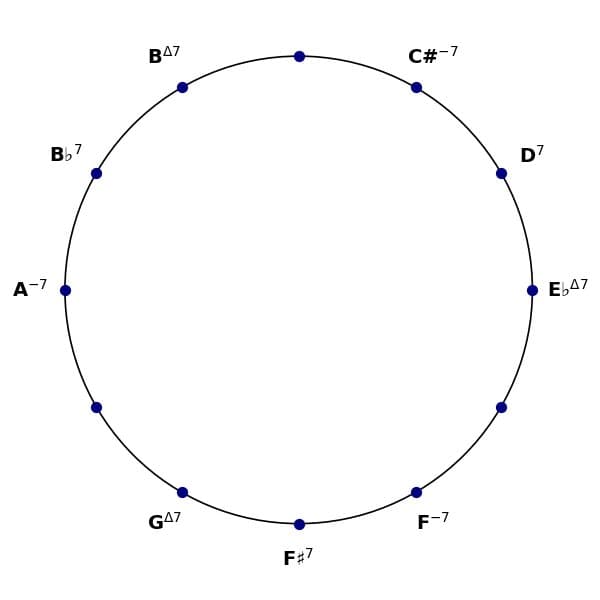
John Coltrane's Giant Steps is a masterpiece of musical mathematics, where nine carefully chosen chords create an intricate pattern of 'giant steps' that has challenged musicians for decades.
When John Coltrane composed Giant Steps in 1959, he created not just a jazz standard but a mathematical marvel that continues to challenge musicians and fascinate theorists. The song's reputation for difficulty stems from its unusual chord changes, yet beneath this complexity lies an elegant structure that reveals the deep connection between music and mathematics.
At first glance, the chord progression in Giant Steps appears daunting. Musicians have long struggled with its rapid modulations and unexpected transitions. However, a closer examination reveals that the piece contains only nine unique chords. This constraint is not a limitation but rather the foundation of its sophisticated design.
The true genius of Giant Steps lies in how these nine chords are arranged. If we imagine the chromatic scale wrapped around a circle like a clock face, we discover a remarkable three-fold symmetry. Each chord type appears exactly three times, and the three notes that are not used as chord roots are evenly spaced around the circle. This creates a balanced, almost geometric pattern that is as pleasing to the mathematical mind as it is challenging to the performing musician.
To understand the chord progression more deeply, consider the sequence of chord qualities as they appear when sorted by root: minor 7th, dominant 7th, major 7th, skip minor 7th, dominant 7th, major 7th, skip minor 7th, dominant 7th, major 7th, skip. This pattern reveals the underlying logic of the composition. The "giant steps" that give the song its name and its difficulty are the large intervals between successive chord roots, creating modulations that leap across the circle of fifths in ways that were unprecedented in jazz at the time.
It's important to note that this sorted sequence is not the order in which the chords appear in the actual song. Rather, it's a way of analyzing the complete set of chords used, revealing the compositional logic that might not be apparent when listening to the rapid-fire progression as it unfolds in real time. This analytical approach transforms what seems like chaos into a structured system, much like how chaos theory reveals hidden order in seemingly random phenomena.
The mathematical elegance of Giant Steps extends beyond its chord structure. The song has become a kind of musical Rorschach test, challenging improvisers to navigate its complex changes while maintaining melodic coherence. Each musician who tackles Giant Steps must solve the puzzle of how to create meaningful melodies over these unusual progressions, leading to a rich variety of interpretations and approaches.
This intersection of mathematical structure and artistic expression is what makes Giant Steps so compelling. It demonstrates how constraints can foster creativity rather than limit it. By limiting himself to nine chords arranged in a specific pattern, Coltrane created a framework that has inspired generations of musicians to explore new possibilities in jazz improvisation and composition.
The legacy of Giant Steps extends into modern music theory and education. It has become a benchmark for jazz musicians, a kind of musical Mount Everest that represents both a technical challenge and an artistic opportunity. The song's influence can be seen in countless subsequent compositions that explore similar concepts of rapid modulation and symmetrical chord structures.
For those interested in exploring the mathematical aspects of music further, Giant Steps serves as an excellent case study. It demonstrates how musical concepts like harmony, rhythm, and melody can be analyzed using mathematical tools and frameworks. This approach to music theory has applications beyond jazz, influencing how we understand and create music across genres.
The beauty of Giant Steps lies not just in its sound but in its structure. It represents a perfect marriage of artistic expression and mathematical precision, showing how constraints can lead to extraordinary creativity. As musicians continue to grapple with its challenges and theorists continue to analyze its structure, Giant Steps remains a testament to the power of combining artistic vision with mathematical thinking.
For those who wish to dive deeper into the analysis of Giant Steps and similar musical structures, resources like The Real Book provide the sheet music and theoretical context needed to understand these complex compositions. The ongoing study of pieces like Giant Steps continues to enrich our understanding of both music and mathematics, revealing new connections and possibilities with each analysis.
{{IMAGE:1}}
The enduring appeal of Giant Steps reminds us that the most challenging artistic works often contain the most elegant solutions. In Coltrane's masterpiece, we find not just a difficult jazz standard but a mathematical poem, a composition where every note and every chord serves a purpose in a larger, beautifully structured whole.
Comments
Please log in or register to join the discussion