
Kevin Kelly, a veteran author and digital pioneer, shares hard-won insights on navigating the seismic shift from traditional publishing to tech-enabled self-publishing. His analysis reveals why owning your audience is now non-negotiable and how tools like crowdfunding, on-demand printing, and digital platforms empower creators to bypass gatekeepers.

The publishing industry has undergone a revolution, and the old guard—New York publishers, bookstore tours, and hefty advances—is fading fast. As Kevin Kelly, co-founder of Wired and author of bestselling books through both traditional and self-publishing routes, explains in his comprehensive guide, the power dynamic has flipped. Today, creators wield unprecedented control, but success hinges on mastering a suite of digital tools and strategies. For developers, engineers, and tech leaders, this shift isn't just about books; it's a blueprint for monetizing expertise in an attention economy.
The Collapse of Traditional Publishing
Traditional publishers once handled editing, printing, distribution, and promotion, offering authors advances against royalties. But as Kelly notes, this model is crumbling: "Publishers have lost their audience, which was bookstores, not readers." Without direct customer relationships, publishers now demand authors bring their own followers. Agents, who take 15% of earnings, remain useful for navigating contracts but add friction. Advances, calculated as estimated first-year royalties (e.g., $30,000 for 30,000 copies at $1 royalty each), often go unearned, yet Kelly stresses they signal publisher commitment: "The bigger the advance, the bigger the promotional push."
Crowdfunding: The New Bankroll
Self-publishing’s rise is fueled by crowdfunding platforms like Kickstarter and Patreon, which Kelly calls "the bank" for creators. His seminal "1,000 True Fans" theory—where dedicated followers spending $100/year each can sustain a creator—has become reality. Crowdfunding offers three key advantages:
- Pre-funding creation with minimal risk.
- Higher revenue retention (platforms take just 3-5%, versus publishers' cuts).
- Audience ownership for future projects.
But it demands marketing savvy and relentless effort. "Tending a 30-day campaign is a full-time job," warns Kelly. Services like Jellop (taking 20% of new backers) can amplify reach, but fulfillment—shipping physical goods—often becomes a bottleneck. 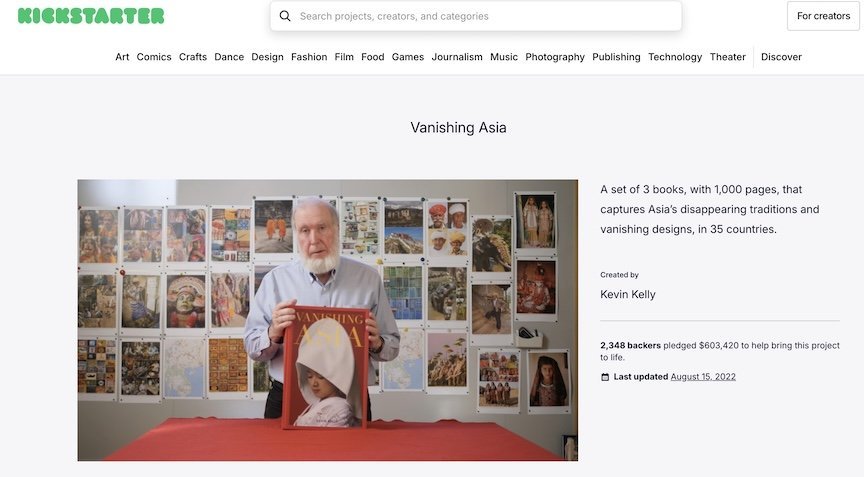 shows stacks of Kelly's Kickstarter-funded photobook Asia Grace, which filled four shipping containers.
Production: From Batch Printing to Digital-Only
Physical book production has three paths, each with tech-driven tradeoffs:
- Batch Printing: Ideal for high-volume runs (5,000+ copies) in Asia or Turkey, where costs plummet. Kelly highlights benefits like scale, premium quality (e.g., embossed covers), and vibrant color reproduction—essential for art books.
 captures pages from his Taschen-printed Asia Grace mid-production. Downsides include storage hassles and upfront costs.
 - On-Demand Printing: Services like Blurb (for color/art books), Lulu (text-focused), and Amazon KDP enable single-copy printing. Blurb integrates with Adobe Lightroom for seamless photo-to-book workflows, while Amazon offers Prime distribution but anonymizes buyers. Kelly uses these for prototypes and niche editions, noting, "The quality is indistinguishable from trade paperbacks."
 showcases his Blurb-printed samples.
 - Digital Formats: E-books (via Amazon KDP, Kobo) and audiobooks (via ACX) eliminate physical logistics. Kelly sells PDFs through Gumroad for direct control. Despite Kindle’s 70% royalty, its proprietary format and exclusivity are drawbacks. Audiobooks, the industry’s fastest-growing segment, require narration investments but tap listeners who "never read books."
Distribution and Promotion: Where Tech Talent Shines
Distribution is now decentralized. On-demand platforms ship directly, but storing bulk prints ( ) demands drop-shipping solutions. Promotion, however, is the true battleground. "Finding an audience consumes 50% of your effort," says Kelly. Crowdfunding requires pre-built communities—platforms won’t magically provide them. Podcasts have replaced bookstore tours, driving sales through niche engagement: "Even small podcasts outsell physical events."
For non-book content, subscription newsletters (Substack, Ghost) monetize serialized writing. Kelly advocates publishing iteratively: "Write in public, gather feedback, and repurpose into long-form." This builds audiences while refining ideas. Meanwhile, video dominates attention—Kelly’s TED talks reach millions versus thousands for his books—signaling a pivot toward screen-first content.
Why This Matters for Tech Professionals
The implications extend beyond authors. Developers can leverage these tools to productize knowledge: serialize tutorials via Substack, fund open-source tools through Kickstarter, or bundle code with digital books. Audience ownership—via email lists or memberful platforms—becomes critical IP. As AI accelerates content creation, Kelly’s insights underscore a core truth: Technology democratizes distribution, but human connection and strategic promotion remain irreplaceable. In his closing metaphor, publishing is no longer about climbing traditional hierarchies but building your own hill—one where the tools are digital, the audience is yours, and the only limit is creativity.
Source: Adapted from Kevin Kelly's Everything I Know about Self-Publishing on The Technium.
Comments
Please log in or register to join the discussion