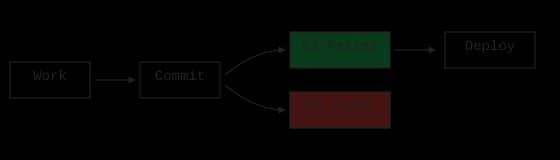
Continuous Integration systems are only valuable when they fail, catching mistakes before deployment. This article explores the counterintuitive truth that passing CI builds are merely overhead, while failures provide the only real value by preventing production errors.
When developers think about Continuous Integration (CI), they typically envision a safety net that catches bugs before they reach production. But what if I told you that CI's true purpose isn't to pass—it's to fail? This counterintuitive perspective reveals why many teams are either underutilizing their CI systems or drowning in unnecessary overhead.
The Feedback Loop Problem
Software development follows a predictable cycle: developers write code, commit changes, deploy to production, and repeat. CI sits between committing and deploying, running automated checks on every change. The conventional wisdom suggests CI prevents bugs from reaching users, but this misses a crucial insight about when CI actually provides value.
Consider what happens without CI. A developer makes a mistake—perhaps a syntax error, a broken test, or a logic flaw. Without automated checks, this error only becomes apparent after deployment, when users or teammates encounter it. At that point, the team must roll back, fix the problem, and redeploy. This feedback loop is slow, manual, and potentially catastrophic.
The Value of Early Detection
CI's true power emerges when it catches mistakes before they reach production. When CI fails, it interrupts the deployment process, forcing developers to address issues immediately. This transforms the feedback loop from "deploy, discover, rollback" to "commit, check, fix, deploy." The difference is profound: shorter cycles, automated detection, and reduced risk.
However, this benefit only materializes when CI actually catches mistakes. If no errors exist, CI merely adds friction—waiting for builds to complete before deployment proceeds. In these cases, CI provides zero value while consuming time and resources.
The Flaky CI Nightmare
Perhaps the most insidious problem in CI systems is flakiness—when builds fail for reasons unrelated to code quality. A flaky test might pass on retry, or environmental issues might cause intermittent failures. This undermines CI's core value proposition: when failures become unreliable, developers lose trust in the system.
Flaky CI creates a dangerous paradox. Teams must decide whether to ignore failures (defeating CI's purpose) or investigate every failure (wasting time on non-issues). The unfixable nature of some flakiness—sometimes machines just explode—makes this particularly frustrating.
Rethinking CI Success Metrics
The terminology around CI outcomes reinforces problematic thinking. We call catching mistakes "failure," using red icons and negative language. Meanwhile, passing builds—which provide no value—are celebrated as "success." This is backwards.
A more accurate representation might use:
- Success: No action needed (grey, neutral)
- Failure: Mistake caught (green, positive—we prevented a production error!)
- Flaky: Uncertain outcome (red, negative—we can't trust this result)

Or with emoji for clarity:

This reframing helps teams appreciate that CI failures are victories, not defeats. Each failed build represents a production bug prevented.
The Cost-Benefit Balance
Too little CI leaves teams vulnerable to production errors. Too much CI creates development friction without proportional benefits. The sweet spot varies by team, project, and risk tolerance, but the fundamental principle remains: CI's value is proportional to its failure rate.
Teams should optimize for catching meaningful errors while minimizing false positives and unnecessary delays. This might mean:
- Running expensive integration tests only for critical changes
- Using faster, targeted checks for routine modifications
- Implementing retry logic for known flaky components
- Prioritizing the most impactful failure modes
The Path Forward
Understanding that CI's value comes from failing—not passing—changes how teams approach automation. Rather than viewing CI as a gatekeeper that must always approve changes, teams should see it as an early warning system that's most valuable when it sounds the alarm.
This perspective also informs CI system design. Instead of maximizing pass rates, teams should focus on maximizing the relevance and actionability of failures. A CI system that fails 20% of the time but catches all critical bugs is more valuable than one that passes 99% of the time but misses important issues.
In the next article, we'll explore how local-first CI can further optimize this feedback loop, catching mistakes even before commits reach the shared repository. But first, teams must embrace the paradox: in Continuous Integration, failure isn't just an option—it's the only true success.
Comments
Please log in or register to join the discussion