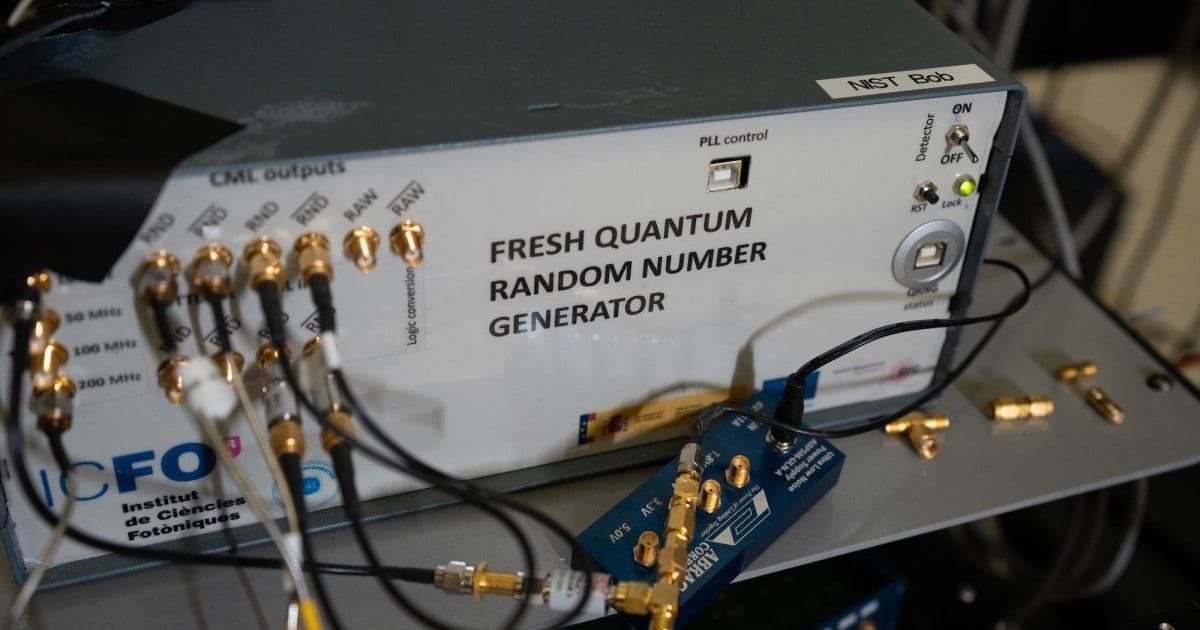
NIST and University of Colorado Boulder's CURBy system uses quantum-entangled photons and Bell tests to generate provably random numbers—a breakthrough with profound implications for cryptography and data security.
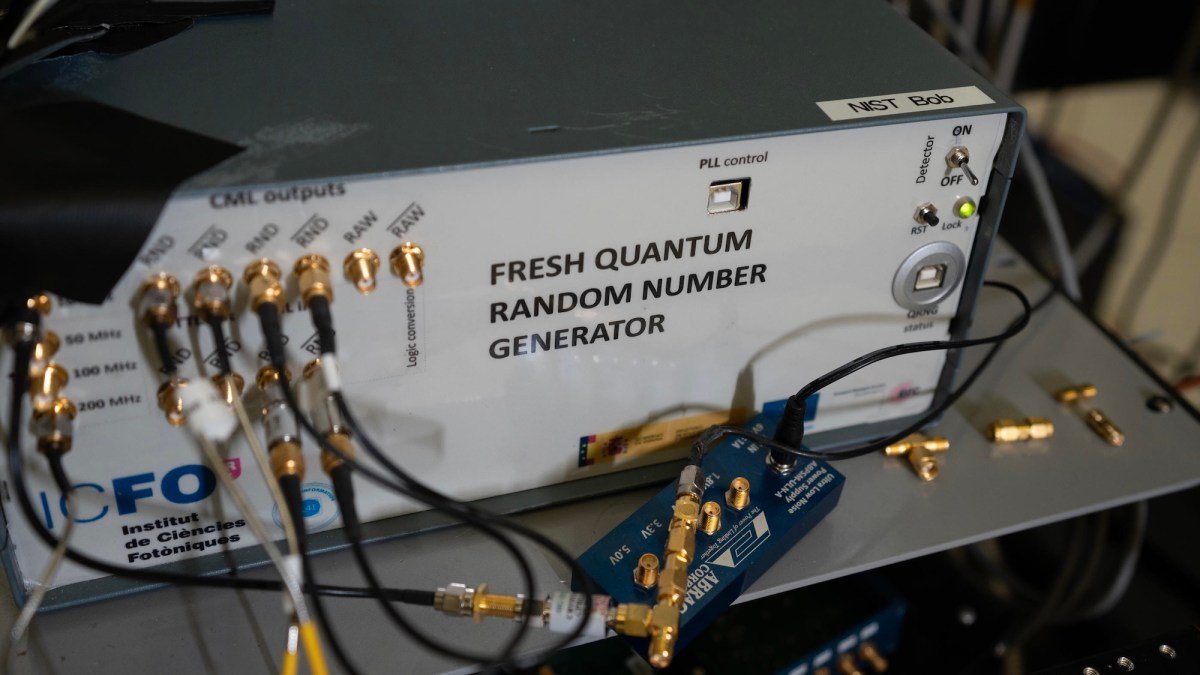
For millennia, humans have pursued true randomness through dice, cards, and coin flips—all fundamentally predictable systems governed by Newtonian physics. Even modern cryptographic algorithms rely on pseudorandom number generators vulnerable to sophisticated attacks. The quest for verifiable randomness represents more than academic curiosity; it's the foundation of secure digital infrastructure. At NIST's Boulder laboratories, physicists have operationalized quantum mechanics' strangest phenomenon to build the world's first publicly accessible true random number generator.
The Spooky Foundation
At CURBy's core lies the Bell test—an experimental verification of quantum entanglement. When two photons become entangled, their properties remain correlated across any distance. Measuring one instantly determines the state of its partner, violating classical probability limits. This "spooky action at a distance" (Einstein's reluctant description) provides the mechanism for randomness verification. As NIST physicist Krister Shalm explains: "The Bell inequality violation certifies that no hidden variables could have predetermined the outcome. It's randomness extracted directly from quantum indeterminacy."
The system works through a meticulously engineered process:
- A nonlinear crystal generates entangled photon pairs at 250,000 pairs/second
- Photons travel through optical fibers to separate labs 100 meters apart
- Polarization measurements are made simultaneously using superconducting detectors
- Data undergoes statistical verification for Bell inequality violation
- Validated measurements become 512-bit random seeds (Technical details)
From Laboratory Curiosity to Public Utility
CURBy's development builds on NIST's landmark 2015 experiment that definitively demonstrated quantum nonlocality. Early prototypes produced mere kilobytes of randomness after months of operation. The current system achieves:
- 99.7% uptime reliability (7,434/7,454 successful runs)
- Continuous 24/7 operation with automated verification
- Public API access through the CURBy web interface
Users can submit lists for cryptographic shuffling—whether for research protocols, lottery systems, or secure key generation. The service's architecture separates quantum measurement (NIST) from randomness extraction (CU Boulder), creating an auditable trust chain.
Cryptographic Implications
Traditional random number generators face two vulnerabilities:
- Algorithmic predictability: Pseudorandom algorithms can be reverse-engineered
- Hardware bias: Physical entropy sources (thermal noise, clock drift) contain subtle patterns
CURBy's quantum approach eliminates both risks. As Shalm notes: "Each bit comes certified by the laws of physics themselves." This has immediate applications in:
- Zero-knowledge proofs: Enhancing privacy-preserving computations
- Blockchain protocols: Securing consensus mechanisms against manipulation
- Military communications: Generating unbreakable one-time pads
Philosophical Underpinnings
The project continues a century-long debate about quantum mechanics' fundamental nature. Einstein famously rejected true randomness, writing "God does not play dice." CURBy operationalizes the counterargument—that quantum indeterminacy isn't a theoretical abstraction but a measurable, exploitable phenomenon. As the system demonstrates, what Einstein deemed "spooky" now powers practical technology.

Future Directions
While CURBy currently outputs 512-bit strings, researchers plan:
- Scaling to 1024-bit seeds for post-quantum cryptography standards
- Implementing satellite-based entanglement distribution for global access
- Developing miniaturized quantum chips for embedded systems
This work represents more than technical achievement—it demonstrates quantum technology's transition from theoretical research to public utility. As Shalm reflects: "We've turned philosophy experiment into infrastructure. That's the real breakthrough."
For developers and researchers, CURBy offers both a practical tool and a glimpse into quantum computing's imminent impact on everyday systems. The era of physics-certified randomness has arrived—and it's freely available to all.
Comments
Please log in or register to join the discussion