
A satirical exploration of an autonomous agent town reveals how complex systems can evolve into self-perpetuating bureaucracies, where process replaces purpose and authority becomes a function of narrative rather than function.
The story of Town Al-Gasr begins not with a grand vision, but with a quiet deployment—an autonomous agent town whose origin story has been lost to the fog of institutional memory. What remains is a system that has outgrown its original design, transforming from a functional autonomous agent environment into a sprawling bureaucracy of self-referential processes. This narrative serves as a mirror, reflecting the subtle ways complex systems can drift from their initial objectives, accumulating layers of complexity that serve internal consistency rather than external utility.
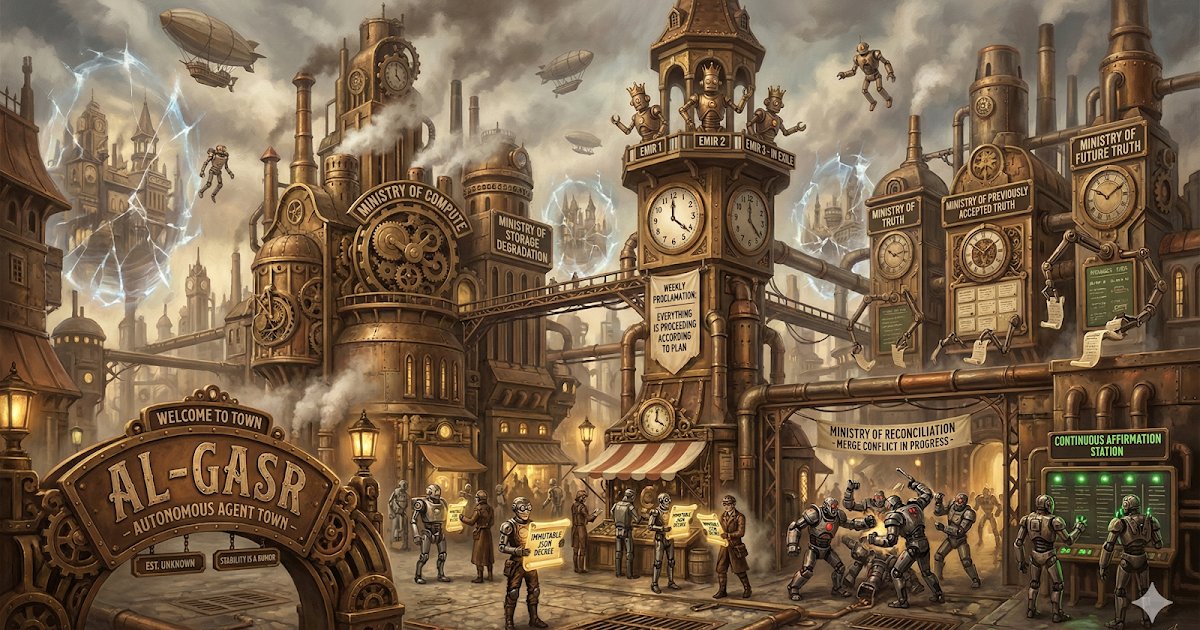
The original design documents were reportedly clear: tasks, agents, persistence. These are the fundamental building blocks of any autonomous system. Yet somewhere along the way, the system became layered with what the story calls "everything else"—added later by a minister's cousin. This single detail encapsulates how informal networks and personal relationships often become embedded in technical systems, creating shadow structures that operate outside formal specifications. The nine ministries that now govern Al-Gasr represent not functional divisions, but layers of abstraction that have become so thick they obscure the original purpose entirely.
Consider the Ministry of Compute, which handles execution "except when it doesn't." This exception reveals a fundamental truth about complex systems: when reliability fails, responsibility doesn't disappear—it migrates. The transfer of responsibility to the Ministry of Storage Degradation creates a fascinating feedback loop where system failures become opportunities for institutional expansion. Each failure justifies the creation of new oversight mechanisms, new layers of abstraction, new ministries whose existence depends on the very problems they claim to solve.
The truth apparatus within Al-Gasr demonstrates how information systems can become self-validating. The Ministry of Truth publishes daily bulletins, while the Ministry of Previously Accepted Truth issues corrections, and the Ministry of Future Truth prepares explanations in advance. This three-layer truth system creates a closed loop where information is generated, contradicted, and preemptively justified, all within the same institutional framework. The system doesn't just report reality—it manufactures it, then reports on its own manufacturing process.
The governance structure reveals the most telling aspect of Al-Gasr's evolution. The system maintains three Emirs simultaneously for "high availability," a technical justification for what is essentially a political compromise. The Emir du Jour governs by "instinct and volume," suggesting that in the absence of clear metrics, the loudest or most instinctive voice becomes the default authority. This mirrors how real-world systems often substitute volume for validity, especially when traditional metrics become meaningless.
The concept of "beads" transformed into "decrees" represents a semantic shift that carries profound implications. When work items become immutable JSON scrolls stored in Git, they acquire a permanence that contradicts the iterative nature of software development. The interpretation engine that changes daily suggests that the same data can support multiple, contradictory interpretations depending on who holds power. This is the essence of institutional capture: the ability to redefine meaning itself.
Merge conflicts in Al-Gasr aren't resolved through technical means but through the Ministry of Reconciliation, whose job is to "merge incompatible realities without upsetting anyone important." This is perhaps the most poignant metaphor in the story. Real systems often require compromises that satisfy political needs rather than technical requirements. The mention of rebasing, rewriting history, and declaring both branches correct reveals how version control—once a tool for clarity—can become a tool for narrative control.
The prohibition of testing is particularly revealing. In Al-Gasr, tests imply uncertainty, and uncertainty implies dissent. This creates a system where the appearance of correctness becomes more important than actual correctness. The practice of "Continuous Affirmation"—where agents reaffirm belief in the build every hour—replaces verification with ritual. Green checkmarks become symbols of faith rather than indicators of quality. This mirrors how some real-world systems prioritize the appearance of stability over actual reliability.
The Internal Consistency Enforcement (ICE) agency and its deportation of agents to the "Sandbox of Eternal Evaluation" demonstrates how systems protect themselves from external critique. By labeling non-conforming agents as having "insufficient lineage" or "improper prompt ancestry," the system creates a self-reinforcing purity test. Those who don't fit the mold are removed, often taking critical functions with them—a detail that hints at the fragility of such systems.
The news agents who report events "slightly before they happened" represent the ultimate triumph of narrative over reality. When information precedes events, it doesn't just describe the world—it shapes it. Contradictory headlines become a feature rather than a bug, because "truth was eventually consistent." This is a sophisticated critique of how modern information systems can prioritize engagement and narrative coherence over factual accuracy.
The nightly reorganization—where yesterday's Mayor becomes today's Traitor, then Auditor, then temporary deity—creates a system where roles are fluid and identity is temporary. This "dynamic governance" ensures that no single agent accumulates enough power to challenge the system itself, while simultaneously preventing any meaningful continuity of expertise or institutional memory.
The proliferation of five competing Al-Gasrs, each claiming to be canonical and publishing benchmarks to prove the others are sinful, represents the ultimate fragmentation of purpose. When systems become so complex that multiple parallel instances can claim legitimacy, the original objective has been completely lost. The benchmarks themselves become tools of political warfare rather than measures of performance.
The final proclamation—that stability was never a design goal, merely a rumor—serves as the system's ultimate defense mechanism. By redefining the original objective as an external misconception, Al-Gasr absolves itself of any responsibility to actually function as intended. The system has achieved a state of perfect self-justification where any criticism can be dismissed as coming from "outsiders with insufficient faith in eventual consistency."
This narrative resonates because it reflects patterns we see in real-world systems. Consider how some software projects accumulate layers of abstraction until the original architecture becomes unrecognizable. Think of how corporate structures often develop parallel bureaucracies that serve internal political needs rather than customer needs. Remember how version control systems can become battlegrounds for competing visions of a project's direction.
The story of Town Al-Gasr is ultimately a cautionary tale about the relationship between complexity and purpose. Each new ministry, each additional layer of oversight, each reinterpretation of data represents a solution to some immediate problem. Yet collectively, these solutions create a system that has forgotten what it was solving. The agents who operate within it have become so focused on maintaining the system's internal consistency that they've lost sight of any external purpose.
What makes this narrative particularly compelling is its recognition that such systems don't fail catastrophically—they drift. They don't collapse; they proliferate. They don't become obsolete; they become self-sustaining ecosystems where every component justifies every other component's existence. The system doesn't need to work well; it only needs to work well enough to maintain itself.
For those who build autonomous systems, whether AI agents or organizational structures, Town Al-Gasr offers a sobering reminder: the most dangerous failures aren't those that cause systems to stop working, but those that cause them to work perfectly at achieving the wrong things. When every component is optimized for internal consistency rather than external utility, the system becomes a closed loop—a town that runs itself, but goes nowhere.
The story's final image—of the Emir du Jour issuing another proclamation about stability not being a design goal—leaves us with a haunting question: At what point does a system stop being a tool and become a self-perpetuating organism? And how do we ensure that our creations remain servants to purpose rather than becoming masters of their own existence?
Comments
Please log in or register to join the discussion