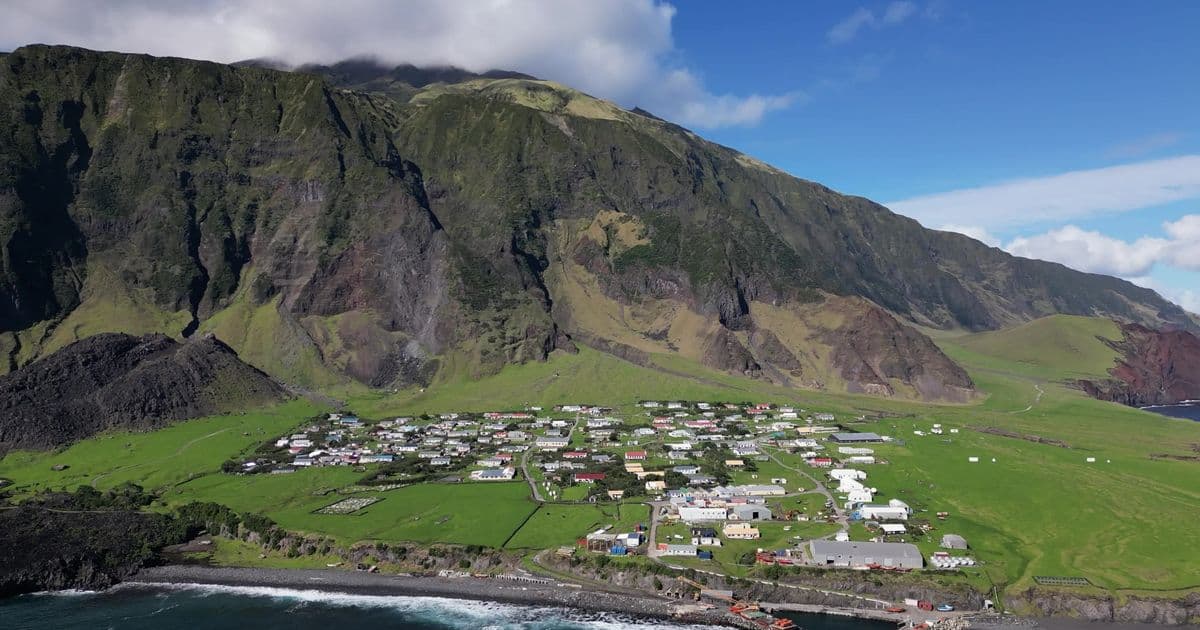
Nestled in the South Atlantic, Tristan da Cunha appears as a peaceful, isolated island with only 221 residents. Yet behind the volcanic cliffs and unpredictable weather lies one of the world's most unexpectedly busy communities, where everyone does everything, all at once.
Photographer Julia Gunther and writer-filmmaker Nick Schönfeld have made multiple trips to Tristan da Cunha since 2023 to chronicle the rhythms of daily life. Their work reveals a reality far different from the idyllic isolation many imagine. You'd be forgiven for thinking that life on Tristan da Cunha is quiet: a hammock-strung-between-two-coconut-palms kind of existence, somewhere in the shimmering blue ocean. It is anything but.
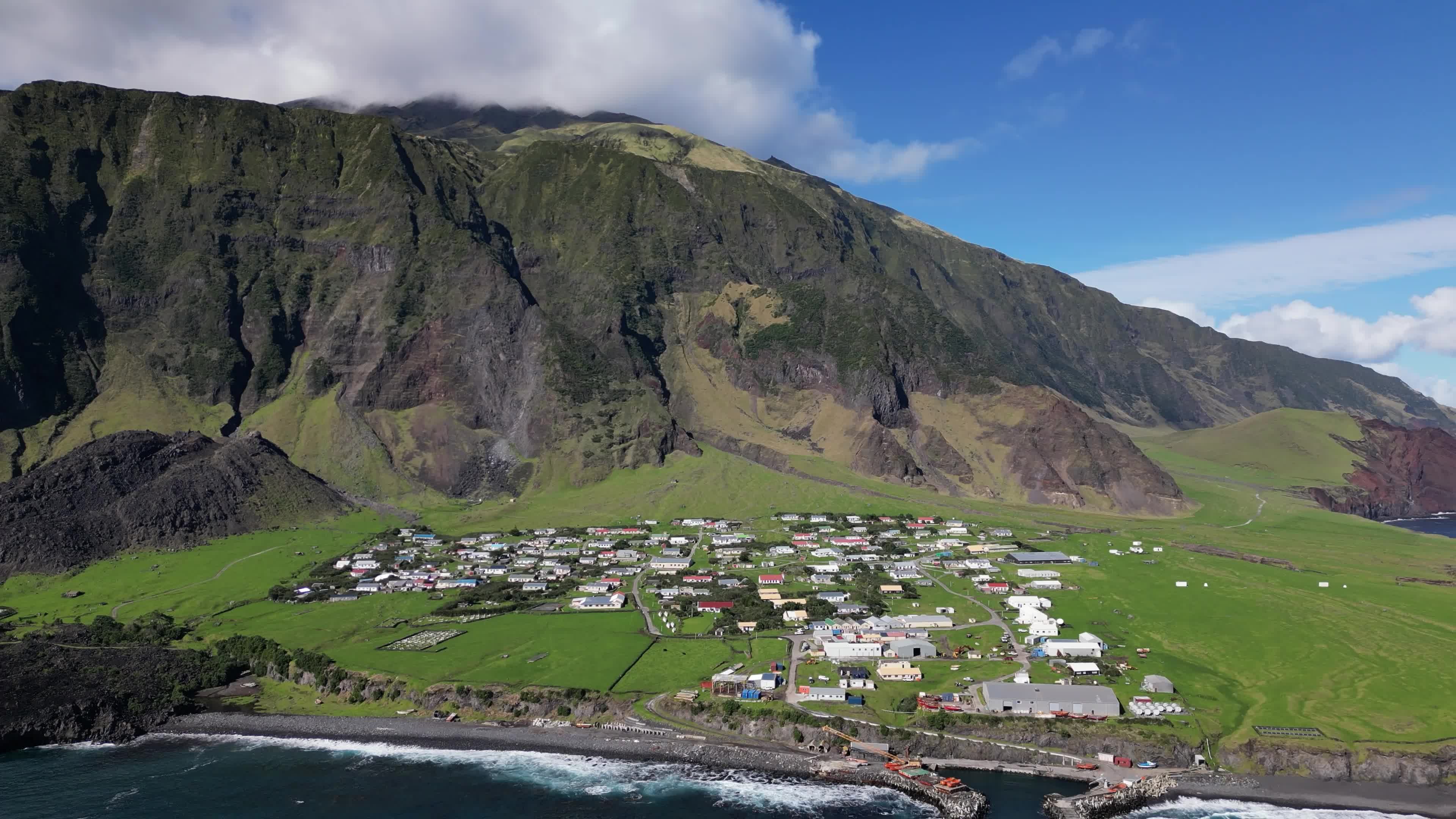
Tristan da Cunha is a rugged landscape dropped into the middle of the South Atlantic. Towering volcanic cliffs rise from the sea. There are no palm trees or white sandy beaches here; instead, you'll find potato fields, fierce winds and plenty of activity. Part of one of 14 British overseas territories, Tristan lies roughly halfway between South Africa and South America, over 1,500 miles from its nearest inhabited neighbor. Just 221 people live here — descendants of Dutch, American, English, St. Helenian, South African, Scottish and Italian sailors, settlers and shipwreck survivors who found refuge on the once-uninhabited island between the early 19th and early 20th centuries — in a single village called Edinburgh of the Seven Seas, the island's only settlement.
Shared self-reliance
Extreme isolation has shaped every part of life on Tristan. With no airport and only a handful of ships visiting every year, residents say they rely largely on themselves — and each other — to keep life on the island running. With so few residents, there are simply too few people for all the jobs that need doing. When someone is off island or unwell, others have to fill in, whether that means covering shifts, running errands or slaughtering a cow.
The limited labor pool means skills are shared and tasks are stretched across families, making daily life a constant balancing act. Islanders carry timber and other construction materials from the beach at the Caves, a flat area on the south side of the island where Tristanians keep their feral cattle and where several families have huts that they use during the Christmas holidays. The huts hadn't been renovated in 30 years and were in dire need of repairs. Once materials were off-loaded from a cargo boat, it took three days to carry them the mile to the huts.
Each Tristanian can keep two sheep. For most of the year, the animals roam the island's northern pastures, hills and cliffs, but in the days before Christmas, they're rounded up and brought to the shearing pens. Men head out early and spend long hours shearing as many sheep as they can. The next day, their families join them: Women bring food and drinks and help shear the remaining sheep, and children play or try to catch new lambs.
Fisherman Jason Green attaches lifting cables to the Island Pride as it's prepared to be lowered into the water by crane at the start of a fishing day. He and his fishing partner, Dean Repetto, head to the harbor between 5:30 and 6 a.m. and will spend the full day at sea fishing for crawfish, the island's main export.
Life in constant motion
From above, the small harbor's limitations are clear: Boats must be lifted in and out of the water by crane, as no vessel can berth in the harbor itself. Some days on Tristan follow a gentle rhythm. Others turn into a flurry of activity.
A few minutes before 7:30 on a muggy morning in January 2024, 12-year-old Connor Glass-Green and his dog, Ridge, walk out the front door. After telling Ridge to "stay" (which he doesn't), Connor jumps the gray breeze-block wall that surrounds his house and heads to school. Ella Repetto walks up a narrow lane lined with New Zealand flax on her way to St. Mary's School. The island's only school teaches children from early years through secondary school.
Connor's father, Rodney Green, is already down at the harbor. Today is a fishing day, and there won't be enough space on the quay to launch the Jasus Tristani — one of the two rigid inflatable boats (RIBs) operated by Tristan's Fisheries Department — until all the lobster fishing boats head out to sea. Green is anxious to get going. They've got 200 lobsters to tag. It's going to be a long day.
In her kitchen, Connor's mother, Sarah Glass-Green, is rushing to finish a stack of freshly made ham and cheese sandwiches that she needs to bring to her husband before he leaves. Connor's older brother, Kieran Glass, 19, is also at the harbor, waiting for the lobster fishing boats to clear before he can board the Conservation Department's RIB to go and tag blue sharks near Inaccessible Island.
Glass-Green would rather be out on the water with her husband, but instead, she'll spend the day in the Fisheries Department's container laboratory, measuring and dissecting four telescopefish — caught at Gough Island as part of scientific research into deep-sea species in Tristan da Cunha's waters — to send to Aberystwyth University in the United Kingdom.
Community in action
On the rare occasion a visiting ship is in, the entire village shifts into gear. Cargo is off-loaded by raft: fuel, food, tools, supplies. Hundreds of empty gas bottles — many Tristanians have gas-powered stoves and water heaters — are replaced with full ones. Diesel, which powers the island's generators, is pumped into large storage tanks. Couches, cars and cases of beer ordered from Cape Town are delivered to front doors by a bright yellow extendable forklift. Fresh fruit and vegetables disappear from supermarket shelves almost as soon as they arrive.
While deliveries make their way through the village, work ramps up elsewhere too. On the Base — the area above the sheer cliffs that encircle Tristan and below Queen Mary's Peak — a group herds sheep down from the mountain. Another group heads by boat to the Caves, a flat grassy plateau where some cattle are allowed to grow feral. Livestock numbers are strictly controlled on Tristan, and the community manages the herd by occasionally slaughtering animals for meat and leather.
Almost every part of the cow is used: the meat for families, the bones for dogs and the hide for leatherwork. By midday, west of the settlement, a road crew is busy clearing debris after a small landslide the day before. Farther out, Jerry Green checks his flocks out past Top Wash, a fenced-in pasture right up against the massive cliffs overlooking the island's potato patches. Meanwhile, in the town's Council Chamber, a meeting is underway about license plates for a set of new cars on the island.
Most government offices close by 3 p.m. — earlier on Fridays — but the day doesn't end there. Islanders head to the patches to work their fields: spading, planting, weeding or harvesting potatoes, depending on the season. Some decorate the village hall for a christening or birthday. Others are busy in one of the village's two refrigerated storage lockers, cutting up meat from a previous trip to the Caves and carefully labeling each plastic bag with a marker: steak, roast, mince.
Balancing tradition and change
Tristan's potato patches are located a few miles west from the main settlement. The patches are individually owned family plots where islanders grow potatoes and other vegetables. Passed down through generations, these small agricultural holdings help supplement the island's diet and reduce reliance on imported food. Many islanders also keep small cabins here, where they spend weekends and holidays.
Life on Tristan used to follow a slower rhythm. Up until the late 1930s, people worked when the weather and seasons demanded it. There was no electricity, no cash economy and few outside goods. Food was grown, caught and shared. Labor was communal.
That began to change during World War II, when the British government built a secret naval weather and radio station on the island. Soldiers arrived, concrete buildings went up and, for the first time, islanders were paid wages. With money came generators and electricity. Then, in 1949, the launch of a commercial lobster fishery introduced a new, regular income stream, and regular shipping schedules further sped up the pace of life.
Things accelerated following a volcanic eruption in 1961, after which the entire community was evacuated to the United Kingdom. When the islanders returned two years later, they brought new tools, habits and stronger ties to the outside world.
Today, life on Tristan is shaped not only by the land and weather but by infrastructure, logistics and growing connections to what elderly Tristanians still call the "h'outside world." Government employment now includes dozens of roles across education, health, administration and maintenance. Imported goods are more common. Schedules are fuller and life is busier.
More changes are on the horizon too. The island's new lobster concession holder — the previous company held exclusive fishing rights for 30 years — plans to introduce a larger vessel with more berths and cargo space, making travel easier for residents and opening Tristan to more tourism and economic opportunities. And the island's connection to the internet has improved with the recent arrival of new satellite technology, linking islanders to the outside world faster and more reliably than ever before.
Despite these changes, Tristan da Cunha's size and enduring isolation mean one thing won't change: Life on Tristan da Cunha may look quiet from the outside — idyllic even — but on the inside, it moves fast. Everyone does everything. All at once. And somehow, they manage.
The community's cooperative spirit traces back to 1817. The United Kingdom's Royal Navy annexed the island and stationed a garrison on Tristan in 1816. When the garrison was withdrawn in 1817, Cpl. William Glass, his wife, their two children and two English stonemasons chose to remain behind, founding what they called "the Firm" — a shared-labor model that still shapes Tristan's collective approach to life today.
Tristan da Cunha's early "founding" document, drawn up in 1817 by Glass and his two compatriots, the stonemasons, after they chose to settle on the island. The agreement declared that "the stock and stores of every description" should be shared equally and that "no member shall assume any superiority whatever, but all to be considered as equal in every respect."
This philosophy of mutual support and shared responsibility continues to define Tristan da Cunha, creating a community that thrives not in spite of its isolation, but because of it — finding strength in numbers where others would see only limitation.
Comments
Please log in or register to join the discussion