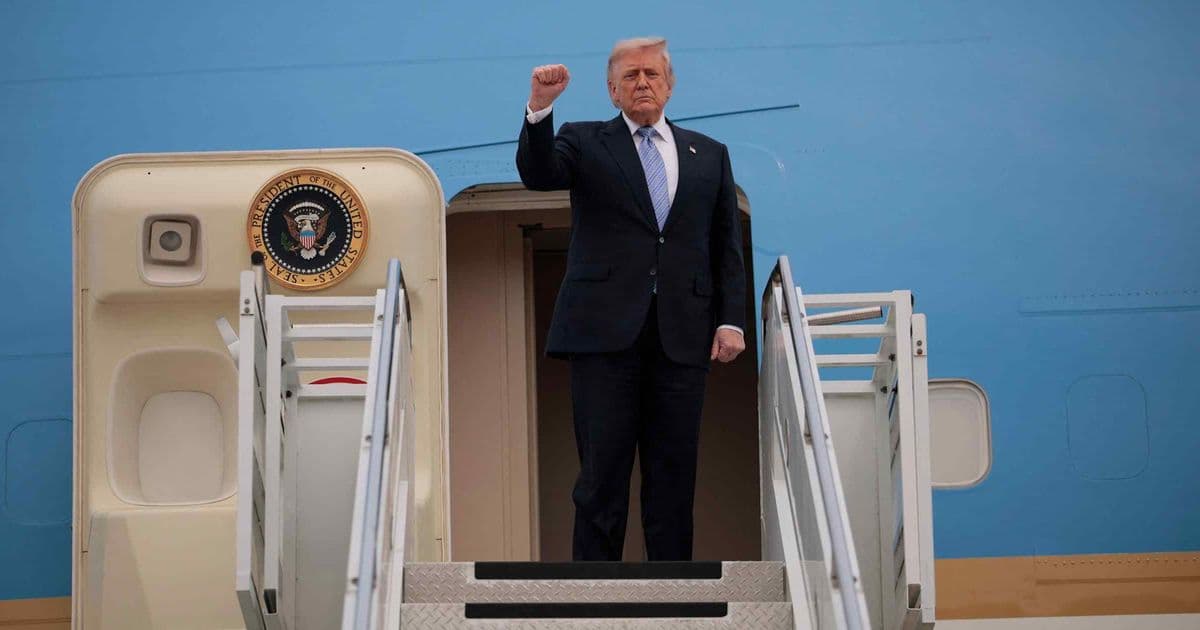
US President Trump's China visit prioritizes business interests amid geopolitical tensions, with corporate executives playing central roles in talks that could reshape trade relations, AI policy, and Taiwan tensions.
The recent Trump-Xi summit in Beijing demonstrated how economic interests and corporate engagement continue to shape the complex US-China relationship, even amid geopolitical tensions. The May 13-15, 2026 visit included extensive business diplomacy, with corporate executives from Tesla, Apple, Nvidia, and Boeing playing prominent roles in discussions that could impact global markets and supply chains.
Corporate Delegation Drives Economic Dialogue
Trump arrived with an entourage of top American business leaders, signaling the economic dimension of this diplomatic engagement. Tesla CEO Elon Musk, Apple CEO Tim Cook, Nvidia CEO Jensen Huang, and Boeing CEO Kelly Ortberg participated in bilateral meetings and separate engagements with Chinese Premier Li Qiang. This corporate presence underscored the business-focused nature of the summit, with Chinese officials explicitly stating that "China and the U.S. can and should continue to be friends and partners."
The business meetings yielded immediate market reactions. Nvidia's shares rose 4% after reports confirmed US approval for sales of the powerful H200 AI chip to Chinese companies—more advanced than the H20 chips previously designed for the Chinese market in response to export restrictions. Meanwhile, Boeing stocks dropped more than 4% following Trump's announcement that China would purchase 200 aircraft, a smaller order than market expectations.
Trade Dynamics and Market Access
Trade discussions centered around potential aircraft purchases and investment frameworks. Trump touted expected Boeing sales during his visit, though analysts noted that even a 200-jet order would barely impact Boeing's market share in China, where French competitor Airbus has been gaining ground. China's airlines have announced deals to buy 238 Airbus planes worth $37.2 billion in recent months.
Treasury Secretary Scott Bessent discussed establishing a bilateral investment board to identify "non-strategic, non-sensitive areas where it would be possible for the Chinese to invest" in the US. This framework could help manage investment flows while addressing national security concerns. The Chinese government, meanwhile, emphasized its role as "a key supplier of global AI infrastructure," noting that chip exports grew 83.7% year-on-year in dollar terms during the first four months of 2026.
Taiwan Tensions and Strategic Implications
Taiwan emerged as a critical issue during the summit, with Xi warning Trump that handling the issue "poorly" risks a "clash" between the powers. China's Taiwan Affairs Office issued a strong statement before the meeting, declaring that "our resolve to oppose Taiwan independence is as firm as a rock, and our capability to crush Taiwan independence is unbreakable."
Despite these tensions, Trump stated he gave Xi "no commitment" on Taiwan, maintaining a position that balances Washington's unofficial relations with Taipei while avoiding explicit concessions to Beijing. The US also raised the case of imprisoned Hong Kong media tycoon Jimmy Lai, with Secretary of State Marco Rubio indicating the administration hopes for a "positive response" on his release.
AI Competition and Technology Controls
Artificial intelligence represented another key area of discussion, reflecting the technological competition between the two nations. While Treasury officials mentioned plans to establish "guardrails" for AI development, Anthropic concurrently urged the US and its allies to maintain strict chip export controls to prevent "authoritarian governments" from taking the lead in the AI race.
Huang's participation in the delegation sparked particular interest given Nvidia's complex position in the Chinese market. While the CEO previously stated that China should not have access to the "latest and greatest chips," his company has designed specialized versions for the Chinese market to comply with US restrictions while maintaining market presence.
Market Reactions and Strategic Outcomes
Financial markets reacted cautiously to the summit's outcomes, with investors seeking concrete details about the agreements reached. Analysts characterized the meeting as providing "a bit of additional stability" to the relationship rather than producing major breakthroughs. As Stephen Olson from the ISEAS-Yusof Ishak Institute noted, "Trump approaches summits with Xi looking for 'deals' he can tout as 'wins,' while Xi approaches these summits looking to reframe the relationship in ways that support China's long-term objectives."
The summit occurred against a backdrop of continued Chinese military activity in the Taiwan Strait and South China Sea, with regional officials reporting approximately 90 Chinese defense and coast guard vessels detected in those waters during the visit. This demonstrated the limits of diplomatic engagement in altering China's strategic behavior.
Looking ahead, the summit established a framework for continued dialogue, particularly on economic issues and AI governance. The invitation extended by Trump for Xi to visit the White House on September 24, 2026, suggests both sides recognize the importance of maintaining high-level communication despite persistent disagreements on strategic issues.
The business-focused nature of this summit highlights how corporate interests continue to serve as a stabilizing force in the US-China relationship, even as geopolitical tensions persist. The presence of major American CEOs and discussions about trade deals, investment frameworks, and technology cooperation demonstrate that economic engagement remains a critical component of managing this complex bilateral relationship.
Comments
Please log in or register to join the discussion