
GitHub's 2025 Octoverse report reveals TypeScript as the new #1 language, with Python dominating AI projects and developers prioritizing speed and reproducibility in their tool choices.
In 2025, software development crossed a quiet threshold. In our latest Octoverse report, we found that the fastest-growing languages, tools, and open source projects on GitHub are no longer about shipping more code. Instead, they're about reducing friction in a world where AI is helping developers build more, faster.
By looking at some of the areas of fastest growth over the past year, we can see how developers are adapting through:
- The programming languages that are growing most in AI-assisted development workflows
- The tools that win when speed and reproducibility matter
- The areas where new contributors are showing up (and what helps them stick)
Rather than catalog trends, we want to focus on what those signals mean for how software is being built today and what choices you might consider heading into 2026.
The elephant in the room: TypeScript is the new #1
In August 2025, TypeScript became the most-used language on GitHub, overtaking Python and JavaScript for the first time. Over the past year, TypeScript added more than one million contributors, which was the largest absolute growth of any language on GitHub.
Python also continued to grow rapidly, adding roughly 850,000 contributors (+48.78% YoY), while JavaScript grew more slowly (+24.79%, ~427,000 contributors). Together, TypeScript and Python both significantly outpaced JavaScript in both total and percentage growth.
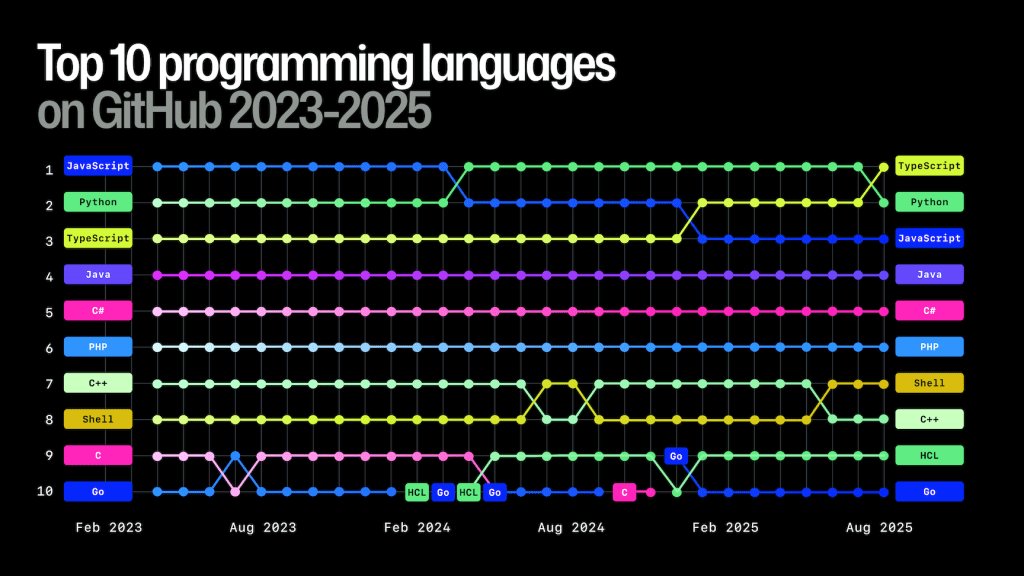
This shift signals more than a preference change. Typed languages are increasingly becoming the default for new development, particularly as AI-assisted coding becomes routine.
Why is that? In practice, a significant portion of the failures teams encounter with AI-generated code surface as type mismatches, broken contracts, or incorrect assumptions between components. Stronger type systems act as early guardrails: they can help catch errors sooner, reduce review churn, and make AI-generated changes easier to reason about before code reaches production.
If you're going to be using AI in your software design, which more and more developers are doing on a daily basis, strongly typed languages are your friend.
Here's what this means in practice:
- If you're starting a new project today, TypeScript is increasingly becoming the default (especially for teams using AI in daily development)
- If you're introducing AI-assisted workflows into an existing JavaScript codebase, adding types may reduce friction more than switching models or tools
Python remains the backbone of AI development
Python is key for AI Contributor counts show who is using a language. Repository data shows what that language is being used to build. When we look specifically at AI-focused repositories, Python stands apart.
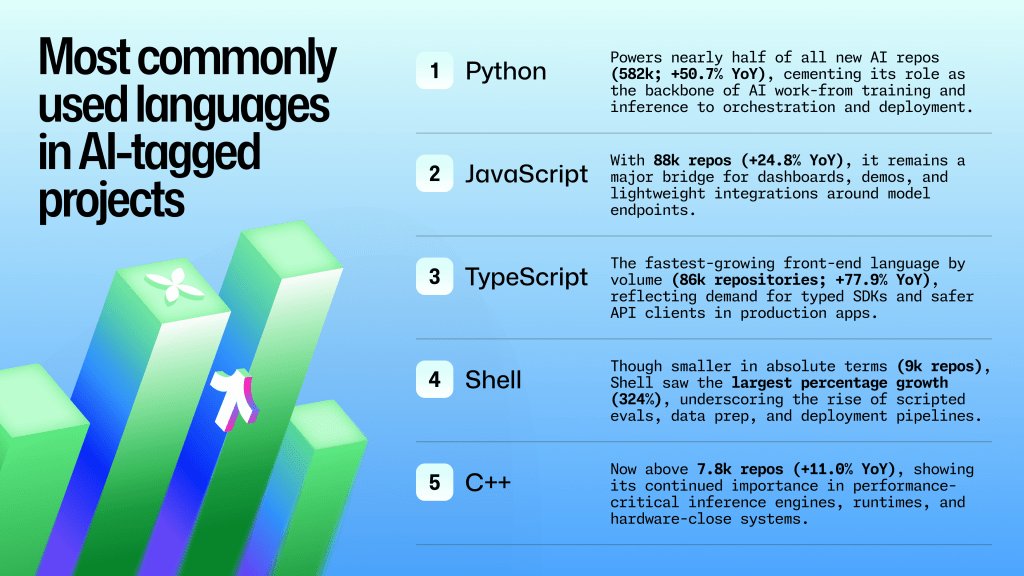
As of August 2025, nearly half of all new AI projects on GitHub were built primarily in Python. This matters because AI projects now account for a disproportionate share of open source momentum. Six of the ten fastest-growing open source projects by contributors in 2025 were directly focused on AI infrastructure or tooling.
Python's role here isn't new, but it is evolving. The data suggests a shift from experimentation toward production-ready AI systems, with Python increasingly anchoring packaging, orchestration, and deployment rather than living only in notebooks.
Moreover, Python is likely to continue to grow in 2026, as AI continues to gain support and additional projects.
Here's what this means in practice:
- Python remains the backbone of applied AI work from training and inference to orchestration
- Production-focused Python skills such as packaging, typing, CI, and containerization are becoming more important than exploratory scripting alone
The rise of speed and reproducibility
A deeper look at the top open source projects Looking across the fastest-growing projects, a clear pattern emerges: developers are optimizing for speed, control, and predictable outcomes.
Many of the fastest-growing tools emphasize performance and minimalism. Projects like astral-sh/uv, a package and project manager, focus on dramatically faster Python package management. This reflects a growing intolerance for slow feedback loops and non-deterministic environments.
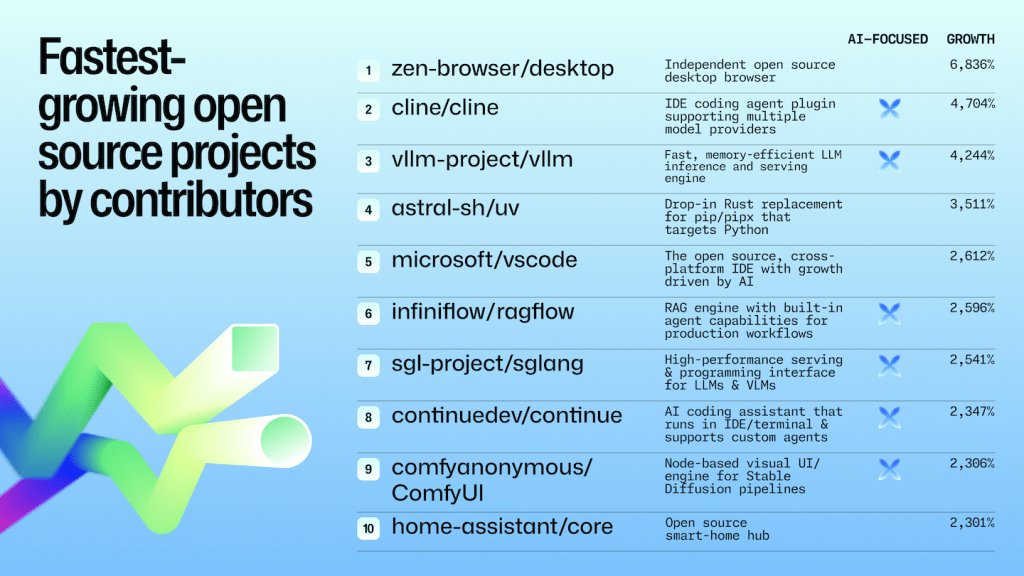
Having just one of these projects could be an anomaly, but having multiple indicates a clear trend. This trend aligns closely with AI-assisted workflows where iteration speed and reproducibility directly impact developer productivity.
Here's what this means in practice:
- Fast installs and deterministic builds increasingly matter as much as feature depth
- Tools that reduce "works on my machine" moments are winning developer mindshare
Where new contributors are showing up
As the developer population grows, understanding where first-time contributors show up (and why) becomes increasingly important. Projects like VS Code and First Contributions continued to top the list over the last year, reflecting both the scale of widely used tools and the persistent need for low-friction entry points into open source (notably, we define contributions as any content-generating activity on GitHub).
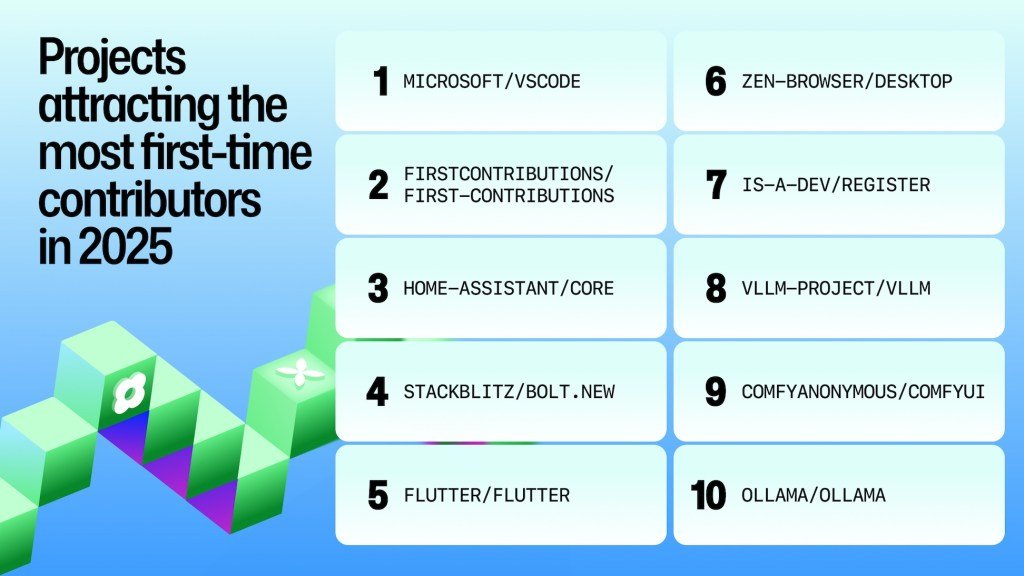
Despite this growth, basic project governance remains uneven across the ecosystem. README files are common, but contributor guides and codes of conduct are still relatively rare even as first-time contributions increase. This gap represents one of the highest-leverage improvements maintainers and open source communities can make.
The fact that most of the projects on this list have detailed documentation on what the project is and how to contribute shows the importance of this guidance.
Here's what this means in practice:
- Clear documentation lowers the cost of contribution more than new features
- Contributor guides and codes of conduct can help convert curiosity into sustained participation
- Improving project hygiene is often the fastest way to grow a contributor base
Putting it all together
Taken together, these trends point to a shift in what developers value and how they choose tools. AI is no longer a separate category of development. It's shaping the languages teams use, which tools gain traction, and which projects attract contributors.
Typed languages like TypeScript are becoming the default for reliability at scale, while Python remains central to AI-driven systems as they move from prototypes into production. Across the ecosystem, developers are rewarding tools that minimize friction with faster feedback loops, reproducible environments, and clearer contribution paths.
Developers and teams that optimize for speed, clarity, and reliability are shaping how software is being built.
As a reminder, you can check out the full 2025 Octoverse report for more information and make your own conclusions. There's a lot of good data in there, and we're just scratching the surface of what you can learn from it.
Comments
Please log in or register to join the discussion