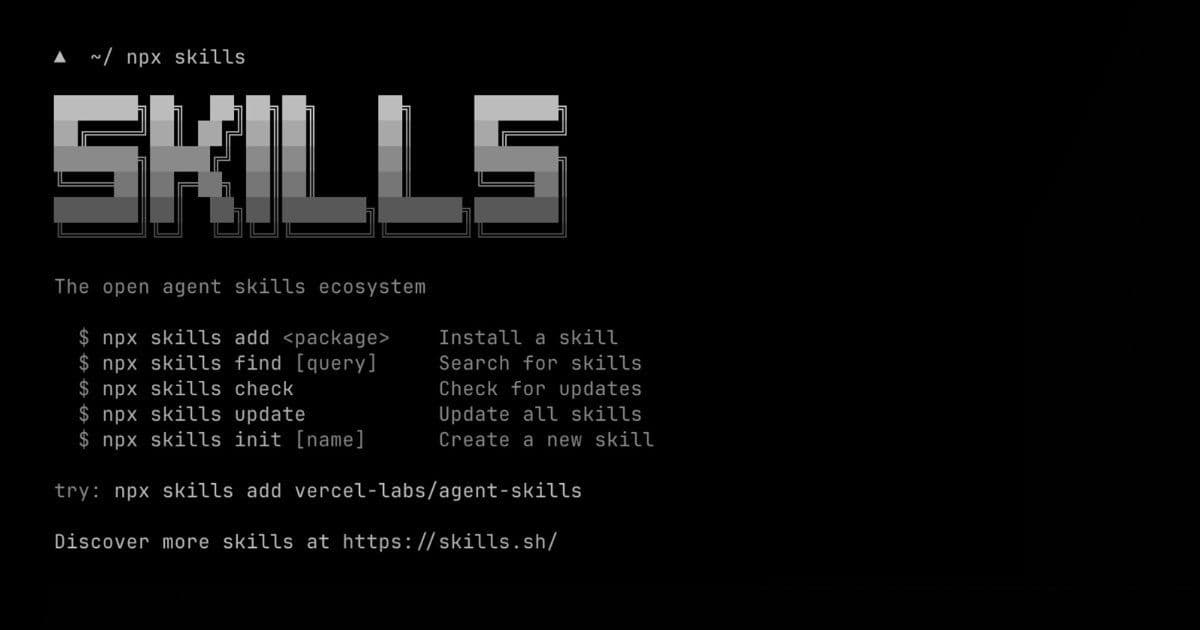
Vercel has introduced Skills.sh, an open-source tool that provides AI agents with standardized, reusable commands through the command line, aiming to separate agent reasoning from execution and enable a shared library of common agent actions.
Vercel has released Skills.sh, an open-source tool designed to provide AI agents with a standardized way to execute reusable actions, or skills, through the command line. The project introduces what Vercel describes as an open agent skills ecosystem, where developers can define, share, and run discrete operations that agents can invoke as part of their workflows. The goal is to separate agent reasoning from execution by giving agents access to a controlled set of predefined commands instead of relying on dynamically generated shell logic.
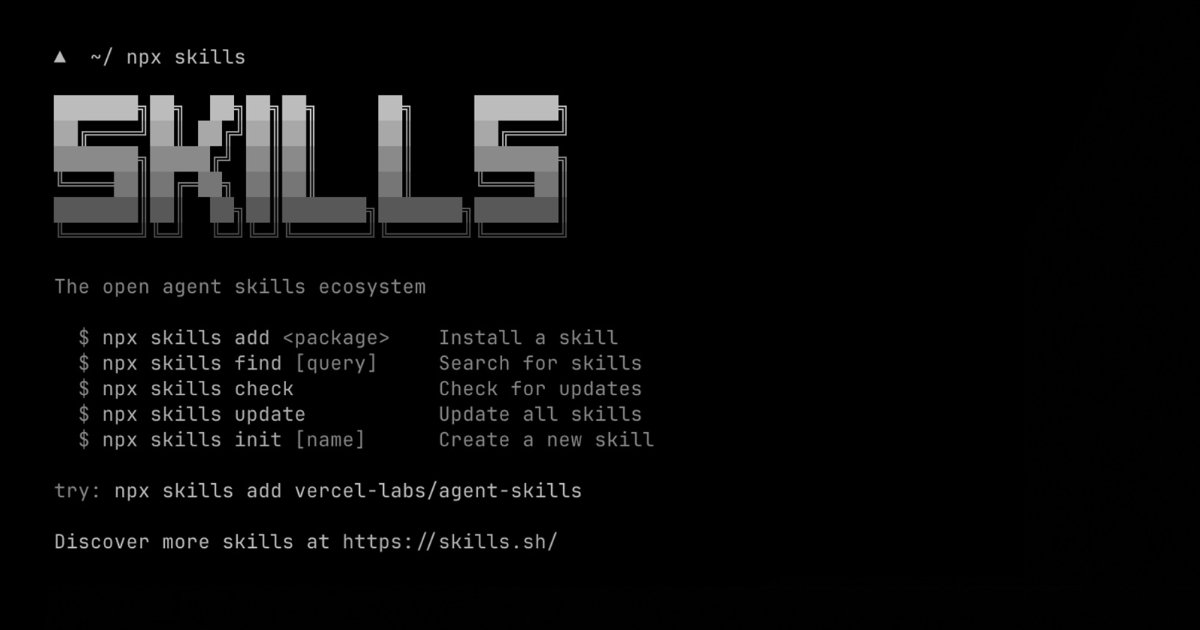
At a technical level, Skills.sh acts as a lightweight runtime that allows agents to call skills implemented as shell-based commands. Each skill follows a simple contract that defines its inputs, outputs, and execution behavior. This makes it possible for agents to perform tasks such as reading or modifying files, running build steps, interacting with APIs, or querying project metadata in a predictable and auditable way. Because skills are explicit and versioned, teams can better understand what actions an agent is allowed to take and review those actions during development or in production environments.
Skills are designed to work locally as well as in automated environments such as CI pipelines. Developers can install Skills.sh and run skills directly on their machines, while also integrating the same skills into agent-driven workflows. This consistency is intended to reduce friction when moving from experimentation to more structured use cases. Skills are described using simple configuration files, making them easy to inspect, extend, or customize without introducing additional frameworks or heavy dependencies.
Vercel has positioned the ecosystem as open and community-driven. Developers can publish their own skills and reuse skills created by others, enabling a shared library of common agent actions. Early usage data shared by the company indicates rapid adoption, with the project reportedly reaching tens of thousands of installs shortly after launch.
Community comments have focused on the practicality of the approach rather than its novelty. Developers on X have pointed out that many agent failures stem from unreliable execution rather than poor reasoning, and that a skills layer could help address this gap. Software Developer Thomas Rehmer commented: Makes sense. Discoverable skills solve the 'what can you do?' problem that most agent setups have. Meanwhile AI Engineer Aakash Harish posted: This is npm for AI agents. The key insight: Skills prioritizes composability over protocol complexity. MCP solved "how do agents talk to tools" but Skills solves "how do devs share and discover agent capabilities." The winner won't be either/or - it'll be Skills for discovery + MCP for deterministic enterprise use cases where you need guaranteed behavior.
Several developers have compared Skills.sh with other tools and standards emerging around agent execution. Similar ideas can be seen in protocol-driven approaches such as Anthropic's Model Context Protocol (MCP), which focuses on structured, API-based access to tools and data, and OpenAI's function calling, which exposes predefined actions through JSON schemas. Other projects, including LangChain tools, and CrewAI tasks, also aim to give agents controlled access to execution, though they often rely on higher-level Python abstractions rather than shell-based commands.
The Skills.sh approach represents a pragmatic middle ground between fully open-ended agent execution and rigid protocol-based systems. By grounding skills in shell commands with clear contracts, Vercel has created a system that's both accessible to developers familiar with command-line workflows and structured enough to provide the predictability that enterprise environments require.
This launch comes at a time when the AI agent ecosystem is rapidly evolving, with multiple companies and open-source projects attempting to solve the challenge of giving agents reliable, safe access to tools and data. Vercel's bet is that a simple, shell-based approach with strong discoverability will win out over more complex protocol-driven alternatives for many use cases, particularly in development workflows where developers already work extensively with command-line tools.
For teams building AI-powered development tools or workflows, Skills.sh offers a way to package common operations in a reusable format that can be shared across projects and organizations. The open ecosystem model means that as more developers contribute skills, the library of available actions will grow, potentially covering a wide range of common development tasks from code generation and testing to deployment and monitoring.
The project's rapid early adoption suggests there's significant demand for this kind of standardized approach to agent execution. As the ecosystem matures, it will be interesting to see how Skills.sh integrates with other emerging standards and whether it can maintain its momentum in the face of competition from more established players in the AI tooling space.
For developers interested in exploring Skills.sh, the project is available on GitHub with documentation covering how to create, publish, and use skills. The simple configuration format and shell-based implementation mean that getting started requires minimal overhead, making it accessible even to teams that are new to AI agent development.
As AI agents become increasingly central to software development workflows, tools like Skills.sh that provide reliable, standardized ways to execute common tasks will likely play an important role in making these agents more practical and trustworthy for everyday use. The success of this approach could influence how other companies design their agent ecosystems, potentially leading to greater standardization across the AI development tooling landscape.
Comments
Please log in or register to join the discussion