Despite its iconic status today, NASA's Apollo program faced overwhelming public opposition and fierce criticism from scientists and politicians in the 1960s. This deep dive explores the surprising history of tech skepticism surrounding the moon landing and its stark parallels to modern innovation battles.
The Uncomfortable Truth: America's Moon Landing Was Deeply Unpopular
July 20th, 2025 marks the 56th anniversary of the Apollo 11 moon landing—an event now synonymous with American technological triumph. Yet newly resurfaced polling data and historical records reveal a startling reality: most Americans actively opposed funding the moonshot during its development. This forgotten chapter of tech history offers crucial insights for today's innovators facing public skepticism.
The Polls Don't Lie: Overwhelming Public Resistance
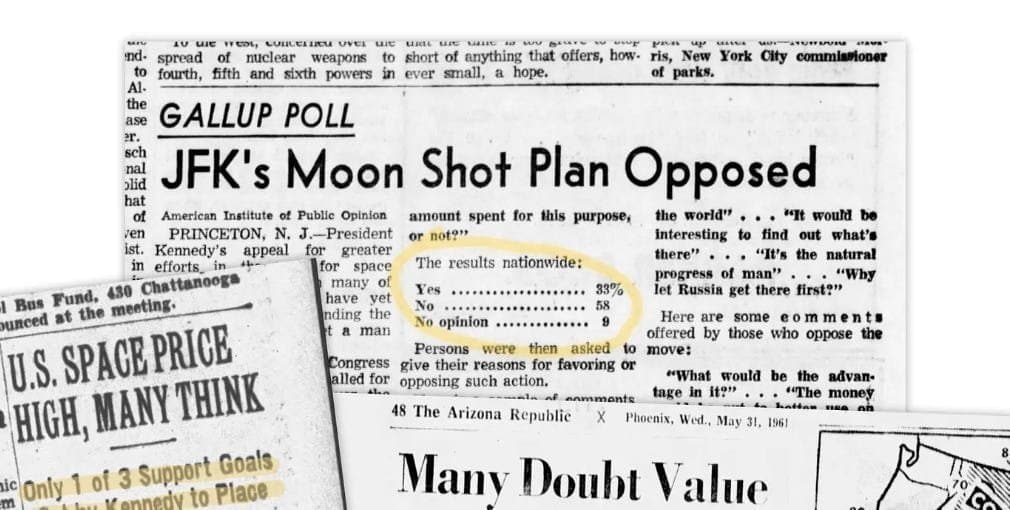
Following President Kennedy's 1961 declaration to reach the moon by decade's end, a Gallup poll found only 33% of Americans supported the endeavor, with 58% opposed—despite Alan Shepard's recent milestone as the first American in space. As historian Roger D. Launius documented, disapproval consistently outweighed support throughout the 1960s:
"Aggregations of opinion polls through the 1960s have shown disapproval of the moon landing was consistently higher than approval."
(Launius, 'Public opinion polls and perceptions of US human spaceflight')
The 'Moondoggle' Rebellion: Scientists and Politicians Push Back
The backlash wasn't limited to the public. Tech luminaries and leaders launched scathing critiques:
- Dr. Norbert Wiener, the "father of cybernetics," coined the term "Moondoggle" in 1961, a label adopted by conservatives like Barry Goldwater.
- Jerome Wiesner, Kennedy's own head of the Science Advisory Committee, opposed manned missions before Kennedy took office.
- Former President Eisenhower dismissed the $40 billion program as "nuts," calling the ambition "almost hysterical."
Scientific heavyweights argued resources should prioritize earthly problems. Philip Abelson, editor of Science, condemned the mission as a "moral outrage" when funds could combat cancer or build hospitals. The New York Times calculated the budget could fund "over a hundred universities, millions of homes, [and] hundreds of hospitals."
Kennedy's Calculated Gamble: Politics Over Popularity
Even JFK privately expressed doubts, telling NASA chief James Webb in 1963:
"This looks like a hell of a lot of dough to go to the moon... everybody says, 'What the hell are we making this trip for?'"
Kennedy ultimately justified it as a Cold War necessity, admitting the cost "could only be justified if framed in the context of military superiority over the Soviet Union." His famous Rice University speech—"We choose to go to the Moon... not because they are easy, but because they are hard"—was as much about salvaging political support as inspiring the nation.
The Long Road to Acceptance: A Lesson for Modern Innovators
Public opinion shifted glacially:
- Only 47% deemed Apollo "worth it" in 1979
- Approval didn't peak until 1989 (77%)
- Opposition to further moon missions persisted until the mid-1990s
Science fiction legend Isaac Asimov noted in 1974 that his 1938 story 'Trends'—featuring backlash against a private space launch—unexpectedly predicted this resistance: "It never occurred to anybody that people might think it was a rotten idea and a waste of money."
Why This Matters for Tech Today: Apollo's journey from "Moondoggle" to national icon mirrors modern skepticism toward AI, quantum computing, and private space ventures. It underscores that transformative technology often faces its fiercest resistance mid-journey, requiring leaders to articulate value beyond immediate utility—a crucial lesson for innovators navigating today's own frontiers.
Source: Pessimists Archive Newsletter (https://newsletter.pessimistsarchive.org/p/most-americans-opposed-the-moon-landing)
Comments
Please log in or register to join the discussion