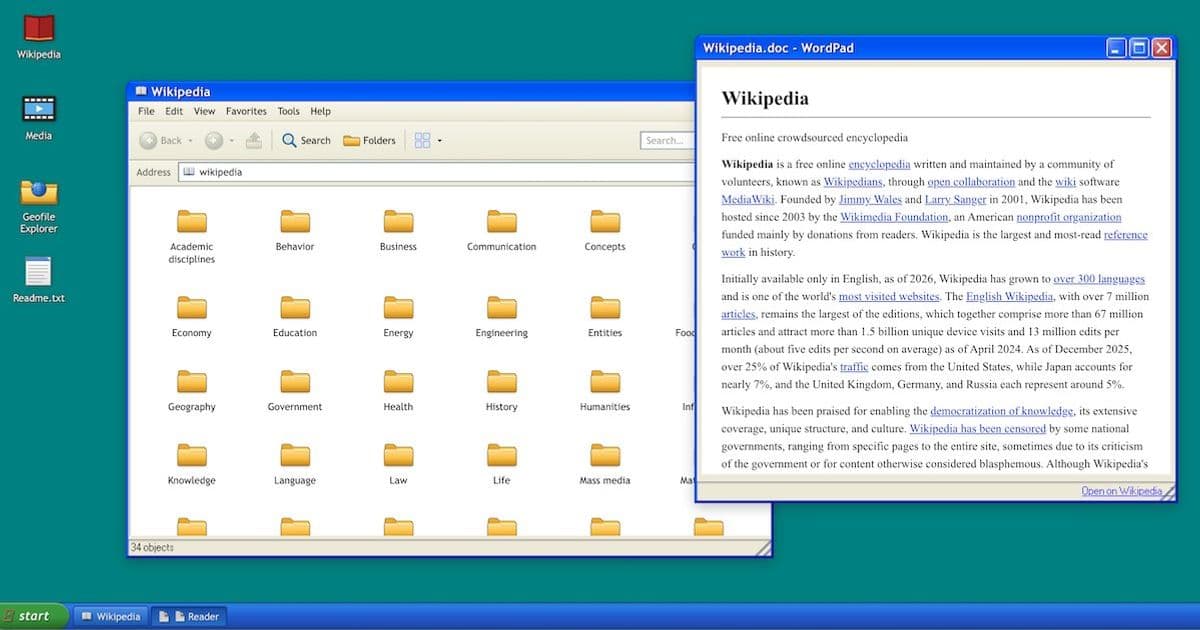
A new open‑source tool lets users navigate Wikipedia as if it were a file system, offering a familiar Windows XP interface for browsing articles, media, and categories without leaving the desktop.
Wikipedia File Explorer – Bringing the Encyclopedia to a Windows XP‑style Desktop
The problem it solves
Most people interact with Wikipedia through a web browser, which works well for occasional look‑ups but feels clunky when you want to explore related topics, browse media assets, or treat the encyclopedia like a library of files. The web UI forces you to click links, open new tabs, and scroll through endless sidebars. For power users, educators, or developers who already spend time in a file‑manager environment, that friction translates into lost time and a higher barrier to integrating Wikipedia content into scripts or offline workflows.
What Wikipedia File Explorer does
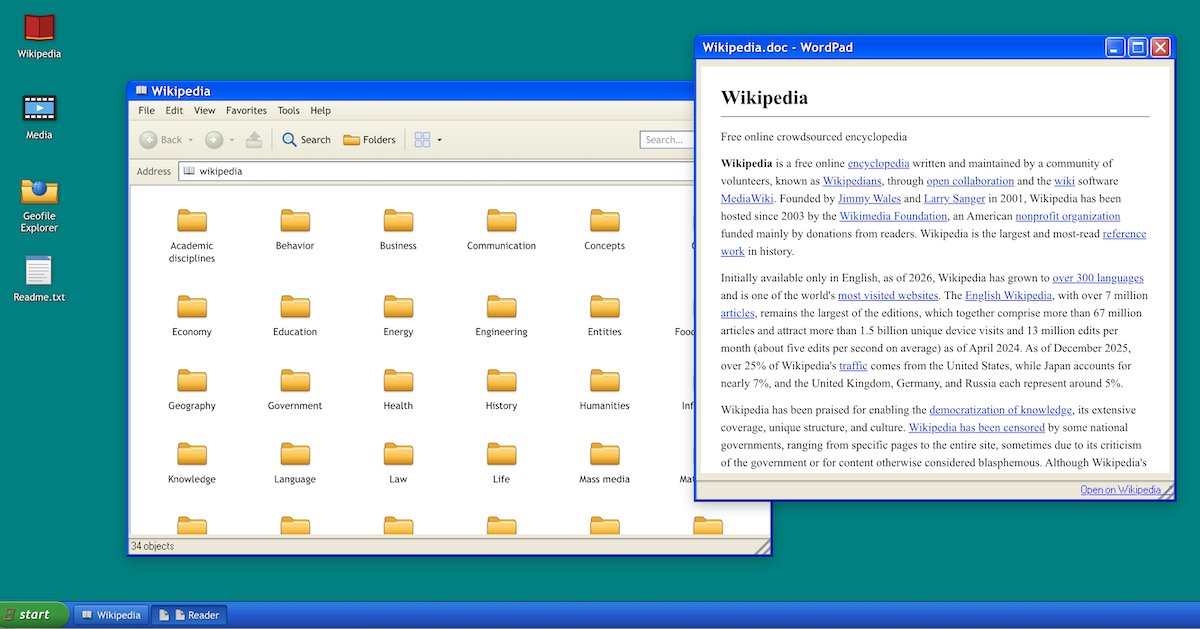
Wikipedia File Explorer (WFE) is a lightweight desktop application that maps the entire Wikipedia knowledge base onto a virtual file system. When you launch the app, you are greeted with a Windows XP‑style window that looks and behaves like the classic My Computer view. The left pane shows a hierarchy of top‑level categories (e.g., Science, History, Arts). Clicking a category expands it into sub‑categories, and eventually into individual article “files.”
Each article appears as a plain‑text file with the .wiki extension. Double‑clicking opens the article in a read‑only view that renders the wikitext as formatted HTML, complete with images, tables, and references. Media files (photos, audio, video) are exposed as their native file types, so you can open a JPEG in your default image viewer or play an OGG audio clip directly from the explorer.
Behind the scenes, WFE uses the MediaWiki API to fetch content on demand. It caches pages locally, so navigating back to a previously opened article is instantaneous. The cache can be cleared manually, and the app respects Wikipedia’s usage guidelines by throttling requests and providing a configurable API key for higher‑rate limits.
Funding and traction
The project is maintained by a small team of open‑source contributors led by former Wikimedia engineer Lena Kovács. In March 2024, they closed a seed round of $750 k from the Open Knowledge Fund and Tech for Good Ventures, both of which focus on tools that make public data more accessible. The round will fund:
- Adding support for additional language editions (currently English‑only).
- Building a plug‑in system that lets developers mount custom datasets alongside Wikipedia.
- Improving the offline cache to allow full‑encyclopedia browsing on low‑bandwidth connections.
Since its GitHub release in November 2023, the repo has attracted 1,200 stars and 300 forks. Early adopters include university libraries that embed the explorer in their digital resource portals, and a handful of hobbyist programmers who use it to generate bulk‑download scripts for research datasets.
Why it matters
By presenting Wikipedia as a file system, WFE lowers the cognitive load for users who are already comfortable with desktop navigation. It also opens up new automation possibilities: scripts can now treat article titles as file paths, enabling batch processing of content for natural‑language‑processing pipelines, educational content curation, or offline archiving. The approach sidesteps the need for heavyweight browser extensions while staying within Wikipedia’s terms of service.
Getting started
The latest version (v1.2) can be downloaded from the official releases page. Installation is a simple executable for Windows, with a portable zip for Linux and macOS users who prefer a virtual‑file‑system mount via FUSE. The project’s README includes step‑by‑step instructions for configuring API keys, adjusting cache size, and extending the explorer with custom plug‑ins.
For developers interested in the internals, the source code lives on GitHub at https://github.com/wikipedia-file-explorer/wfe, and the API wrapper is documented in the developer guide. The community maintains a public Discord channel where contributors discuss feature requests and share scripts that leverage the explorer’s file‑based interface.
Outlook
With the fresh funding and growing user base, Wikipedia File Explorer is poised to become a niche but valuable tool for educators, researchers, and developers who need a more programmatic way to interact with the world’s largest free encyclopedia. Its Windows XP aesthetic may be nostalgic, but the underlying concept—making massive public knowledge feel as navigable as a local folder—could inspire similar interfaces for other open data platforms.
Comments
Please log in or register to join the discussion