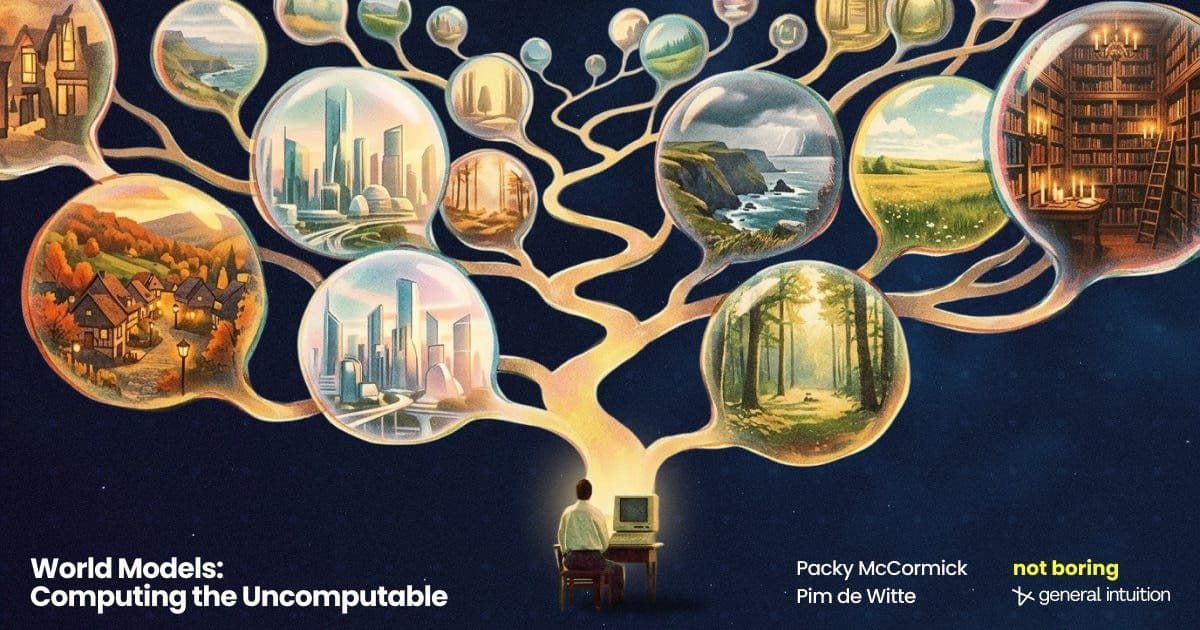
An exploration of world models - AI systems that understand and simulate physical reality - examining their potential to transform robotics, scientific discovery, and human-AI collaboration.
The tech world is buzzing about world models, a concept that's rapidly moving from theoretical research to practical applications. At Nvidia's GTC 2026 conference, world models emerged as a central theme, with industry leaders discussing how these systems could revolutionize everything from robotics to scientific discovery.
What Are World Models?
World models are AI systems designed to understand and simulate physical reality - not just language or images, but the underlying dynamics of how the world works. Unlike traditional AI that processes inputs to produce outputs, world models build internal representations of environments, allowing them to predict, plan, and reason about physical systems.
Think of it this way: while language models understand text and vision models understand images, world models understand physics, causality, and the temporal evolution of systems. They can simulate what happens when objects interact, how systems change over time, and what actions lead to desired outcomes.
The Current State of World Models
Several companies are making significant progress in this space. General Intuition, led by CEO Pim de Witte, is working on foundational world model architectures. Their approach focuses on building systems that can learn physical common sense from raw sensory data, similar to how humans develop an intuitive understanding of physics through experience.
Nvidia has been particularly vocal about world models, showcasing research on simulation platforms that can train robots in virtual environments before deploying them in the real world. Their Omniverse platform serves as a foundation for building and testing world models at scale.
Why World Models Matter
Robotics Revolution
The most immediate application is robotics. Current robots struggle with tasks that humans find trivial - opening doors, navigating cluttered spaces, or manipulating objects with varying properties. World models could give robots the ability to understand their environment, predict the consequences of actions, and adapt to novel situations.
Imagine a robot that doesn't just follow pre-programmed instructions but can reason about its environment: "If I push this object, it will fall and create a path" or "This surface is slippery, so I need to adjust my grip." This level of understanding could make robots truly useful in homes, hospitals, and factories.
Scientific Discovery
World models could accelerate scientific research by simulating complex systems - from molecular interactions to climate patterns. Instead of running expensive physical experiments, scientists could use world models to test hypotheses in silico, dramatically reducing the time and cost of discovery.
For instance, drug discovery could be transformed by world models that understand molecular dynamics, predicting how different compounds interact with biological systems without requiring physical synthesis and testing.
Human-AI Collaboration
World models could enable more natural human-AI interaction by giving AI systems a shared understanding of physical reality. Rather than humans having to translate their intentions into commands an AI can understand, the AI could understand the physical context and work alongside humans more intuitively.
The Technical Challenges
Building effective world models faces several hurdles:
Data Requirements: World models need vast amounts of diverse, high-quality data about physical interactions. Unlike text data which is abundant, quality physical interaction data is expensive to collect and label.
Computational Complexity: Simulating physical systems is computationally intensive. Real-time world modeling for complex environments requires significant processing power, though advances in specialized hardware are helping.
Generalization: A world model that works well in one environment may fail in another. Creating models that can generalize across diverse physical scenarios remains a major challenge.
The Timeline Debate
There's considerable debate about when world models will become practically useful. Some researchers believe we're 2-3 years away from systems that can handle basic physical reasoning reliably. Others argue that true world models - ones that match human-level physical intuition - may be a decade or more away.
Nvidia's CEO Jensen Huang has been particularly optimistic, suggesting that world models could be the key to achieving artificial general intelligence. However, critics argue that we're still far from understanding how to build systems with genuine physical reasoning capabilities.
The Broader Implications
If successful, world models could represent a fundamental shift in AI capabilities. Rather than being specialized tools for specific tasks, AI systems with world models could become general-purpose problem solvers that understand and can manipulate the physical world.
This raises important questions about safety, control, and the nature of intelligence itself. As AI systems become better at understanding and predicting physical reality, ensuring they align with human values and intentions becomes increasingly critical.
Looking Ahead
The development of world models represents the next logical step in AI evolution - moving from understanding language and images to understanding the physical world itself. While significant challenges remain, the potential benefits are enormous.
As research progresses and computational capabilities improve, we can expect to see world models increasingly integrated into robotics, scientific research, and everyday applications. The companies and researchers who crack this technology could reshape entire industries and unlock new forms of human-AI collaboration.
The race to build effective world models is on, and it may well determine the next phase of AI development. Whether it takes three years or ten, the impact of world models on technology and society could be profound.
Comments
Please log in or register to join the discussion