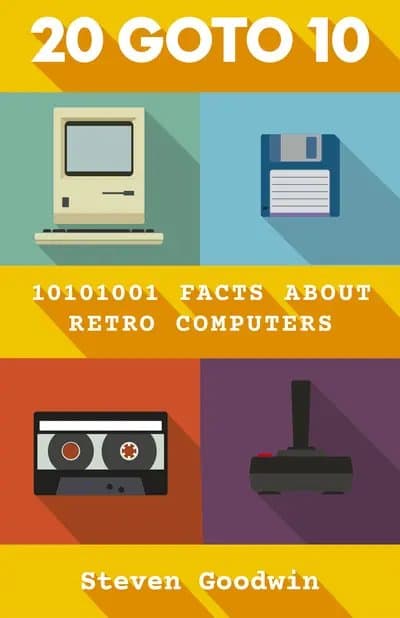
Steven Goodwin's '20 GOTO 10' offers a unique, choose-your-own-adventure approach to retro computing history, blending trivia, technical details, and nostalgic anecdotes into an engaging exploration of the machines that shaped modern computing.
The book opens with a deceptively simple premise: what if the history of computing wasn't a straight line but a network of interconnected stories? Goodwin delivers exactly that with his collection of nearly 200 articles that range from bite-sized trivia to deep technical dives.
The GOTO Structure
Each chapter ends with a multiple-choice GOTO statement, sending readers down different paths through computing history. This isn't just a gimmick—it fundamentally changes how you experience the material. One moment you're reading about the ZX Spectrum's memory limitations, the next you're exploring the origins of ASCII art, then suddenly you're deep in the weeds of early networking protocols.
Some paths loop back on themselves, others lead to dead ends with playful "Game Over" messages. It's a structure that mirrors the actual experience of exploring retro computing—you start with one question and suddenly find yourself three hours later wondering how you ended up reading about the Manchester Baby.
The Content Spectrum
The book covers territory that will feel familiar to anyone who's spent time in retro computing circles. The stories about POKE commands, the rivalry between Commodore and Atari, the rise and fall of various home computers—these are the well-trodden paths. But Goodwin also digs into delightfully obscure corners.
One particularly memorable section explores the world of text adventures and how they pushed the boundaries of what early computers could do with limited memory. Another dives into the surprisingly complex world of early computer graphics, explaining why certain colors appeared the way they did on specific hardware.
The technical depth varies significantly. Some entries are accessible anecdotes that anyone can enjoy, while others assume a level of familiarity with assembly language or hardware architecture that might leave casual readers behind. This unevenness is both a strength and weakness—it means there's something for everyone, but also that you might find yourself skipping sections that are either too basic or too advanced.
The Easter Eggs
Goodwin clearly had fun writing this book. Scattered throughout are references, callbacks, and outright jokes that reward careful reading. Finding these Easter eggs feels like discovering hidden features in old software—that moment when you realize the programmer left something special just for people who looked closely enough.
The Production Challenges
The book's availability is unfortunately complicated by ongoing issues with Unbound, the crowdfunding publisher. This creates a frustrating situation where a book about preserving computing history is itself difficult to preserve and distribute. Signed copies are available through The Centre for Computing History, but the limited availability means many interested readers may struggle to obtain a copy.
Who This Is For
This isn't a comprehensive history textbook. It's more like having a knowledgeable friend who's excited to tell you stories about old computers, jumping from topic to topic based on whatever connection seems interesting at the moment. If you remember typing LOAD "",1 on a Commodore 64 or arguing about whether the Amiga or Atari ST was superior, you'll find plenty to enjoy.
For younger readers or those who didn't experience the home computer revolution firsthand, the book serves as an accessible entry point. The non-linear structure means you can jump in anywhere and start exploring without needing to understand the entire context.
The Verdict
Four stars feels right. The book succeeds at what it sets out to do—create an engaging, non-linear exploration of retro computing history. The GOTO structure is clever and genuinely enhances the reading experience rather than feeling like a gimmick. The content is well-researched and covers both familiar ground and obscure corners of computing history.
The main drawbacks are the uneven technical level and the unfortunate availability issues. Some sections might be too basic for hardcore retro computing enthusiasts, while others might be impenetrable to casual readers. And the difficulty in obtaining a copy is a real shame for a book that deserves to be read.
But for anyone with even a passing interest in the history of personal computing, 20 GOTO 10 offers a unique and entertaining journey through the machines, people, and ideas that shaped our digital world. It's the kind of book you can pick up, read a few sections, and come back to later without losing your place—because in a very real sense, you never really had a "place" to begin with.
Comments
Please log in or register to join the discussion