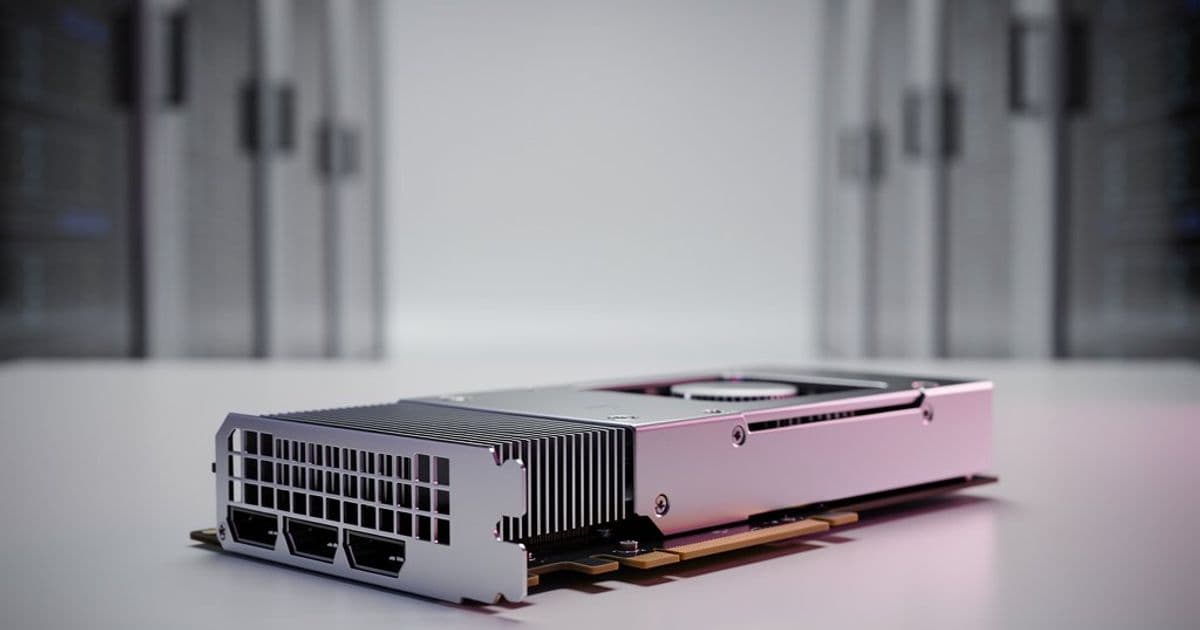

The Trump administration imposes a 25% tariff on exports of advanced AI chips including Nvidia H200 and AMD MI325X, requiring domestic demand fulfillment and potentially reshaping global AI infrastructure economics.

The Trump administration has implemented a 25% tariff on exports of advanced AI accelerator chips including Nvidia's H200 and AMD's MI325X, marking a strategic pivot from previous export bans to a revenue-generating trade barrier. Announced via White House press release, this narrowly targeted measure applies exclusively to chips destined for non-U.S. datacenters, exempting domestic research, public sector, and stateside commercial deployments. Commerce Department data cited in the release highlights the policy's motivation: while the U.S. consumes 25% of global advanced chip output, it manufactures just 10%, creating critical dependencies in military, healthcare, and energy infrastructure.
Technical Specifications Under Tariff
The tariff specifically targets cutting-edge AI accelerators manufactured at 4nm (Nvidia H200) and 5nm (AMD MI325X) process nodes. Nvidia's H200 delivers 1.8x the FP8 performance of its predecessor H100, featuring 141GB of HBM3e memory with 4.8TB/s bandwidth. AMD's MI325X counters with 288GB of HBM3 memory and 6TB/s bandwidth, positioning both chips as foundational infrastructure for large language model training. The regulation explicitly prohibits export of modified variants like Nvidia's China-specific B40 or AMD's MI308, which were designed to circumvent previous export controls through reduced specifications.

Supply Chain Mechanics
Exporters must now demonstrate full fulfillment of domestic orders through verified purchase agreements before shipping chips overseas. This "domestic first" requirement fundamentally alters inventory allocation strategies, forcing global cloud providers to prioritize U.S. facilities. For non-exempt exports, the 25% tariff applies at point of customs clearance, potentially adding $20,000-$40,000 per unit based on current market pricing. The administration notes this figure could increase after a 90-day review period where Commerce Department analysts will assess market impact.
Global Market Implications
While China had already implemented H200 import blocks through customs interdiction—accelerating adoption of domestic alternatives like Huawei's Ascend 910B—the tariff directly impacts AI infrastructure development in Europe, India, and Southeast Asia. Meta's European datacenters face an estimated $120M annual cost increase based on projected H200 deployments, while Indian startups report reevaluation of GPU leasing contracts. The policy creates an effective price umbrella for U.S. cloud providers: AWS, Google Cloud, and Microsoft Azure can leverage tariff-free access to supply while international competitors absorb cost penalties.
Economic and Strategic Outcomes
Administration projections estimate $1.2-1.8B in annual tariff revenue from affected chips alone, representing 25% of their projected export value. More significantly, the measure incentivizes onshore AI compute deployment—TSMC's Arizona fab becomes strategically vital for AMD, while Samsung's Texas expansion gains urgency for Nvidia packaging. Grey market arbitrage faces new barriers as customs documentation must now validate end-use locations, though enforcement challenges remain for transshipped components. Industry analysts note this accelerates investment in chiplet architectures where final assembly could occur in tariff-exempt locations.

Bruno Ferreira is a contributing writer covering semiconductor markets and supply chain dynamics.
Comments
Please log in or register to join the discussion