
Practical insights from distributed systems trenches showing why microservices demand organizational maturity, disciplined documentation, and context-aware implementation rather than dogmatic adoption.

The microservices versus monolith debate often generates more heat than light. Having witnessed both spectacular successes and catastrophic failures in distributed systems, I've compiled hard-won lessons that transcend theoretical ideals. These principles address the gritty reality of building maintainable systems at scale.
1. Architectural Pragmatism Over Purity
Don't treat architecture selection as religious dogma. The most effective systems often blend patterns strategically. A payment processing service might benefit from isolated microservices handling fraud detection, while user profile management remains in a well-structured monolith. This hybrid approach leverages each pattern's strengths: microservices for independently scalable high-risk components, monoliths for transactional coherence where strong consistency matters. The Amazon Prime Video case exemplifies this – their shift from microservices to a monolith for specific video processing workflows wasn't failure, but intelligent pattern matching.
2. Organizational Alignment Precedes Technical Implementation
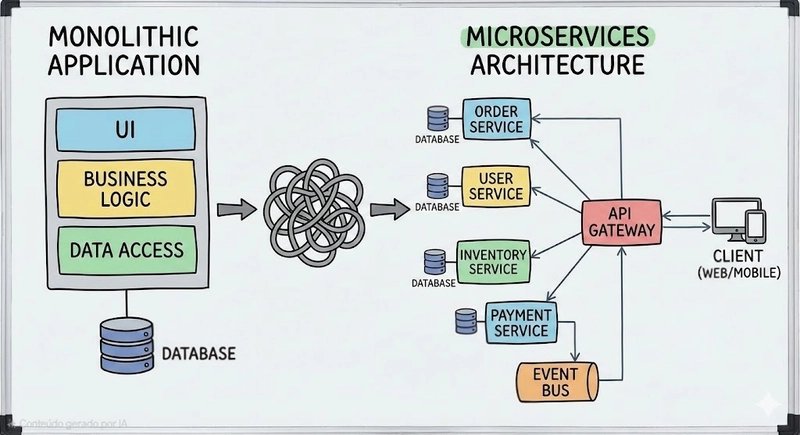
Microservices amplify technical debt without enforced standards. Uncontrolled technology sprawl creates "snowflake systems" – services built with unique languages, frameworks, or infrastructure that become unmaintainable. Establish clear guardrails:
- Approved language list (e.g., only JVM/Python/Go)
- Mandatory logging formats (OpenTelemetry)
- Centralized observability requirements Without these, you risk creating systems where only the original developer understands the implementation, leading to operational fragility and onboarding nightmares.
3. Strategic Reusability Drives ROI
Well-designed microservices become force multipliers. Consider a government ID validation service: this single deployable unit can serve:
- Customer onboarding flows
- HR employee verification
- Supplier due diligence Build it once with a clean OpenAPI specification, and multiple business units consume it. This contrasts sharply with monoliths where such functionality gets duplicated or entangled with domain logic.
4. Documentation Is Non-Negotiable Infrastructure
In microservices, undocumented contracts cause systemic breakdowns. When Service A changes an output field without updating its Swagger docs or AsyncAPI specs, dependent services fail unpredictably. Treat documentation as code:
- Versioned alongside service code
- Contract tests validating implementations
- Published to internal registries like HashiCorp Consul Without this discipline, microservices devolve into distributed monoliths with hidden coupling.
5. Testing Complexity Scales Exponentially
Testing microservices demands layered strategies:
| Test Layer | Tools | Challenge |
|---|---|---|
| Unit | JUnit, pytest | Mocking external dependencies |
| Contract | Pact, Spring Cloud Contract | Ensuring interface compliance |
| Integration | Testcontainers | Managing dependent services |
| E2E | Cypress, K6 | Coordinating distributed flows |
This requires investment in observability – structured logs via ELK Stack, metrics with Prometheus, and distributed tracing using Jaeger become operational necessities, not luxuries.
6. Resource Isolation Enables Precision Scaling
Microservices excel at containing resource-intensive operations. Imagine a monolith where image processing consumes 70% of resources. Scaling means over-provisioning the entire application. With microservices:
- Isolate the image processor in its own service
- Deploy on GPU-optimized instances
- Scale independently during peak loads This granularity also enables incremental modernization – rewrite a legacy COBOL module as a microservice while keeping other components intact, avoiding big-bang rewrites.
7. Evolution Trumps Perfection
Initial domain boundaries will be wrong. Services will need splitting, merging, or retiring. The key is designing for change:
- Loose coupling via message queues (RabbitMQ, Kafka)
- Anti-corruption layers for inter-service communication
- Explicit versioning in APIs and events A shipping service might start handling both domestic and international logistics, only to split when cross-border compliance rules explode in complexity. This isn't failure – it's responsive architecture.
8. Context Determines Success
Microservices aren't intrinsically superior. They introduce complexity that only pays off when:
- Teams have DevOps maturity
- Cross-service debugging tools exist
- Organizational structure supports autonomous teams Evaluate tradeoffs ruthlessly: do you need independent deployability? Differential scaling? Technology heterogeneity? If not, a modular monolith might offer simpler operational overhead. The goal isn't microservices – it's sustainable systems aligned to business needs.
Conclusion
The microservices journey resembles Frederick Brooks' "no silver bullet" wisdom. They solve specific problems while introducing new challenges around distributed transactions, testing, and observability. Success comes from understanding these tradeoffs deeply, standardizing judiciously, and accepting that your architecture will – and should – evolve as your systems interact with real-world complexity.
Comments
Please log in or register to join the discussion