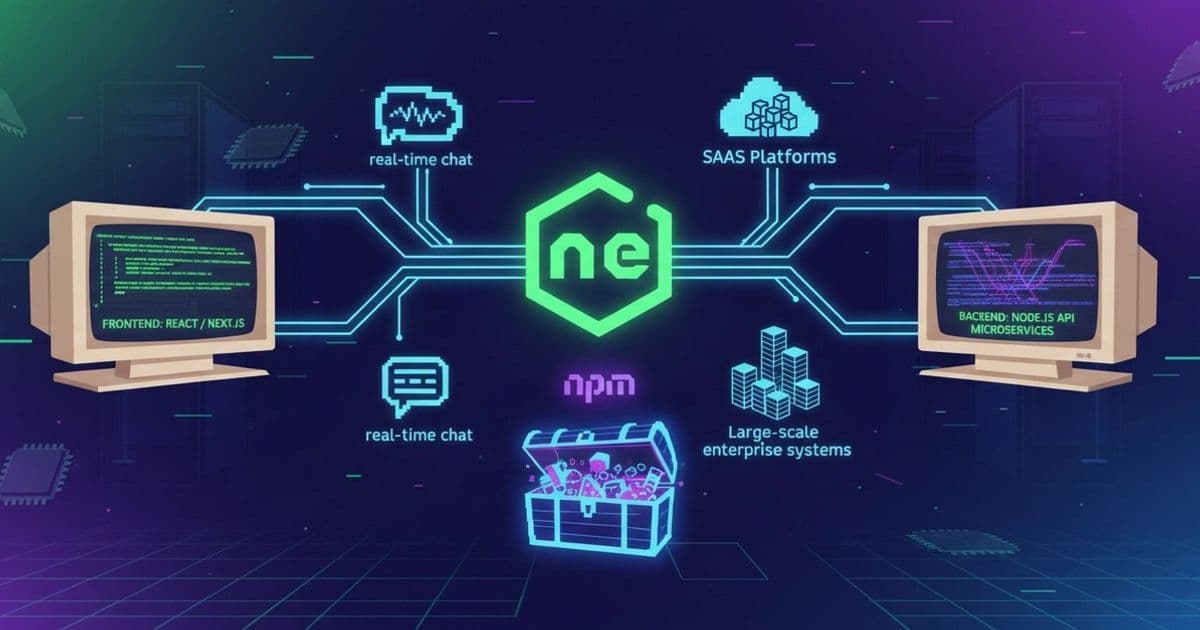
Node.js's non-blocking architecture and massive ecosystem make it the go-to choice for building high-performance backend systems that can handle real-time workloads at scale.
Node.js has become one of the most widely used technologies for building scalable backend systems and modern web applications. Built on Chrome's V8 JavaScript engine, Node.js allows developers to run JavaScript on the server side, making it possible to use a single language across both frontend and backend development.
One of the biggest advantages of Node.js is its ability to handle large numbers of simultaneous connections efficiently. Its non-blocking, event-driven architecture makes it ideal for building high-performance applications that need to process many requests in real time. This is why Node.js is commonly used for real-time chat applications, SaaS platforms, streaming services, and large-scale enterprise systems.
The Event Loop: Node.js's Secret Weapon
The core of Node.js's scalability lies in its event loop architecture. Unlike traditional thread-based servers that create a new thread for each connection, Node.js uses a single-threaded event loop that handles all I/O operations asynchronously. When a request comes in that requires I/O operations like database queries or file system access, Node.js doesn't block waiting for the operation to complete. Instead, it registers a callback and moves on to the next request.
This non-blocking behavior means a single Node.js process can handle thousands of concurrent connections without the overhead of context switching between threads. For applications that need to handle many simultaneous users—like social media platforms, multiplayer games, or financial trading systems—this architecture provides significant performance advantages.
Business Impact: Why Companies Hire Node.js Developers
Businesses often hire Node.js developers to build powerful backend APIs, scalable microservices, and cloud-based applications. Node.js enables faster development cycles and improves overall application performance, making it a preferred choice for startups and large organizations alike.
Consider the development efficiency gains: a team can build both frontend and backend using JavaScript, reducing context switching and enabling full-stack developers to work across the entire application stack. This unified language approach also means better code reuse and shared tooling between client and server.
The npm Ecosystem: Accelerating Development
Another key benefit of Node.js is its massive ecosystem of libraries and packages available through npm (Node Package Manager). With over 2 million packages available, developers can leverage these tools to speed up development and build robust applications with fewer resources.
This ecosystem includes everything from database connectors and authentication libraries to testing frameworks and deployment tools. For example, Express.js provides a minimal and flexible framework for building web applications, while Socket.io enables real-time bidirectional communication between clients and servers.
Integration with Modern Frontend Frameworks
Node.js also works seamlessly with modern frontend frameworks such as React and Next.js, allowing businesses to create fully integrated full-stack applications. This integration is particularly powerful for building isomorphic applications that can render on both server and client sides, improving initial load times and SEO.
Next.js, built on top of Node.js, provides features like server-side rendering, static site generation, and API routes—all within a single framework. This tight integration between frontend and backend development streamlines the development process and reduces the complexity of deploying full-stack applications.
Real-World Use Cases and Performance Benefits
Node.js excels in scenarios requiring high concurrency and real-time capabilities. Companies like Netflix, PayPal, and LinkedIn have all adopted Node.js for various parts of their infrastructure.
Netflix uses Node.js for their user interface and part of their API infrastructure, handling millions of concurrent streams. PayPal rebuilt their web application using Node.js and reported a 35% decrease in the average response time for the same page, serving 200ms faster while building the app in 33% fewer lines of code.
Scalability Patterns with Node.js
Node.js supports several architectural patterns that enhance scalability:
Microservices Architecture: Node.js is particularly well-suited for microservices due to its lightweight nature and ability to handle many concurrent connections. Each microservice can be a separate Node.js process, allowing teams to scale different parts of the application independently.
Event-Driven Architecture: Node.js's event-driven nature makes it ideal for building systems that need to react to events, such as message queues, IoT applications, or real-time analytics platforms.
API Gateway Pattern: Node.js can serve as an API gateway, handling authentication, rate limiting, and routing requests to different backend services while maintaining high performance under load.
The Community and Long-Term Support
Node.js's flexibility, scalability, and strong community support make it an excellent choice for companies building modern digital platforms. The Node.js Foundation (now part of the OpenJS Foundation) ensures long-term support for different versions, providing stability for enterprise applications.
The active community contributes to continuous improvements, security updates, and the development of new tools and frameworks. This ecosystem continues to evolve, with recent additions like native ES modules support and improved TypeScript integration making Node.js even more powerful.
When Node.js Might Not Be the Right Choice
While Node.js excels at I/O-bound tasks, it's not ideal for CPU-intensive operations. The single-threaded nature means that blocking operations can stall the entire event loop. For applications requiring heavy computation—like video processing, complex mathematical calculations, or machine learning inference—other technologies might be more appropriate.
However, Node.js can be combined with worker threads or child processes to handle CPU-intensive tasks, allowing developers to leverage its strengths while mitigating its weaknesses.
The Future of Node.js Development
For organizations that need fast, reliable, and scalable backend systems, hiring experienced Node.js developers can help ensure efficient development and long-term product scalability. As web applications continue to demand real-time features, high concurrency, and rapid development cycles, Node.js remains at the forefront of backend technology.
The rise of serverless computing has further enhanced Node.js's appeal, with platforms like AWS Lambda, Google Cloud Functions, and Vercel offering excellent Node.js support. This allows developers to build scalable applications without managing infrastructure, paying only for the compute time they consume.
Node.js has proven itself as a mature, scalable technology that continues to evolve with the needs of modern web development. Its combination of performance, developer productivity, and ecosystem maturity makes it an essential tool for building the next generation of web applications.
Comments
Please log in or register to join the discussion