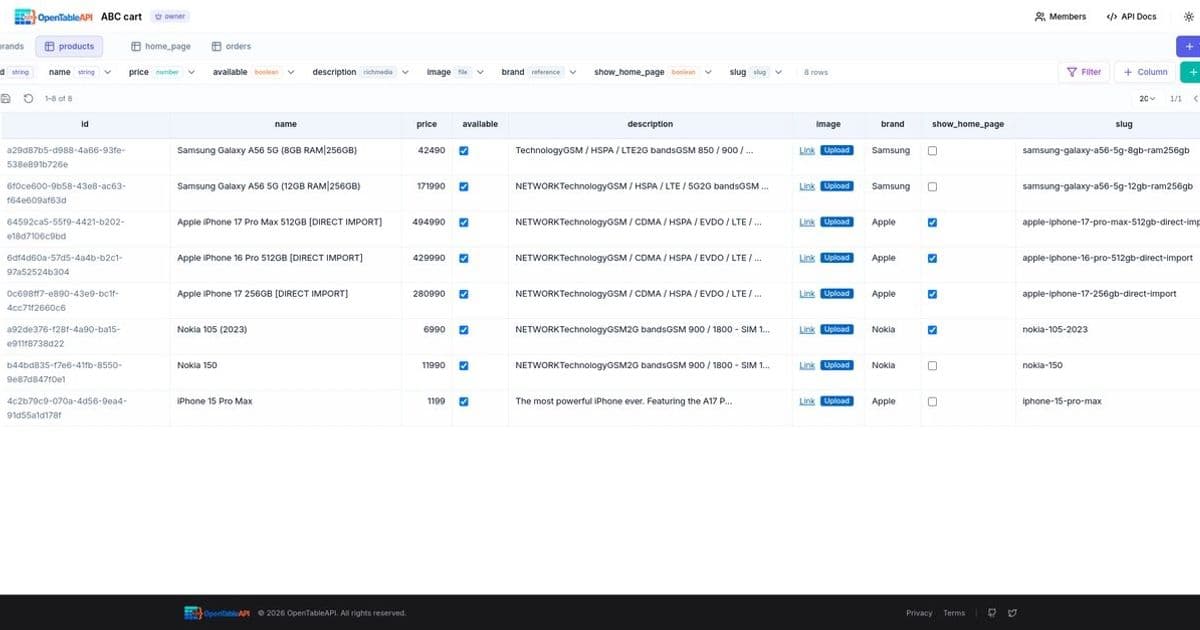
OpenTableAPI offers an intriguing approach to eliminating traditional backend infrastructure by turning table data directly into APIs. This platform promises faster development cycles but introduces important trade-offs in control, performance, and scalability that teams must carefully consider.
In the complex landscape of modern application development, teams constantly grapple with the trade-offs between building custom backend infrastructure and using third-party services. OpenTableAPI presents itself as a compelling solution by eliminating the traditional backend stack entirely, allowing developers to create APIs directly from table data through a managed platform.

The Traditional Backend Burden
Building and maintaining backend systems has always been a source of friction in application development. Teams face the perpetual challenge of:
- Designing database schemas that evolve with application requirements
- Implementing secure authentication and authorization mechanisms
- Building and documenting RESTful APIs with proper error handling
- Managing server infrastructure, scaling, and uptime
- Ensuring data consistency and handling concurrency issues
- Implementing proper logging, monitoring, and alerting
These responsibilities create significant overhead, especially for teams focused primarily on building user-facing features or internal tools. The cognitive load required to maintain a robust backend often distracts from core product development.
OpenTableAPI's Approach
OpenTableAPI addresses this complexity by providing a unified platform that combines a content management system with automatically generated APIs. The core value proposition lies in its ability to transform structured table data into immediately accessible REST endpoints without requiring custom backend development.
The architecture simplifies the traditional three-tier application stack:
Traditional approach: Frontend → Backend Application → Database
OpenTableAPI approach: Frontend / Backend App → OpenTableAPI
This reduction in components offers immediate benefits:
- Faster development cycles from concept to API
- Elimination of server management overhead
- Built-in API documentation and testing capabilities
- Simplified data access patterns
Technical Implementation Details
Under the hood, OpenTableAPI implements several interesting patterns that merit examination:
API Generation Model
Each table in the system automatically becomes a REST resource with standardized endpoints. For a table named products, the system would generate endpoints like:
GET /api/products- Retrieve all productsGET /api/products/{id}- Retrieve a specific productPOST /api/products- Create a new productPUT /api/products/{id}- Update an existing productDELETE /api/products/{id}- Delete a product
This approach follows REST principles consistently across all tables, reducing the learning curve for developers integrating with the system.
Authentication and Authorization
The platform implements API key-based authentication with granular permission controls. Each request must include an X-API-Key header, and permissions can be scoped to:
- Specific tables
- Endpoint types (GET, POST, PUT, DELETE)
This permission model enables fine-grained access control, allowing teams to implement the principle of least privilege effectively. For example, a frontend application might only have read access to certain tables, while an administrative tool could have full CRUD permissions.
Data Consistency Model
OpenTableAPI operates with eventual consistency by default, which is a common pattern in distributed systems. When records are created or updated, changes propagate asynchronously across the system. This approach favors availability and partition tolerance over strong consistency, aligning with the CAP theorem's trade-offs.
For applications requiring stronger consistency guarantees, developers must implement client-side validation or compensate for potential inconsistencies in their application logic.
Trade-offs and Considerations
While OpenTableAPI offers compelling benefits, teams must carefully consider several important trade-offs:
Control vs. Convenience
The platform abstracts away database management, which reduces operational overhead but also limits control over:
- Database optimization strategies
- Custom indexing approaches
- Complex transaction handling
- Data migration strategies
Teams with specialized data requirements or performance needs may find these limitations restrictive.
Scalability Implications
OpenTableAPI handles scaling transparently, but this comes with potential performance characteristics:
- Latency may increase as the platform scales shared resources
- Complex queries might not benefit from application-specific optimizations
- Data transfer costs could become significant at scale
For applications with extreme performance requirements or specialized data access patterns, a custom solution might ultimately prove more efficient.
Vendor Lock-in
Adopting OpenTableAPI creates dependency on the platform for data access and business logic. Teams should consider:
- Data export capabilities
- API versioning strategy
- Long-term roadmap alignment
- Exit strategy if requirements change
This vendor lock-in risk is particularly relevant for applications storing core business data.
Cost Structure
While eliminating infrastructure management reduces operational overhead, the platform's pricing model may become expensive at scale:
- Costs typically scale with API calls and data storage
- Complex applications might require multiple projects/environments
- Premium features may be necessary for advanced use cases
Teams should model total cost of ownership, especially as usage grows beyond initial prototypes.
Best Practices for Implementation
Teams adopting OpenTableAPI should implement several best practices to maximize success:
Environment Isolation
Create separate projects for development, staging, and production environments. This prevents:
- Development changes affecting production data
- Configuration drift between environments
- Testing with real production data
API Key Management
Implement strict API key hygiene:
- Use separate keys for different applications and services
- Follow least-privilege principles when assigning permissions
- Implement regular key rotation procedures
- Monitor API usage for anomalies
Data Modeling Strategy
Careful table design becomes critical:
- Normalize data appropriately for access patterns
- Consider relationships between tables
- Plan for future schema evolution
- Implement proper data validation rules
Error Handling and Resilience
Build applications that gracefully handle:
- API rate limiting
- Temporary service unavailability
- Data consistency issues
- Authentication failures
Use Case Analysis
OpenTableAPI excels in several specific scenarios:
Internal Tools and Dashboards
For applications primarily used within an organization, the platform provides rapid development of data access interfaces without backend complexity.
Prototyping and MVP Development
The platform enables teams to build functional prototypes quickly, allowing for faster validation of ideas before committing to custom infrastructure.
Data Integration Layers
As a lightweight integration layer between systems, OpenTableAPI can serve as a middle ground between direct database access and complex enterprise service buses.
SaaS Applications with Simple Data Models
For SaaS products with straightforward data requirements and limited customization needs, the platform can significantly reduce development time.
Conclusion
OpenTableAPI represents an interesting evolution in backend development paradigms, offering a compelling alternative to traditional infrastructure for certain use cases. By abstracting away database and server management, it enables teams to focus on application logic rather than operational concerns.
However, the platform's approach introduces important trade-offs in control, performance, and vendor dependence. Teams should carefully evaluate their specific requirements, data complexity, and long-term roadmap before adopting this approach.
For applications with straightforward data requirements, rapid development needs, or limited operational resources, OpenTableAPI offers a pragmatic solution that accelerates time-to-value. For systems requiring specialized performance characteristics, complex data relationships, or maximum control, a custom backend implementation may remain the more appropriate choice.
Ultimately, the decision to adopt such a platform should be based on a thorough analysis of the specific problem domain, team expertise, and long-term product strategy—not just the immediate convenience of reduced infrastructure management.

Did you know 96% of developers don't fully trust that AI-generated code is functionally correct, yet only 48% always check it before committing? Check out Sonar's new report on the real-world impact of AI on development teams.
Comments
Please log in or register to join the discussion