Allen Pike's article explores a fascinating performance mystery where a single heart emoji caused a 100x slowdown in Safari, revealing unexpected interactions between font technologies and browser rendering engines.
Allen Pike's article "A Broken Heart" presents a compelling case study in web performance debugging that begins with a deceptively simple problem: a dashboard that suddenly slowed from loading in one second to taking ten seconds. The narrative unfolds like a detective story, with the author initially suspecting React-related issues—a common assumption in modern web development—before discovering that the true culprit was something far more unexpected: a heart emoji rendered using the Noto Color Emoji font.
The article demonstrates the increasingly complex nature of web performance debugging in an ecosystem where multiple layers of technology interact in unpredictable ways. The author's initial approach—using Claude, an AI coding assistant, to identify React performance issues—reflects a modern debugging methodology that leverages AI to accelerate problem identification. When this approach yielded minimal improvements, it highlighted an important truth: not all performance problems originate in the framework we expect them to, and sometimes the most obvious culprits are red herrings.
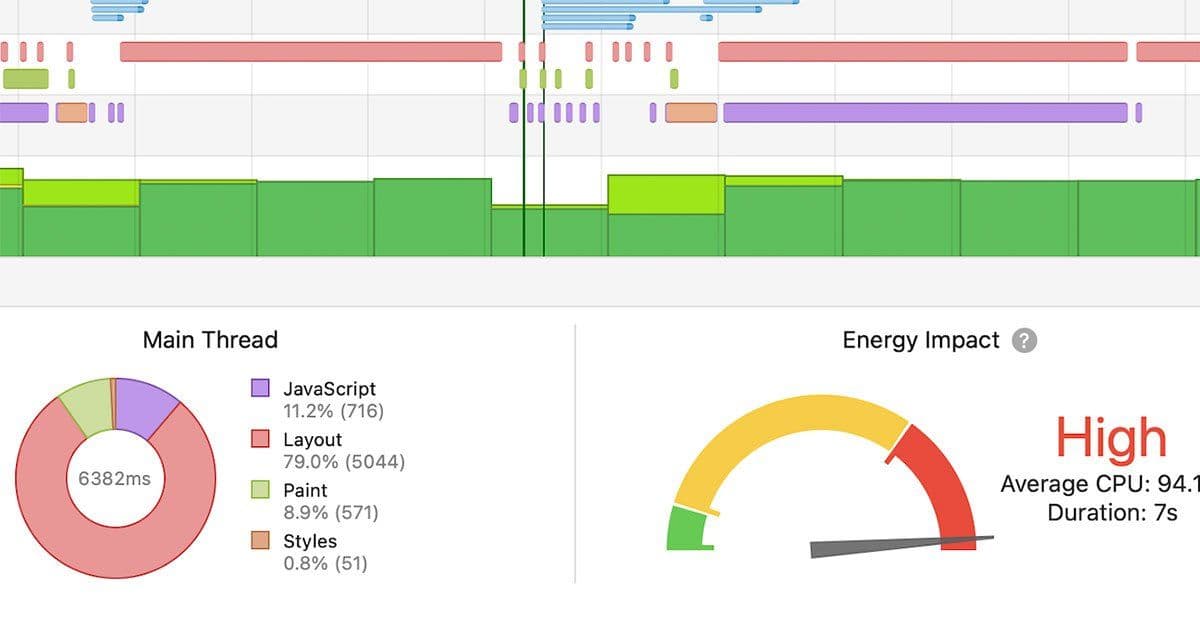
The investigation process itself is instructive. The author systematically eliminated potential causes—server performance, cross-browser issues, third-party scripts—before focusing on Safari's performance inspector, which revealed that 94% of CPU time was being consumed by "Layout" operations. This precision in diagnostic tools represents the sophistication of modern browser development environments, allowing developers to pinpoint performance bottlenecks with granular detail.
The eventual discovery—that removing a heart emoji from a "Send Feedback" button restored performance from 1600ms to 2ms—reveals a fascinating intersection of typography and rendering technologies. The root cause lies in Noto Color Emoji, a Google font that uses the COLRv1 specification for colored glyphs. While this specification promises smaller file sizes and better performance across platforms, Safari appears to handle it poorly, falling back to SVG rendering that causes extreme performance degradation for certain characters.
This finding has several important implications for web developers. First, it demonstrates that seemingly innocuous design choices—like adding an emoji to a button—can have dramatic performance consequences on specific platforms. Second, it highlights the importance of font selection and ordering in CSS, particularly when targeting multiple platforms. The author's recommendation to prioritize "Apple Color Emoji" on Apple platforms until the Safari bug is fixed provides a practical workaround.
The article also offers thoughtful reflections on the role of AI in software development. The author credits Claude with dramatically accelerating the debugging process, noting that it would have taken "10x longer" without the AI assistant. This acknowledgment of AI's utility while maintaining a healthy skepticism about its potential pitfalls—comparing it to a "power saw" that is both profoundly useful and proportionately dangerous—reflects a balanced perspective on these emerging tools.
Interestingly, the author reveals a meta-layer to the story: Claude had actually recommended the Noto Color Emoji font in the first place to solve a Linux emoji rendering issue. This self-referential aspect adds depth to the narrative, suggesting that AI tools can sometimes contribute to the problems they help solve—a recursive pattern that becomes increasingly common as we integrate these systems more deeply into our development workflows.
The article concludes with an important contribution to the collective knowledge base: documenting this specific Safari performance issue to help other developers avoid similar pitfalls. The minimal reproduction case—a simple HTML file loading Noto Color Emoji and displaying a heart emoji—serves as a valuable example of how concise, focused bug reports can help browser manufacturers identify and fix issues more efficiently.
From a broader perspective, this case study illustrates several important truths about modern web development. The web platform's complexity has grown to the point where seemingly simple changes can have unexpected consequences across different browsers and devices. The interaction between font specifications, browser rendering engines, and CSS font fallback rules creates a landscape where performance characteristics can vary dramatically based on factors developers might not immediately consider.
The article also highlights the evolving nature of debugging practices. As AI tools become more integrated into development workflows, the process of identifying and resolving issues is changing. These tools can help developers navigate complexity more quickly, but they also introduce new considerations about understanding root causes versus accepting surface-level solutions.
For web developers, this story serves as a reminder that performance optimization requires a holistic approach, considering not just JavaScript execution and network requests, but also rendering behavior across different browsers. The humble emoji, often treated as a simple decorative element, can become a performance bottleneck when font rendering technologies interact unexpectedly with browser implementations.
As web technologies continue to evolve, with new font formats, rendering techniques, and browser optimizations emerging regularly, developers must remain vigilant about these kinds of edge cases. The story of the broken heart emoji is a perfect example of how the most unexpected elements can sometimes be the source of our most challenging performance mysteries.
Comments
Please log in or register to join the discussion