
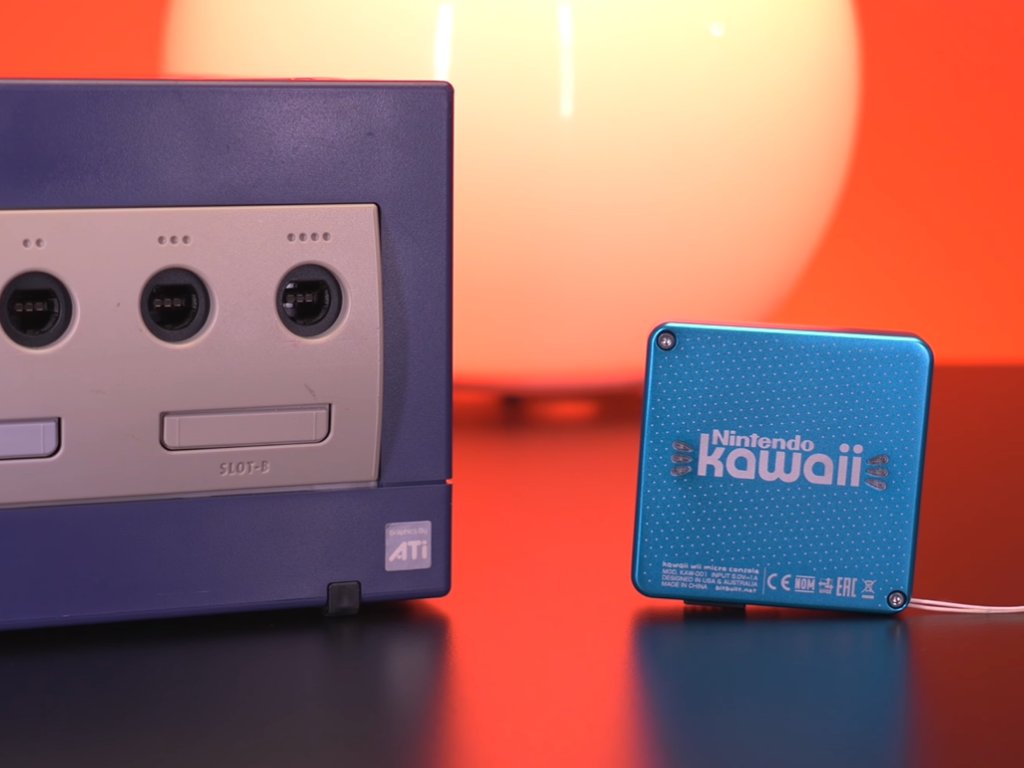
A team of modders has created what might be the smallest Nintendo GameCube ever made - a keychain-sized Wii called "Kawaii" that runs actual GameCube hardware without emulation.
What's new:
The Kawaii is a remarkable feat of miniaturization that takes a full Nintendo Wii motherboard and shrinks it down to just 60 x 60 x 16 mm. Created by modders YveltalGriffin and WeskMods, this tiny console runs GameCube games using actual Nintendo hardware rather than emulation or Raspberry Pi solutions. The device features a blue anodized aluminum unibody finish with laser-etched artwork and RGB acrylic windows, complete with a keychain loop for portability. Under the hood, it uses an undervolted Omega-trim Wii motherboard with Thundervolt hardware and a breakout PCB for SD card or USB support. A 12-pin magnetic pogo-pin connector handles power, video output, and controller signals, functioning like "MagSafe for retro hardware."
How it compares:
Unlike previous portable retro gaming solutions that rely on emulation or Raspberry Pi boards, the Kawaii runs authentic Nintendo hardware. This means perfect compatibility with GameCube games without the performance compromises or input lag that emulation can introduce. The device connects to an add-on dock that provides four full-size GameCube controller ports along with composite and component video output and stereo audio. While the original Wii motherboard has been significantly trimmed down, it maintains the ability to play GameCube titles natively, something no other keychain-sized console can claim. The cooling solution is purely passive, using the aluminum shell as a heatsink, which means the device runs hot during extended play sessions but doesn't require any fans.
Who it's for:
The Kawaii is clearly not for casual gamers or those new to console modding. As YveltalGriffin noted, "Kawaii will be a challenging build, and there won't be a full kit you can buy or even a step-by-step assembly guide." This project is aimed at experienced retro gaming enthusiasts and hardware modders who appreciate extreme miniaturization and technical challenges. The device serves as a testament to what's possible with dedicated hardware modification skills and appeals to collectors who want unique conversation pieces that actually function. For those who have been following the portable retro gaming scene, the Kawaii represents a new frontier in miniaturization that pushes the boundaries of what's possible with classic Nintendo hardware.
Technical specifications:
- Dimensions: 60 x 60 x 16 mm
- Motherboard: Undervolted Omega-trim Wii with Thundervolt hardware
- Connectivity: 12-pin magnetic pogo-pin connector for power, video, and controller signals
- Video output: Composite and component via add-on dock
- Audio output: Stereo via add-on dock
- Controller support: Four GameCube controller ports via add-on dock
- Cooling: Passive (aluminum shell heatsink)
- Special features: RGB acrylic windows, laser-etched artwork, keychain loop
Performance considerations:
During testing, the Kawaii ran games like Mario Kart: Double Dash and Crazy Taxi smoothly, but the device gets quite hot during gameplay. Tito noted that without external cooling, the console would shut down after about 20 minutes as a safety precaution. With an external fan blowing on it, the device could run for over half an hour. This thermal limitation means the Kawaii is better suited for shorter gaming sessions rather than marathon play sessions unless additional cooling solutions are implemented.
The future of portable retro gaming:
The Kawaii project demonstrates that there are still new frontiers to explore in portable retro gaming, even as the market becomes increasingly saturated with emulation-based solutions. For purists who demand authentic hardware performance, projects like this show that it's still possible to create truly portable versions of classic consoles without compromising on compatibility or performance. As miniaturization techniques continue to advance, we may see even more ambitious projects that shrink classic gaming hardware into increasingly smaller packages.
The modding community has always been at the forefront of hardware innovation, and projects like the Kawaii highlight the incredible talent and dedication within this community. While the Kawaii may not be a practical gaming solution for most people, it serves as an inspiration and a benchmark for what's possible when skilled modders push the boundaries of hardware modification.
For more information about the Kawaii project, you can check out the hands-on video by Macho Nacho Productions and discussions on the BitBuilt Forums.
Comments
Please log in or register to join the discussion