
Micron has expanded its 6600 ION NVMe SSD family with a groundbreaking 245.76TB capacity point, leveraging G9 QLC NAND technology to deliver unprecedented storage density for AI data lakes, hyperscale environments, and analytics workloads.
Technical Announcement
Micron has announced a significant expansion to its 6600 ION NVMe SSD family, introducing a 245.76TB capacity point that pushes the boundaries of data center storage density. This new offering represents a substantial leap forward in enterprise storage capabilities, utilizing Micron's ninth-generation quad-level cell (QLC) NAND technology to deliver nearly a quarter petabyte of storage capacity in a single solid-state drive.
The 6600 ION family, which already included the 122.88TB E3.S model, now extends its capacity reach to 245.76TB through larger E3.L and U.2 form factors. This development addresses the growing demand for ultra-high-density storage solutions in modern data centers, particularly for AI training, large-scale analytics, and hyperscale object storage applications where maximizing capacity per rack unit and minimizing watts per terabyte are critical design considerations.
Specifications
The Micron 6600 ION 245TB SSD is built on Micron's G9 QLC NAND technology, which represents the company's latest advancement in multi-level cell flash memory. The drive delivers impressive performance characteristics while maintaining a power envelope suitable for data center deployments:
- Capacity: 245.76TB (raw capacity may vary slightly)
- Form Factors: E3.L (Enterprise & Datacenter Storage Form Factor Large) and U.2
- Interface: PCIe Gen5 NVMe
- Sequential Read: Up to 13.7GB/s
- Sequential Write: Up to 3.0GB/s
- Random Read IOPS: Up to 1.78 million
- Power Consumption: Maximum 30W
- NAND Technology: Micron G9 QLC
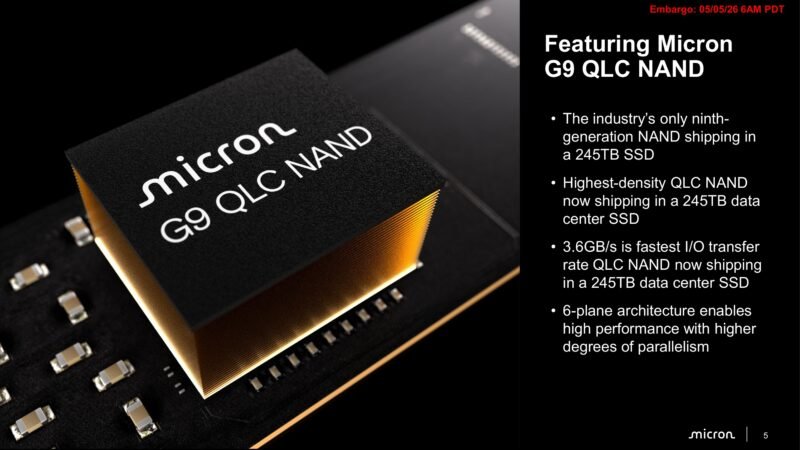 Micron 6600 ION featuring G9 QLC NAND
Micron's public product page highlights the density advantages of these drives, with the E3.S 122TB version capable of storing over 2.4PB per 1U, while the E3.L 245TB version can reach over 3.9PB per 1U. When scaled to a full 36U rack configuration, the company claims the 245.76TB E3.L SSDs can enable deployments of up to 176.9PB in a single rack.
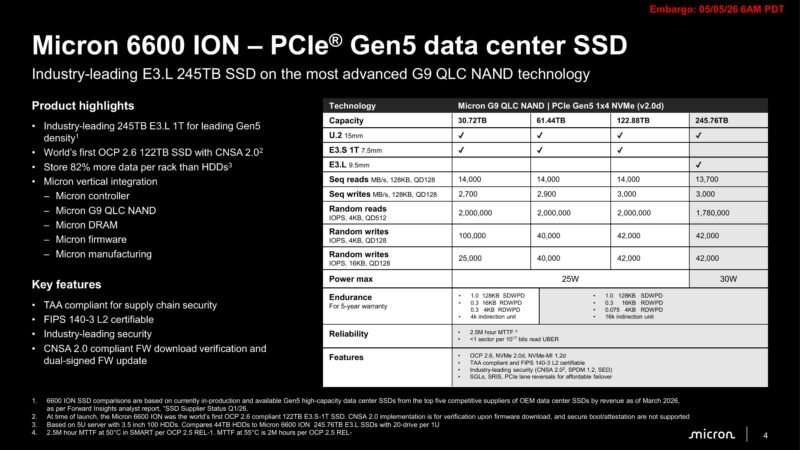 Micron 6600 ION PCIe Gen5 data center SSD specifications
Real-World Implications
The introduction of the 245TB 6600 ION SSD represents more than just a capacity increase—it signifies a fundamental shift in how data center architects approach storage density. The key differentiator lies in the EDSFF (Enterprise & Datacenter Storage Form Factor) implementation, which enables much denser storage shelves compared to traditional 2.5-inch form factors.
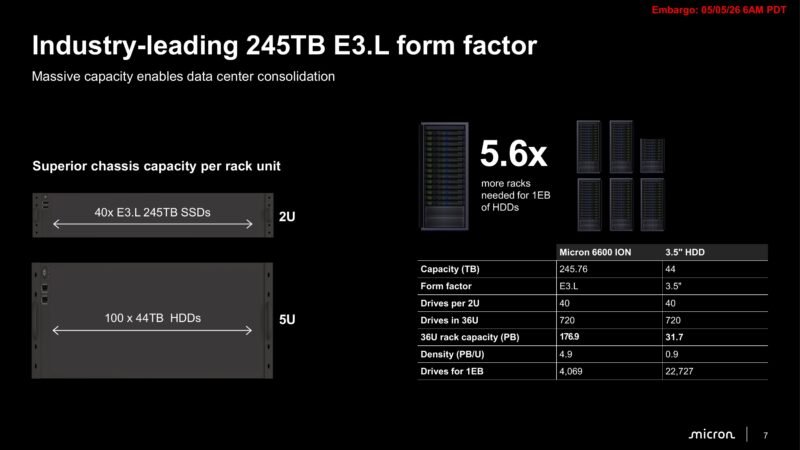 Micron 6600 ION E3.L rack density comparison
Micron's briefing materials present a compelling comparison: a 1 exabyte (EB) deployment using 245.76TB E3.L SSDs versus traditional 44TB hard drives shows a 5.6x reduction in rack space requirements based on the company's 36U storage allocation assumptions. This density translates to fewer chassis, fewer racks, and reduced supporting infrastructure—including power supplies, cooling systems, and cabling—for the same dataset.
The drive is particularly well-suited for several emerging data center workloads:
AI Data Lakes: The massive capacity enables storage of enormous training datasets while maintaining the performance required for data access during model training.
Hyperscale Object Storage: For cloud providers and large enterprises building object storage repositories, the high capacity per drive reduces the number of nodes required.
Analytics Clusters: Big data analytics environments benefit from the combination of high capacity and sufficient random read performance for query processing.
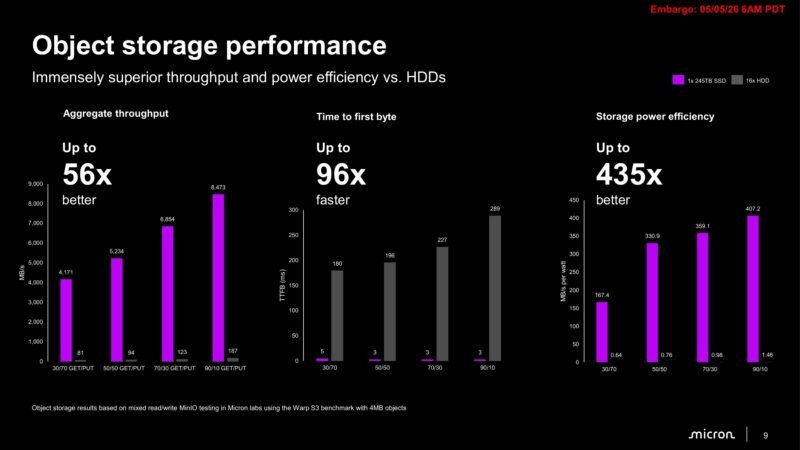 Micron 6600 ION object storage performance comparison
Micron is strategically positioning this drive around AI and object storage applications, which are becoming increasingly prevalent in modern data center architectures. The 6600 ION family represents a departure from peak transactional performance optimization, instead focusing on the metrics that matter most for capacity-optimized workloads: terabytes per rack unit and watts per terabyte.
The jump from previous-generation ION SSD capacities (such as the 61.44TB 6550 ION and 30.72TB 6500 ION) to 245TB underscores the rapid evolution of QLC technology and EDSFF form factors in transforming the dense storage landscape. This progression highlights how quickly these technologies are changing the economics and physical footprint of enterprise storage.
Deployment Considerations
While the density advantages are significant, organizations should carefully consider several factors when evaluating the 6600 ION 245TB for deployment:
Cost Structure: The price per terabyte for QLC-based drives typically remains higher than HDDs, though the total cost of ownership may be favorable when considering reduced rack space, power, and cooling requirements.
Workload Suitability: QLC technology offers good performance for read-intensive and sequential workloads but may not be ideal for highly random, write-intensive applications that would benefit more from SLC or TLC-based SSDs.
Endurance Considerations: QLC NAND generally has lower endurance compared to SLC or TLC, requiring careful workload placement and potentially more aggressive data protection strategies.
Refresh Cycles: With such high capacities, data migration during drive refreshes becomes more complex and time-consuming, requiring careful planning.
Power Density: While the drive operates at 30W, the concentration of this power in a small form factor requires adequate cooling planning in dense rack deployments.
For organizations building next-generation AI infrastructure or hyperscale storage systems, the Micron 6600 ION 245TB represents a compelling option for maximizing storage density while maintaining acceptable performance characteristics. The drive's ability to dramatically reduce physical footprint while providing the capacity needed for modern data-intensive workloads makes it a significant addition to the enterprise storage landscape.
Official Micron 6600 ION Product Page Micron G9 QLC Technology Overview EDSFF Specification Information
Comments
Please log in or register to join the discussion