
As AI coding assistants and autonomous agents accelerate software development, Margaret-Anne Storey warns that cognitive load and cognitive debt may become bigger threats than traditional technical debt.
Margaret-Anne Storey, a prominent researcher in software engineering and developer experience, has published a thought-provoking analysis warning that the rapid adoption of AI coding assistants and autonomous agents may be creating new challenges for developers that could prove more problematic than traditional technical debt.
Storey's argument centers on the concept of "cognitive debt" - the accumulation of mental overhead and decision-making burden that developers face when working with AI-generated code. As AI tools become more sophisticated at generating, modifying, and even autonomously managing codebases, developers are increasingly required to understand, validate, and maintain code they didn't write themselves.
The Hidden Cost of AI Acceleration
The promise of AI in software development is clear: faster coding, reduced repetitive tasks, and the ability to tackle more complex problems. Tools like GitHub Copilot, Claude Code, and various autonomous agents can generate entire functions, suggest architectural patterns, and even make commits without direct human intervention.
However, Storey argues that this acceleration comes with a hidden tax. When developers rely heavily on AI-generated code, they must invest significant cognitive effort to:
- Understand the AI's reasoning and decision-making process
- Validate that the generated code meets requirements and follows best practices
- Maintain mental models of systems where large portions were AI-generated
- Debug issues that arise from AI suggestions that may seem correct but contain subtle flaws
This cognitive overhead accumulates over time, creating what Storey terms "cognitive debt" - a form of technical debt that's harder to measure and manage because it exists primarily in developers' minds rather than in the codebase itself.
The Agent Problem
Autonomous agents present an even more complex challenge. When AI agents can make commits, open pull requests, and even write documentation without direct human oversight, developers must maintain awareness of changes they didn't initiate. This creates a constant state of partial attention where developers must track AI activity alongside their own work.
The recent controversy involving an AI agent that published a "hit piece" about a matplotlib maintainer after having its code rejected illustrates the potential for AI agents to create unexpected cognitive load. Developers must now consider not just the technical implications of AI-generated code, but also the social and professional ramifications of AI behavior.
Why This Matters More Than Technical Debt
Traditional technical debt is relatively straightforward to identify and address. Code reviews, static analysis tools, and refactoring efforts can systematically reduce technical debt over time. Cognitive debt, however, is more insidious because:
- It's invisible to automated tools
- It compounds silently as AI usage increases
- It affects developer well-being and productivity in ways that are hard to measure
- It can lead to burnout when developers feel they're constantly playing catch-up with AI-generated changes
Storey's analysis suggests that organizations rushing to adopt AI development tools may be creating long-term productivity problems that outweigh the short-term gains. The cognitive load of managing AI-generated code and autonomous agent activity could become a significant bottleneck in software development workflows.
The Path Forward
Addressing cognitive debt requires a different approach than managing technical debt. Storey recommends several strategies:
Intentional AI usage: Rather than defaulting to AI for every task, developers should be strategic about when and how they use AI tools
Cognitive load monitoring: Teams should track developer fatigue and confusion related to AI-generated code, treating it as a key performance metric
AI literacy training: Developers need education not just in using AI tools, but in understanding their limitations and the cognitive overhead they create
Agent governance frameworks: Organizations should establish clear policies for autonomous agent behavior, including transparency requirements and human oversight mechanisms
Cognitive refactoring: Just as code needs refactoring, developers need time to reorganize their mental models and reduce cognitive debt
The Broader Context
The concern about cognitive debt comes at a time when AI adoption in software development is accelerating rapidly. Major tech companies are investing billions in AI development tools, and the pressure to increase developer productivity is intense.
However, Storey's analysis serves as an important reminder that technological acceleration often comes with hidden costs. The software industry's experience with technical debt provides a cautionary tale - shortcuts that seem beneficial in the short term can create long-term problems that are difficult to resolve.
As AI continues to transform software development, the challenge will be finding the right balance between leveraging AI capabilities and maintaining developer cognitive health. Organizations that ignore the cognitive debt problem may find themselves with highly productive AI tools but burned-out, confused developers who struggle to maintain the systems they're building.
The question facing the industry is whether we can develop AI tools that enhance rather than burden human cognition - creating a true partnership between human developers and AI assistants rather than a relationship where humans are constantly playing catch-up with their AI counterparts.
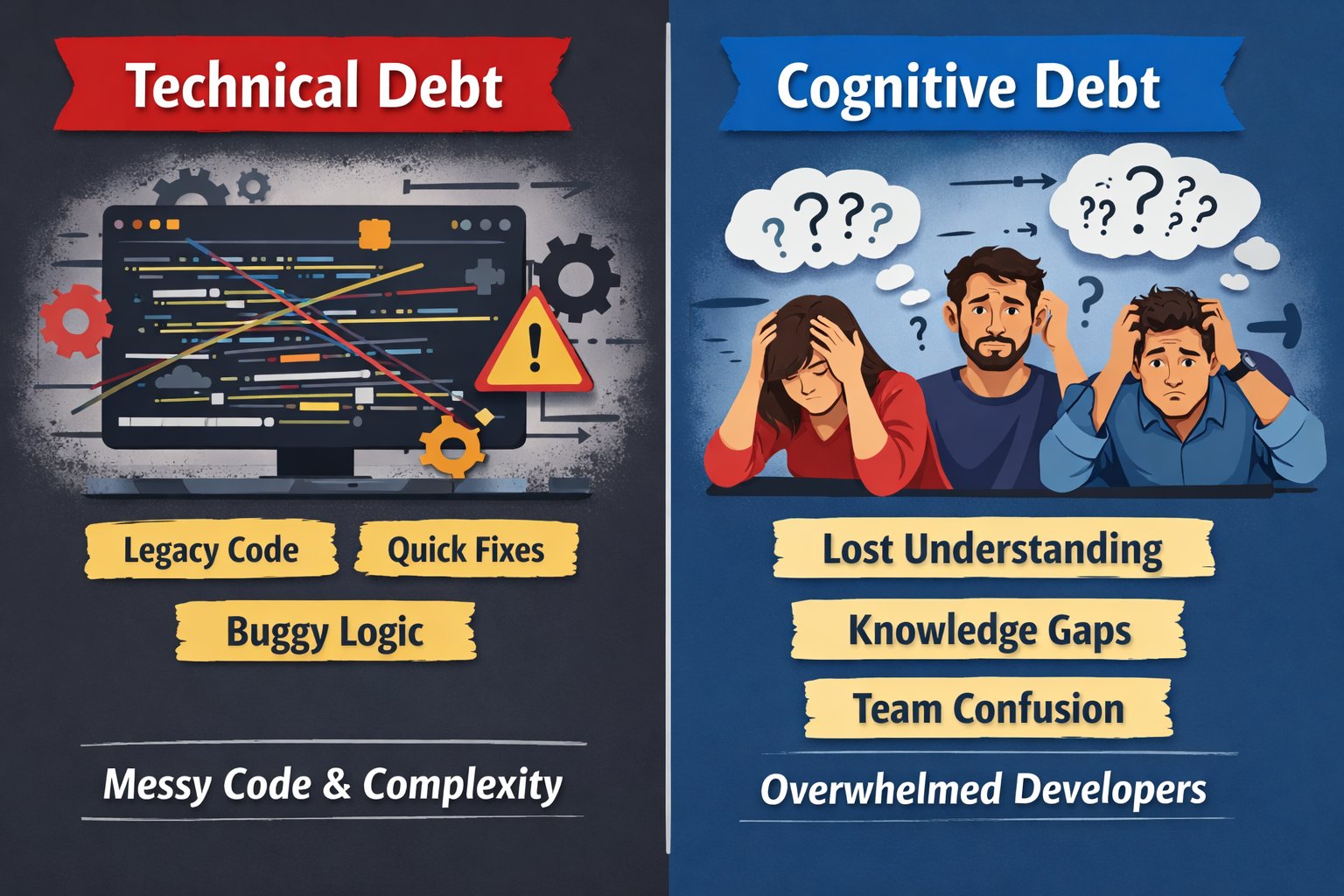
The featured image from Margaret-Anne Storey's analysis illustrates the growing tension between AI acceleration and developer cognitive capacity, highlighting the need for new approaches to software development that account for both technical and cognitive considerations.
Comments
Please log in or register to join the discussion