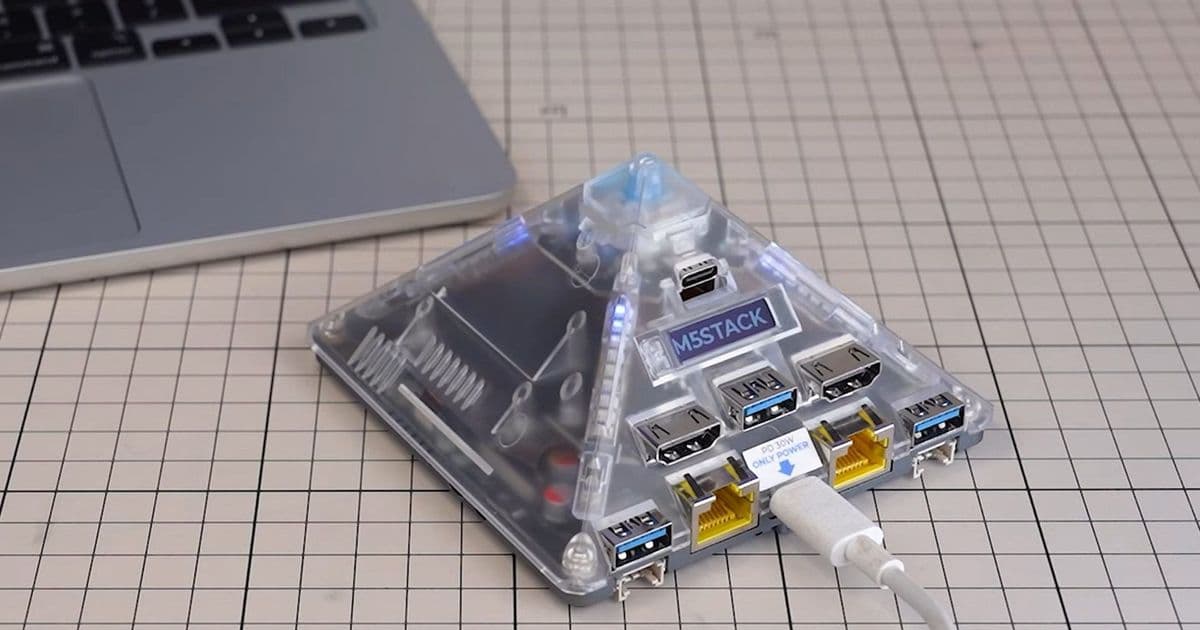
M5Stack's AI Pyramid Computing Box combines striking design with edge-AI capabilities, featuring an Axera AX8850 SoC, 24 TOPS NPU, and translucent RGB-infused enclosure for local AI deployments.
M5Stack has unveiled the AI Pyramid Computing Box, a striking edge-AI appliance that blends eye-catching design with serious computational capabilities. The device's translucent, RGB-infused tetrahedral shell houses an Axera AX8850 system-on-chip designed specifically for local AI and edge computing deployments rather than traditional desktop computing tasks.
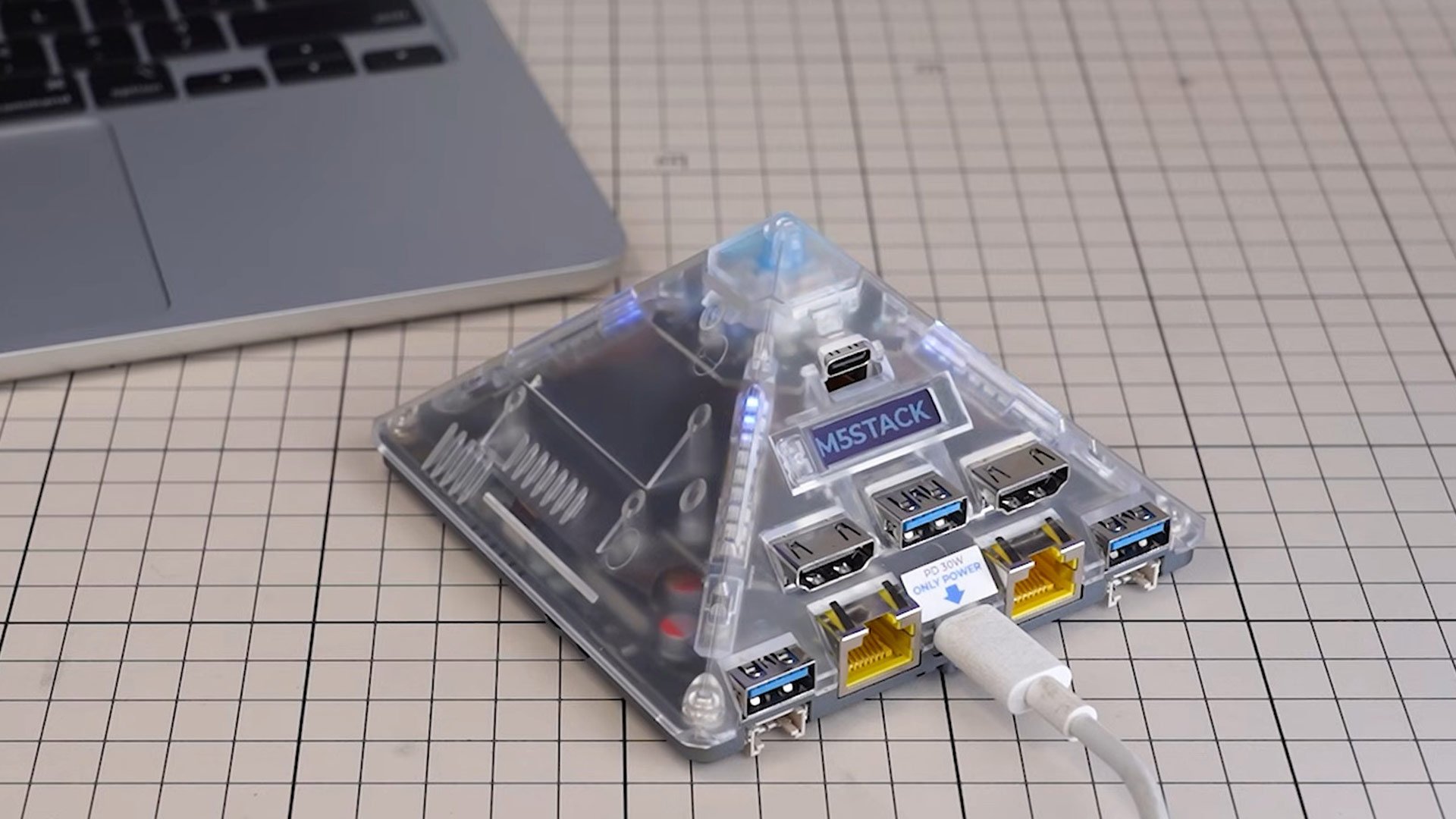
At its core, the AI Pyramid features an octa-core Arm Cortex-A55 processor running at 1.7 GHz, paired with a 24 TOPS INT8 neural processing unit. This NPU delivers substantial AI inference performance while maintaining the power efficiency required for edge deployments. The SoC also includes hardware H.264/H.265 encode/decode engines capable of handling 8K video streams, making it suitable for vision-based AI applications.
Memory Architecture and Performance Considerations
The memory configuration reveals the device's true purpose. The base 4GB model splits its LPDDR4x-4266 memory evenly, with 2GB allocated to the system and 2GB reserved exclusively for the NPU and video engines. The Pro model doubles this to 8GB total, maintaining the 4GB/4GB split. This architecture, while limiting for general-purpose computing, optimizes the device for AI workloads where dedicated memory for neural network processing is crucial.
Target Deployments and Use Cases
M5Stack positions the AI Pyramid for several specific edge-AI scenarios:
- AI PC and Edge Intelligent Terminals
- Smart Interactive Devices including Home Assistant implementations
- AI-Generated Content (AIGC) applications
- Voice cloning and meeting transcription systems
- AI Vision Gateways
- Local AI Smart Photo Album solutions using Immich
- AI-Powered Intelligent Security systems with Frigate
These use cases emphasize the device's role as an edge appliance rather than a general-purpose computer. The dedicated NPU and video processing capabilities make it particularly suited for vision-based AI applications and real-time inference tasks.
Connectivity and I/O Capabilities
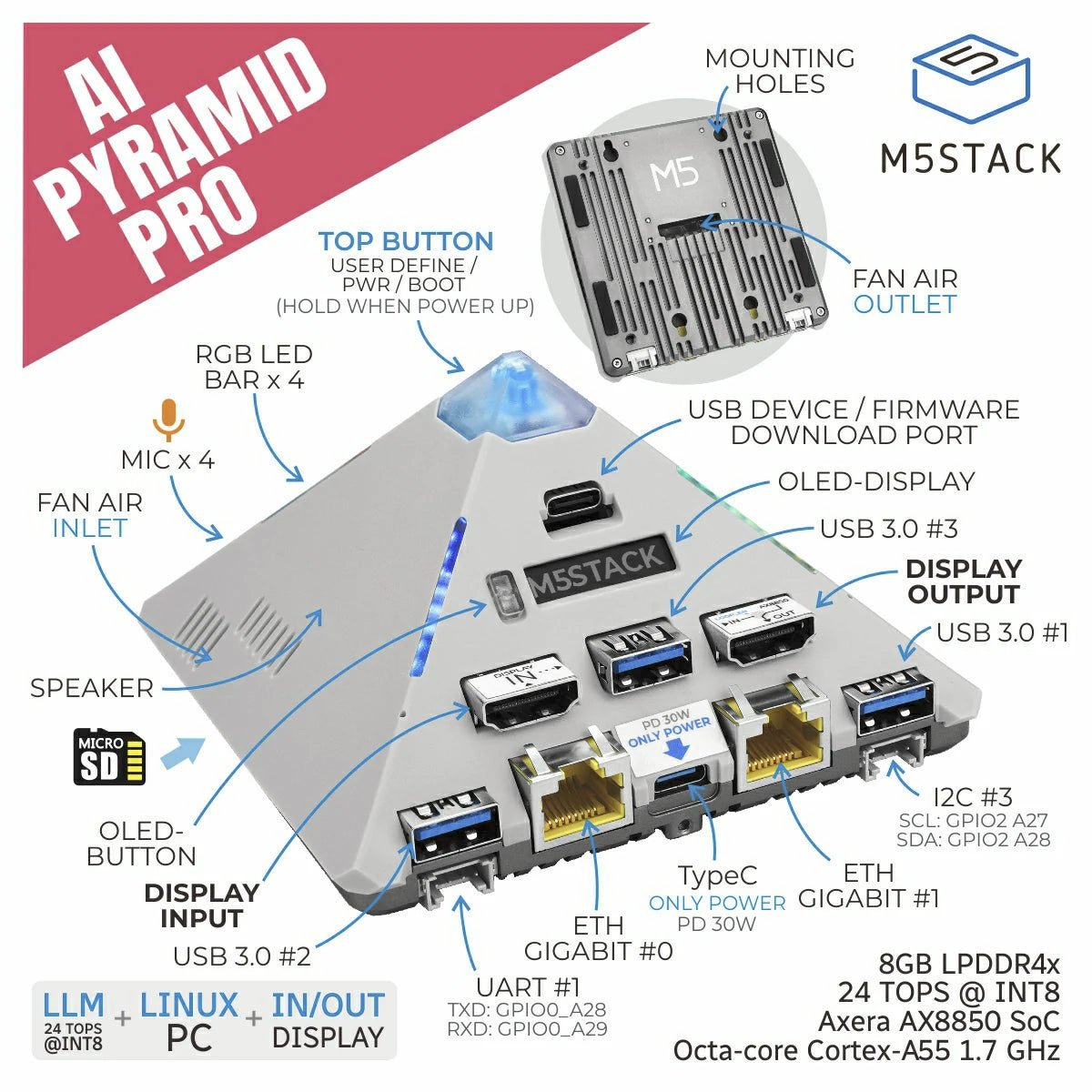
The AI Pyramid offers robust connectivity options for its size:
- Dual Gigabit Ethernet ports for network redundancy
- Wi-Fi and Bluetooth support via optional modules
- 2× HDMI 2.0 outputs supporting 4K60 resolution
- 4× USB-A 3.0 ports (including one internal)
- 2× USB-C ports (one host, one power delivery input)
- HY2.0-4P expansion ports for GPIO and I²C connectivity
- 3.5mm headphone jack
- 4-microphone array with ES7210 codec
- Built-in speaker with ES8311 audio codec
Power and Thermal Management
Power delivery comes through USB-C PD with a 9V/3A (27W) requirement. The device employs active cooling through a single thermal-sensing fan, ensuring stable performance during extended AI workloads. The compact dimensions of 144.5 × 105 × 62mm and weight of 195g make it highly portable while maintaining adequate thermal headroom.
Software and AI Framework Support
The AI Pyramid runs Axera Linux as its official operating system, with support for multiple AI frameworks including AXCL, Whisper, CLIP, Llama 3.2, Qwen 3, and InternVL3. This software stack enables developers to deploy various AI models locally without relying on cloud services, addressing privacy and latency concerns common in edge deployments.
Design and User Experience
The device's most striking feature is its translucent pyramid enclosure illuminated by 48 RGB LEDs arranged in four segments. A 32×128 pixel OLED status display provides system information, while two user-configurable buttons offer physical control options. The combination of these elements creates an aesthetically pleasing device that doubles as a conversation piece.
Market Position and Pricing
Priced at $199 for the 4GB model and $249 for the 8GB Pro version, the AI Pyramid targets developers and enthusiasts interested in edge AI experimentation. The aggressive pricing strategy appears to have resonated with the market, as initial stock sold out quickly. However, potential buyers should note that these prices may not hold if supply chain constraints emerge.
Technical Limitations for General Computing
Despite its attractive design and capable AI performance, the AI Pyramid has significant limitations as a general-purpose computer. The memory split architecture, while optimal for AI workloads, restricts the available system RAM to just 2GB or 4GB depending on the model. This limitation, combined with the Arm Cortex-A55 cores rather than more powerful x86 processors, makes it unsuitable for demanding desktop applications or gaming.
Comparison to Traditional Mini-PCs
Traditional mini-PCs in similar price ranges typically offer more flexible memory configurations, x86 processors with broader software compatibility, and better performance for general computing tasks. The AI Pyramid's specialization comes at the cost of versatility, making it a niche device for specific AI and edge computing applications rather than a replacement for conventional desktop systems.
Future Implications for Edge AI Hardware
The AI Pyramid represents a growing trend toward specialized edge AI hardware that balances performance, power efficiency, and cost. As AI models become more sophisticated and edge deployment becomes increasingly important for privacy and latency reasons, devices like the AI Pyramid may become more common in both commercial and enthusiast markets.
Availability and Market Response
The rapid sell-out of initial stock suggests strong market interest in affordable, capable edge AI hardware. M5Stack's established reputation in the IoT and development board space likely contributed to this positive reception. The company's challenge will be maintaining supply to meet demand while preserving the attractive price point that makes the device accessible to hobbyists and developers.
Conclusion
The M5Stack AI Pyramid Computing Box successfully delivers on its promise as an edge AI appliance with compelling design and capable performance. While it falls short as a general-purpose computer due to its memory architecture and processor choice, it excels in its intended role for local AI deployments. The combination of attractive pricing, striking design, and solid AI performance makes it an intriguing option for developers and enthusiasts exploring edge AI applications.
For those specifically interested in edge AI development, vision-based AI applications, or local AI model deployment, the AI Pyramid offers a compelling package. However, users seeking a versatile mini-PC for general computing tasks would be better served by traditional x86-based alternatives that offer more flexible configurations and broader software compatibility.
Comments
Please log in or register to join the discussion