New research shows AI coding tools accelerate implementation but worsen cross-functional misalignment by bypassing critical constraint discovery phases, increasing rework costs despite productivity gains.
A recent analysis of developer experiences reveals that AI-powered coding assistants are inadvertently exacerbating communication breakdowns between engineering teams and product stakeholders. The findings come from a survey of over 40 developers across various industries, prompted by an earlier article questioning whether coding assistants solve the right problems.
The Core Dilemma: Implementation Speed vs. Constraint Discovery
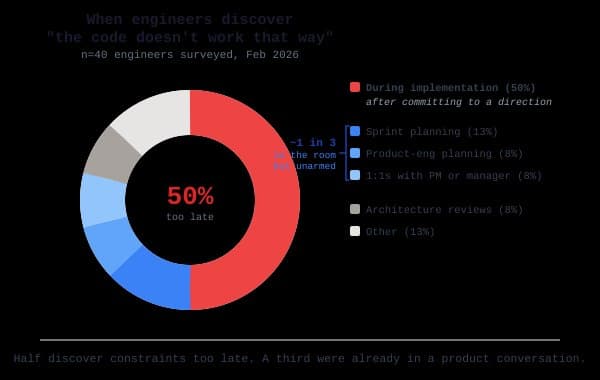
Survey data indicates that 50% of technical constraints emerge only during manual coding implementation – a phase where developers iteratively uncover mismatches between product requirements and technical realities. As one respondent noted: "You only get to know these issues once you start coding. You go through variables and function calls and suddenly remember a process elsewhere changes." 
This implementation phase traditionally serves a dual purpose: building features while simultaneously revealing hidden dependencies and edge cases. However, AI tools shortcut this discovery process by generating code based solely on initial prompts.
Communication Friction: The Silent Productivity Killer
When constraints are identified, communicating them proves challenging:
- 70% of constraints need to reach stakeholders who don't interact with codebases
- 52% of developers share constraints via Slack snippets with no persistent documentation
- 25% communicate constraints verbally without any written record
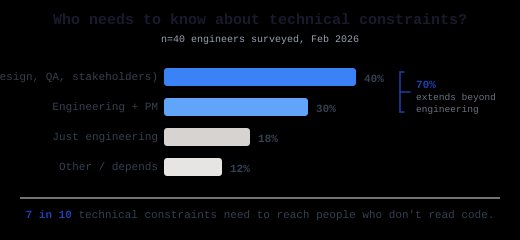
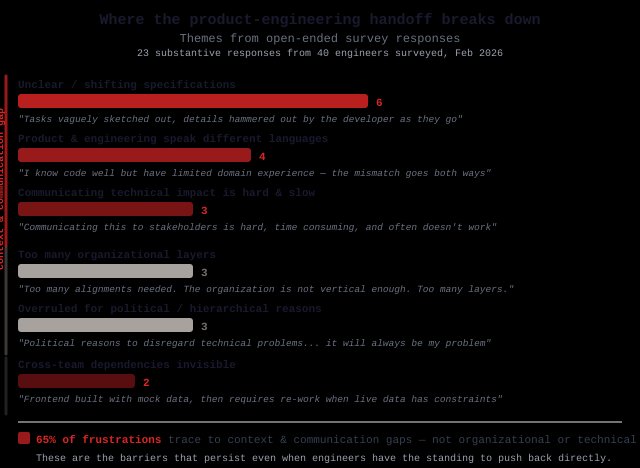
As one senior engineer explained: "I can push back, sometimes it works, sometimes they have political reasons to disregard technical problems, which means it will always be my problem." The cognitive load of translating technical dependencies into business impact during meetings creates bottlenecks, with 35% of constraint communications leaving no digital trail.
AI's Accommodation Problem
Coding assistants fundamentally lack the capacity to question requirements or suggest alternatives. Unlike human developers who might flag potential issues, LLMs generate plausible code without context about business processes or organizational constraints.
"Where AI fails us is when we build new software to improve the business," commented one developer. "AI can write the code, but it doesn't refuse to write the code without first being told why it wouldn't be a better idea to do X first."
Some advocate for better prompting techniques, but survey data suggests this misunderstands the problem: if 50% of constraints remain unknown until implementation, prompt engineering can't anticipate undiscovered issues. As noted in Cursor's experiments, autonomous agents often require human intervention precisely because they lack holistic understanding of distributed business context.
The Vicious Cycle
The research identifies a self-reinforcing pattern:
- AI accelerates implementation but bypasses constraint discovery
- Undetected constraints surface later in reviews or QA
- Resolution requires re-engaging stakeholders (often unavailable)
- Rework costs offset initial time savings
This explains why organizations report increased review/rework time proportional to development savings, as noted in Atlassian's 2025 research.
Path Forward: Upstream Alignment Tools
The solution isn't better code generators but tools that facilitate earlier alignment. As survey respondents emphasized: "What is needed is not another code analysis tool, but ammunition to drive cross-functional alignment upstream." This requires:
- Artifacts that make constraints visible to non-technical stakeholders
- Systems for persistent documentation of decision rationales
- Integration of constraint discovery into planning phases
Projects exploring this space include Bicameral's constraint mapping and V0 by Vercel for rapid prototyping. However, bridging this gap remains a complex interdisciplinary challenge combining technical analysis with organizational psychology.
As AI coding capabilities advance, the industry must consciously redesign workflows to preserve the vital constraint-discovery function that manual implementation once provided. Otherwise, teams risk trading short-term velocity for long-term alignment debt.
Comments
Please log in or register to join the discussion