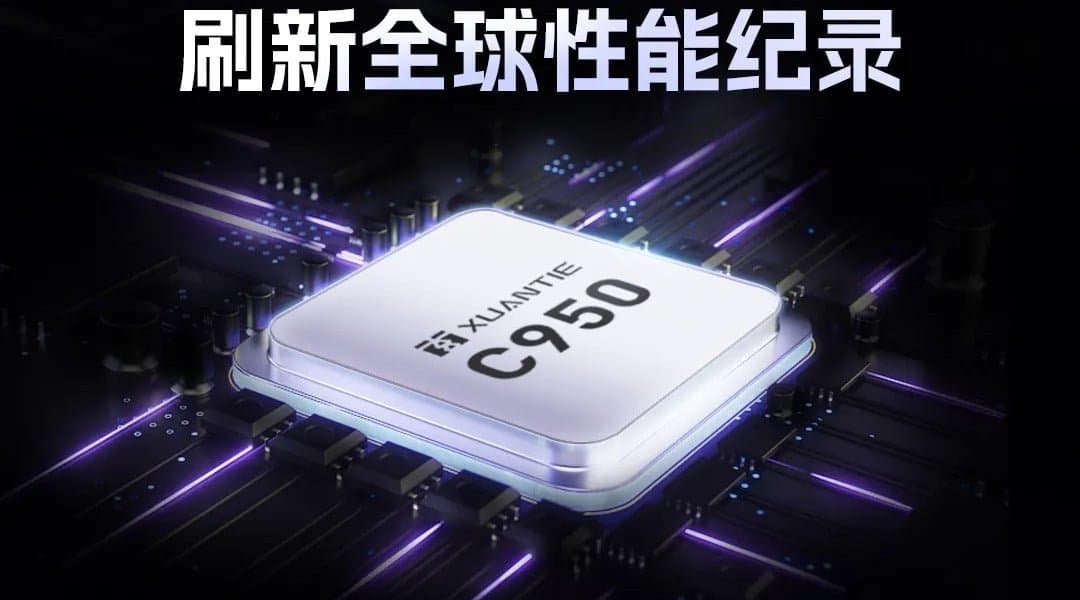
Alibaba's DAMO Academy has unveiled the XuanTie C950, claiming it as the most powerful RISC-V processor ever built, featuring native support for China's leading AI models including Qwen3 and DeepSeek V3, though performance benchmarks suggest it lags behind Western counterparts by several years.
Alibaba has unveiled what it claims is the most powerful processor ever built using the RISC-V instruction set, marking a significant milestone in China's efforts to develop homegrown semiconductor technology independent of Western architectures.
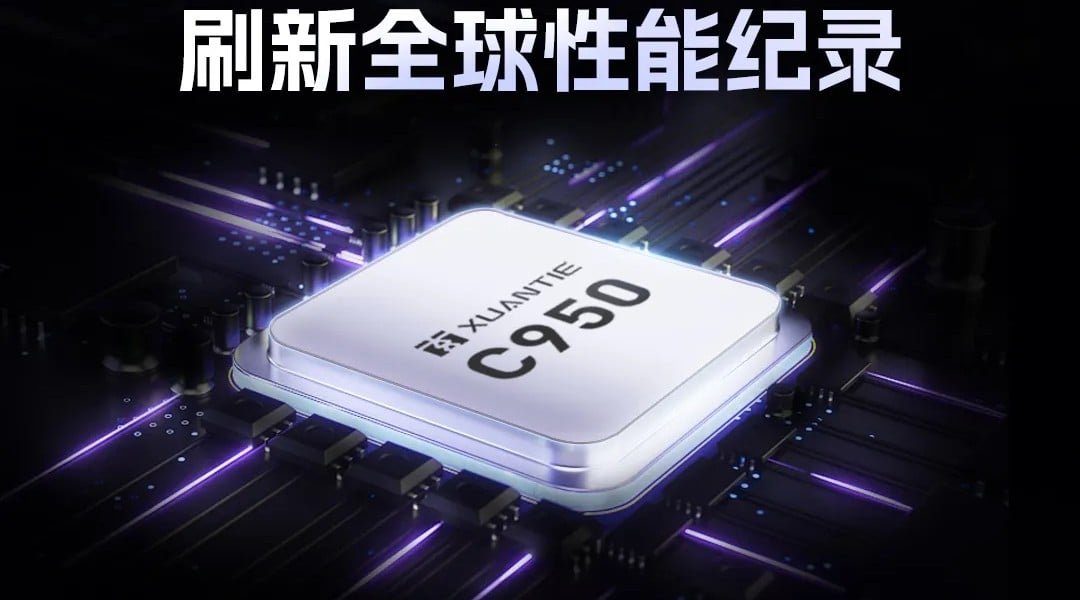
The new XuanTie C950, developed by Alibaba's DAMO Academy research division, represents the company's most ambitious chip project to date. According to Alibaba's announcement, the processor is specifically designed to power cloud servers, generative AI workloads, high-end robotics, and edge computing devices.
Native AI acceleration for Chinese models
What sets the XuanTie C950 apart is its self-developed AI acceleration engine that natively supports large models with hundreds of billions of parameters. The chip is optimized to run China's leading AI models including Qwen3 and DeepSeek V3, suggesting Alibaba is building a vertically integrated technology stack from silicon to software.
"The XuanTie C950 is equipped with a self-developed AI acceleration engine, and for the first time natively supports large models with hundreds of billions of parameters," Alibaba stated in its announcement. This integration could provide significant performance advantages for running Alibaba's own AI services compared to using off-the-shelf processors.
Performance claims and benchmarks
Alibaba claims the chip achieved over 70 points in the SPECint 2006 benchmark test, a measure of general-purpose computing performance. However, analysis by Google researcher Laurie Kirk suggests the processor's SPECInt 2017 benchmark result is 2.6GHz, placing it roughly on par with Apple's M1 chip from 2020.
This performance level indicates that while the XuanTie C950 represents a significant achievement for Chinese semiconductor development, it still lags behind current Western processors by several years. The chip appears to be built using a 5nm process node, which is impressive given the technological restrictions China faces in accessing advanced semiconductor manufacturing equipment.
Technical specifications revealed
The processor features Alibaba's XuanTie Tensor Processing Engine (TPE) for AI acceleration, supporting data types from FP16 down to INT4/FP8, plus specialized micro-scaling formats including MXFP8, MXFP4, and RVFP4. The chip can achieve 8 TOPS (trillion operations per second) per TPE.
The memory subsystem includes a high-performance multi-level cache hierarchy with an ultralow 4-cycle load-to-use L1 data cache latency. The design features private per-core L2 caches with support for large capacity configurations, and an MMU with multiple RISC-V virtual memory modes and two-stage address translation.
Notably, the chip supports multi-processor configurations using the XL-300 interconnect to form clusters of up to 8 cores, though the total core count remains unspecified in available documentation.
Strategic implications for China's tech independence
The XuanTie C950 represents more than just a new processor—it's a statement about China's ambitions in semiconductor technology. Alibaba CEO Yongming Wu acknowledged last week that Chinese chips lag behind Western counterparts, but emphasized the company's strategy of "profound co-design with Alibaba's cloud infrastructure and the Qwen model to provide improved cost effectiveness."
This approach of vertical integration—designing custom silicon optimized for specific software workloads—mirrors strategies employed by companies like Apple and Google. By controlling both the hardware and software stack, Alibaba can potentially achieve better performance and efficiency than using general-purpose processors.
Production and market challenges
While the technical achievement is notable, significant questions remain about the chip's commercial viability. Chinese chipmakers have demonstrated the ability to produce advanced nodes like 5nm, but scaling production to meet commercial demand remains challenging due to limited access to advanced lithography equipment and other manufacturing tools.
Alibaba Cloud has been struggling to deploy servers fast enough to meet AI demand, and the company recently raised prices by up to 34% citing hardware costs and AI demand. The success of the XuanTie C950 will depend not just on its technical merits but on Alibaba's ability to manufacture it at scale and integrate it effectively into its cloud infrastructure.
The RISC-V advantage
By choosing the open-source RISC-V architecture, Alibaba avoids the licensing fees and geopolitical restrictions associated with ARM or x86 architectures. This independence is particularly valuable as tensions between China and Western nations continue to affect technology supply chains.
The XuanTie C950 also implements version 23.1 of the RISC-V RVA, a minor update proposed in August 2025. The rapid adoption of this relatively new specification surprised some industry observers and demonstrates Alibaba's commitment to staying current with RISC-V developments.
Looking ahead
While the XuanTie C950 may not match the raw performance of cutting-edge Western processors, its significance lies in demonstrating China's advancing semiconductor capabilities and Alibaba's strategy of vertical integration. The chip represents a step toward reducing dependence on foreign technology and creating a more self-sufficient technology ecosystem.
As AI workloads continue to grow in importance and complexity, the ability to optimize hardware for specific software workloads becomes increasingly valuable. Whether Alibaba can successfully commercialize the XuanTie C950 and build on this foundation remains to be seen, but the company has clearly signaled its ambitions in the semiconductor space.
The development also highlights the broader trend of cloud providers and large technology companies designing custom silicon to differentiate their services and reduce costs. As this trend accelerates, the traditional boundaries between hardware and software companies continue to blur, with profound implications for the future of computing infrastructure.
Comments
Please log in or register to join the discussion