Amazon has unveiled Redshift RG instances, a new generation powered by AWS Graviton processors that combine data warehouse and data lake querying capabilities while delivering significant performance improvements and cost reductions over previous RA3 instances.
Amazon continues to evolve its cloud data warehousing offerings with the introduction of Redshift RG instances, a new family that leverages AWS Graviton processors and integrates data lake query capabilities directly into the data warehouse engine. This development represents a significant architectural shift that addresses the growing need for unified analytics across structured and unstructured data sources while optimizing performance and cost efficiency.
What Changed: The RG Instance Architecture
The new RG instances mark an important evolution in Amazon Redshift's architecture, moving beyond the previous RA3 generation to deliver a more integrated approach to data analytics. Unlike earlier generations that required separate mechanisms for querying data warehouse tables and data lake objects, RG instances consolidate these capabilities into a single engine.
The key architectural innovation is the integrated data lake query engine, which eliminates the need for Amazon Redshift Spectrum. Previously, data lake queries required Spectrum, which incurred additional $5 per terabyte scanning fees and operated outside the VPC boundary. With RG instances, data lake queries execute on the same compute nodes as data warehouse workloads, staying within the VPC and utilizing existing IAM roles without per-terabyte charges.
Provider Comparison: RG vs. RA3 Instances
The performance and cost benefits of RG instances over their RA3 predecessors are substantial. According to Amazon's announcements:
- Data warehouse workloads run up to 2.2x faster on RG instances
- 30% lower price per vCPU compared to RA3 instances
- Data lake query performance up to 2.4x faster for Apache Iceberg tables
- Data lake query performance up to 1.5x faster for Apache Parquet files
The instance sizing has been optimized to provide a balanced upgrade path:
| Current RA3 Instance | Recommended RG instance | vCPU | Memory (GB) | Primary Use Case |
|---|---|---|---|---|
| ra3.xlplus | rg.xlarge | 4 | 32 | Small cluster departmental analytics |
| ra3.4xlarge | rg.4xlarge | 12 → 16 (1.33:1) | 96 GB → 128 GB (1.33:1) | Standard production workloads, medium data volumes |
This 1.33:1 ratio in both vCPU and memory suggests that Amazon has engineered the RG instances to provide better performance per resource unit, which aligns with the Graviton processor's efficiency advantages.
The elimination of Spectrum scanning fees represents a significant cost reduction, particularly for organizations with large data lakes. Combined with the improved performance and lower per-vCPU pricing, RG instances can substantially reduce total analytics costs for customers running combined data warehouse and data lake workloads.
Business Impact: Cost Optimization and Operational Simplification
The introduction of RG instances addresses several critical business challenges in modern data analytics:
Cost Optimization
Organizations face escalating costs as data volumes grow and AI agents increasingly query data warehouses at unprecedented scales. RG instances provide multiple cost reduction mechanisms:
- Lower per-vCPU pricing (30% reduction)
- Elimination of Spectrum scanning fees
- Improved performance reducing the need for over-provisioning
- Consolidated infrastructure reducing management overhead
For organizations with substantial data lake usage, the elimination of $5/TB scanning fees alone can result in significant cost savings, especially when combined with the performance improvements that allow processing the same workloads with fewer resources.
Operational Simplification
The integrated data lake query engine simplifies the analytics architecture by:
- Eliminating the need to maintain separate query engines for warehouse and lake data
- Reducing operational complexity through a single system for querying both data types
- Preserving existing external tables, schemas, and query syntax without requiring code changes
- Utilizing existing IAM roles and VPC configurations
This simplification is particularly valuable for organizations struggling with the operational overhead of managing multiple data querying systems and maintaining consistency between them.
Enhanced Performance for Modern Workloads
RG instances are specifically optimized for the demands of contemporary analytics and AI workloads:
- Low-latency SQL queries for near-real-time analytics
- Improved response times for BI dashboards
- Faster ETL pipeline processing
- Support for autonomous, goal-seeking AI agents that query data at scale
The combination of Graviton processor efficiency and the integrated data lake query engine makes RG instances well-suited to handle the high query volumes and low-latency requirements of today's analytics and agentic AI workloads.
Migration Considerations
Amazon has provided multiple paths for organizations to migrate to RG instances:
- Elastic Resize: An in-place migration with 10-15 minutes downtime for compatible configurations
- Snapshot and Restore: Creating a RG cluster from an RA3 snapshot, allowing configuration changes during migration
Importantly, existing external tables, schemas, and query syntax—including existing Spectrum queries—remain unchanged. There is no need to recreate external tables or modify application code, which significantly reduces migration friction and risk.
For organizations planning migration, Amazon recommends using the AWS Pricing Calculator with specific workload patterns to estimate potential savings. This tool can help quantify the cost benefits of migrating to RG instances based on actual usage patterns.
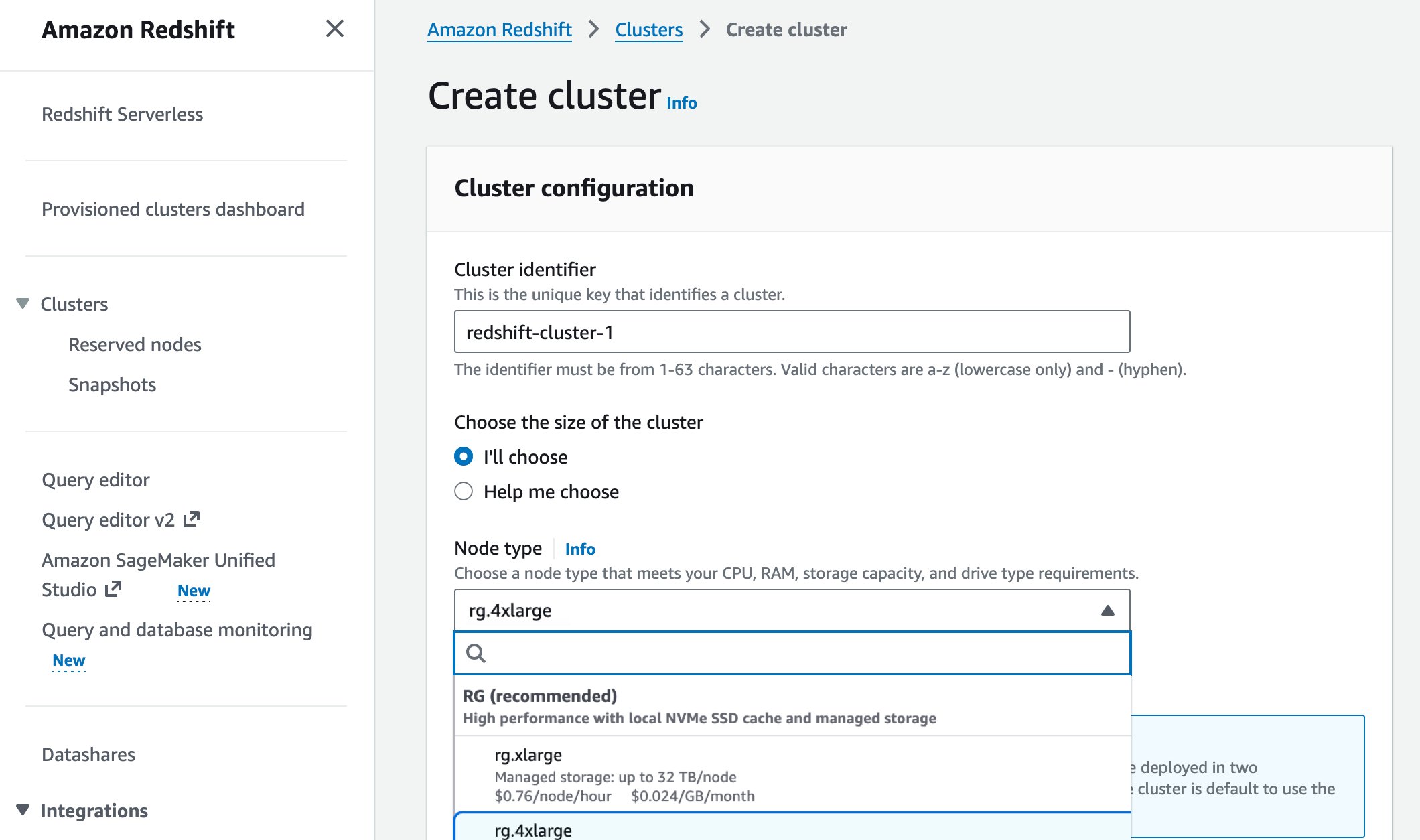
Regional Availability and Adoption
RG instances are now available in numerous AWS Regions globally, including:
- US East (N. Virginia, Ohio)
- US West (N. California, Oregon)
- Asia Pacific (Hong Kong, Hyderabad, Jakarta, Malaysia, Melbourne, Mumbai, Osaka, Seoul, Singapore, Sydney, Taiwan, Tokyo)
- Canada (Central)
- Europe (Frankfurt, Ireland, Milan, London, Paris, Spain, Stockholm)
- South America (São Paulo)
For organizations with regional compliance requirements or latency constraints, this broad availability ensures that RG instances can be deployed in appropriate locations. For the most current regional availability information, organizations should consult the AWS Capabilities by Region page.
For Redshift Provisioned customers, RG instances are available through both On-Demand Instances with hourly billing and Reserved Instances for additional cost savings. Detailed pricing information is available on the Amazon Redshift Pricing page.
Strategic Recommendations
For organizations evaluating the adoption of Redshift RG instances, several strategic considerations should guide the decision:
Workload Characteristics: Organizations with significant data lake usage, particularly Apache Iceberg or Parquet tables, will benefit most from the integrated query engine and elimination of scanning fees.
Cost Optimization: Organizations facing escalating costs due to Spectrum fees or over-provisioned RA3 instances should prioritize migration to RG instances.
AI and Automation: Organizations deploying AI agents that query data warehouses at scale will benefit from the performance improvements that can handle high query volumes with lower latency.
Operational Simplification: Organizations managing complex analytics environments with separate data warehouse and data lake querying systems can reduce operational overhead through consolidation.
As organizations continue to navigate the complexities of multi-cloud strategies and hybrid data architectures, innovations like Redshift RG instances demonstrate how cloud providers are evolving to address these challenges. The combination of Graviton processor efficiency, integrated data lake querying, and significant cost improvements positions RG instances as a compelling option for organizations seeking to optimize their cloud data analytics infrastructure.
For organizations ready to explore RG instances, Amazon encourages experimentation through the Redshift console and welcomes feedback via AWS re:Post for Amazon Redshift or through standard AWS Support contacts.
Comments
Please log in or register to join the discussion