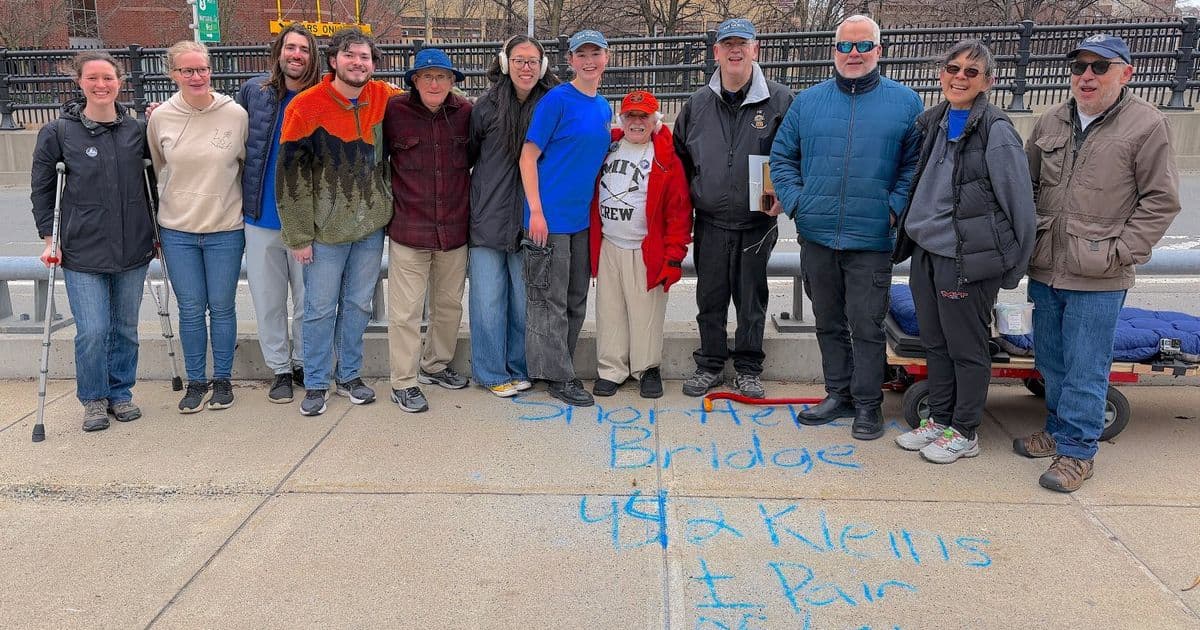
MIT students and alumni have created a new unit of measurement called the 'klein' to honor influential alumnus Martin Klein '62, measuring the Longfellow Bridge in this novel unit as part of a playful engineering tradition that dates back to the famous 'smoot' measurement.
In a celebration that blends engineering precision with MIT's storied tradition of clever pranks, researchers and students have introduced the 'klein' as a new unit of measurement, renaming Boston's Longfellow Bridge as the 'Shortfellow Bridge' in the process. The project, completed on April 4, 2026, honors Martin Klein '62, the pioneering engineer known as the father of commercial side-scan sonar, and coincides with his 85th birthday.
The measurement expedition follows in the footsteps of MIT's most famous prank-turned-unit-of-measurement: the smoot. In 1958, Oliver R. Smoot Jr. '62 was used as a measuring device to determine the length of the Massachusetts Avenue Bridge, resulting in 364.4 smoots (plus one ear). The markings remained visible for decades, eventually becoming so culturally significant that the bridge was officially measured in smoots during renovations in 2009.
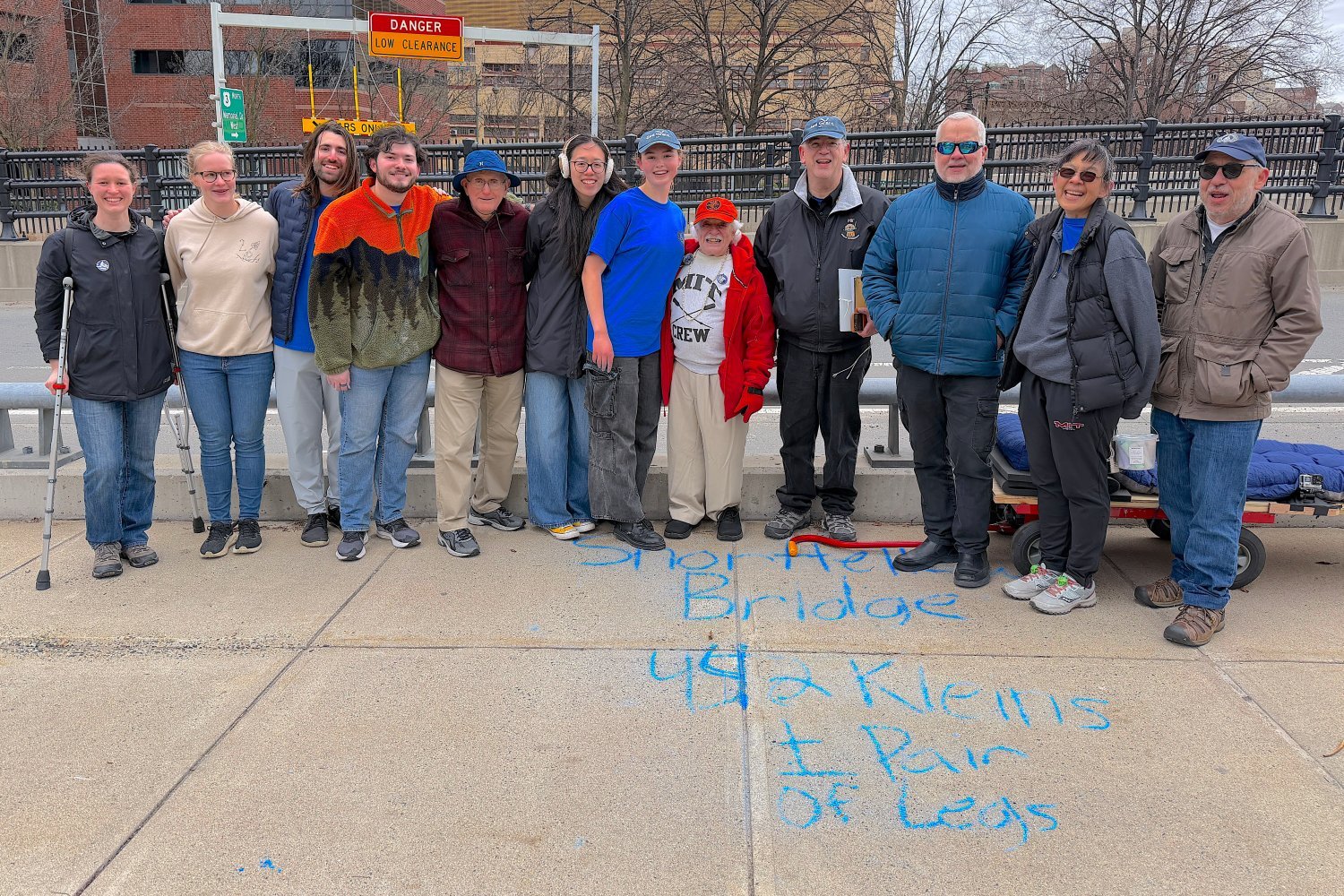
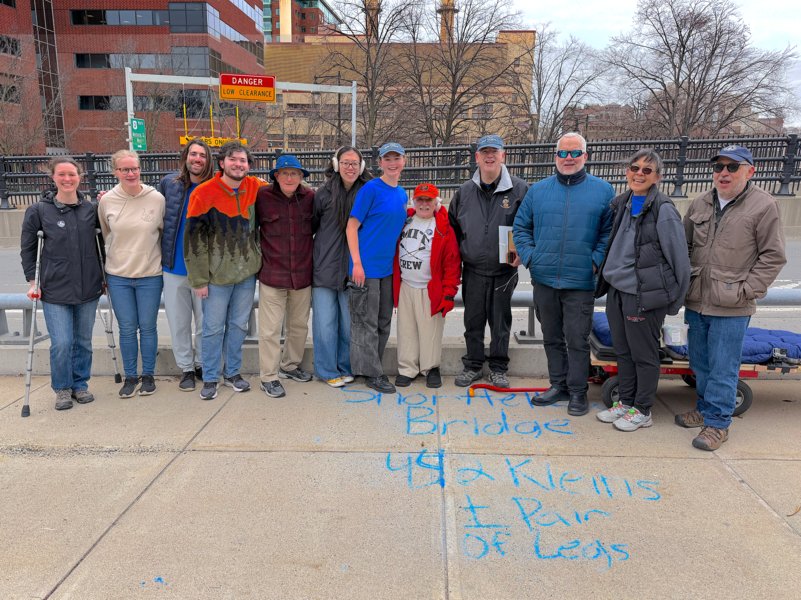
The klein measurement pays homage to both Smoot and Klein, with one klein defined as 4 feet, 9.5 inches (57.5 inches or 146.05 centimeters), making it equivalent to 0.85820896 smoots. The team determined that the Longfellow Bridge spans exactly 442 kleins (plus 2 legs), a measurement that will be chalked onto the bridge sidewalk in a nod to the original smoot markings.
"This project embodies what makes MIT special," said Andrew Bennett '85, PhD '97, MIT Sea Grant education administrator and senior lecturer in Mechanical Engineering, who co-led the initiative with Makenna Reilly, a second-year undergraduate in mechanical engineering. "It combines rigorous engineering methodology with playful creativity, all while honoring one of the most important figures in marine technology history."
Martin Klein's contributions to marine technology are substantial. As a life fellow of both the Marine Technology Society and the Explorers Club, his side-scan sonar technology has been instrumental in locating numerous famous shipwrecks, including the Titanic, the RMS Lusitania, and the Nuestra Señora de Atocha. He currently serves on the MIT Sea Grant Advisory Board and the MIT Museum Collections Committee.
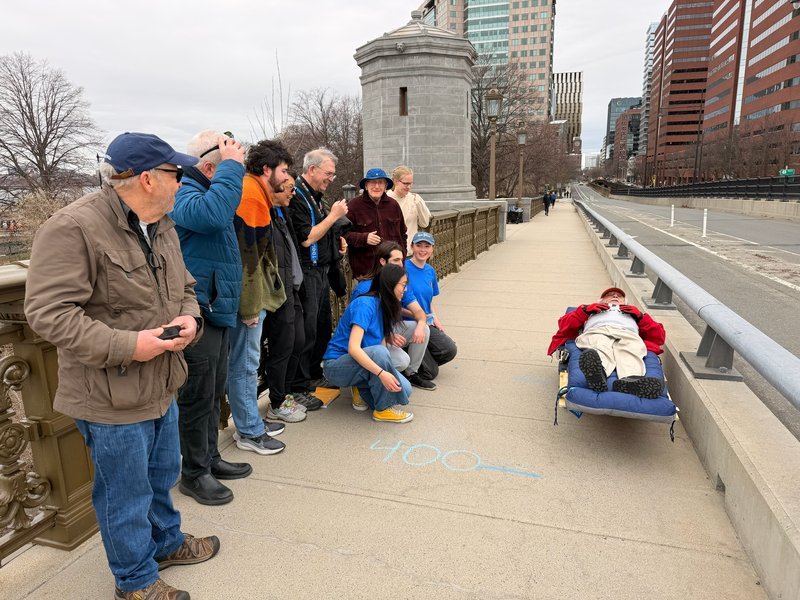
The measurement process itself was a carefully engineered operation. Klein reclined on a custom wooden cart topped with a mission-specific chaise lounge pillow, serving as the primary observation device as the team pulled him along the bridge. This methodology intentionally mirrors Klein's own sonar scanning techniques, where sensors pass over surfaces to create detailed images.

"The side-scan approach was particularly appropriate," explained Reilly. "Just as Klein's sonar technology reveals what lies beneath the water's surface, our Klein-based measurement reveals the bridge's hidden features and character."
The survey team documented several anomalies during their measurement, including a Duck Boat passing underneath, a mermaid tail sculpture, a kayak paddle, a sleeping goose, and various other features that might otherwise go unnoticed. This attention to detail reflects the thoroughness expected in serious engineering work, even when applied to a playful endeavor.
Over a dozen participants joined the expedition, including alumni, faculty, and staff from MIT's Mechanical Engineering department, MIT Sea Grant, MIT Edgerton Center, MIT Museum Hart Nautical Collections, Harvard Extension School, and Woods Hole Oceanographic Institution. The collaborative nature of the project demonstrates how engineering traditions can bridge academic institutions and disciplines.
The conversion factors for the klein are remarkably precise, reflecting the technical rigor behind what appears to be a simple prank:
- 1 klein = 57.5 inches = 146.05 centimeters = 1.4605 meters
- 1 klein = .0009075126 miles = 1.597222 yards = 4.791667 feet
- 1 klein = .0007886069 nautical miles = .007260087 furlongs
- 1 klein = 0.7986111 fathoms = 172.5 barleycorns
- 1 klein = 292,100,000 beard seconds = 647.4421 Ligne
- 1 klein = 14.375 horse hands = 4.819655 shaku
- 1 klein = .85820896 smoots

This project highlights an important aspect of engineering education: the value of blending technical precision with creativity and play. Such initiatives help students develop problem-solving skills while fostering a sense of community and tradition within the engineering discipline.
"The Klein measurement represents more than just a fun activity," noted Bennett. "It demonstrates how engineering can be both rigorous and joyful, how we can honor our past while innovating for the future. It's a perfect example of how MIT balances technical excellence with creative expression."
For those interested in learning more about Martin Klein's contributions or the engineering principles behind side-scan sonar, the MIT Museum maintains a collection of his work, and MIT Sea Grant offers educational resources on marine technology. The project also underscores the importance of playful innovation in engineering education, showing how seemingly frivolous activities can reinforce fundamental concepts and build community among engineers.
Comments
Please log in or register to join the discussion