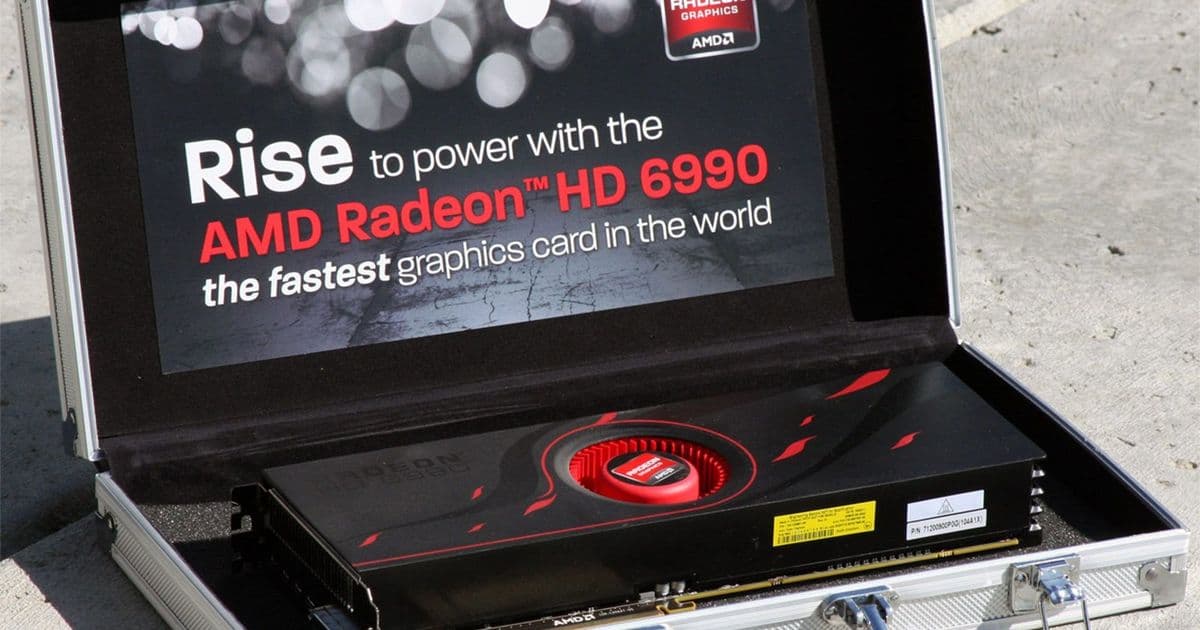
Fifteen years ago, AMD launched the Radeon HD 6990, a dual-GPU graphics card that pushed the boundaries of performance, power consumption, and thermal design, becoming the world's fastest GPU despite significant engineering challenges.
Fifteen years ago, AMD released its powerful Radeon HD 6990 graphics card, a flagship dual-GPU hot rod codenamed Antilles that would redefine what was possible in graphics performance while simultaneously exposing the limitations of contemporary cooling and power delivery technologies.
The Birth of a Graphics Monster
The Radeon HD 6990 emerged in March 2011, several months behind schedule and just weeks before Nvidia's counterpunch. This timing was crucial in the graphics card wars of the era, as AMD had already established dominance with the Radeon HD 5970 2GB. The HD 6990 was designed to cement that position, and it succeeded spectacularly, albeit with significant engineering compromises.
At its core, the HD 6990 represented an audacious engineering feat: two fully-fledged Cayman XT GPUs shoehorned onto a single printed circuit board. This wasn't simply a matter of placing two GPUs side by side; AMD had to solve complex thermal, power delivery, and signal integrity challenges to make this dual-GPU configuration work reliably.
Technical Specifications That Pushed Boundaries
The specifications of the Radeon HD 6990 were nothing short of breathtaking for 2011:
- Dual Cayman XT 40nm GPUs with 3072 stream processors and 5.28 billion transistors combined
- Standard GPU clock of 830 MHz, with overclocking capability up to 880 MHz
- 4GB GDDR5 memory (2GB per GPU)
- Support for five simultaneous displays
- Massive 375W TDP, with overclocked modes pushing 450W
- Dual-slot 12-inch PCB requiring two 8-pin power connectors
- Flagship pricing at $699
The dual-BIOS switch innovation allowed users to toggle between different performance profiles, a feature that would become increasingly important as graphics cards pushed the boundaries of power consumption and thermal output.
Performance That Redefined "Fast"
When tested against contemporary titles, the HD 6990's performance was nothing short of spectacular. The test suite embraced a slew of DirectX 11 titles, including popular franchises like F1, Battlefield, and Metro. These games, many of which are still played today as classics, showcased the card's capabilities in ways that modern hardware can now only reminisce about.
One particularly interesting benchmark was the Quad-CrossFire configuration of the HD 6990 in Crysis, a game notorious for pushing hardware to its limits. The question posed to modern users is intriguing: can your integrated GPU beat that configuration today? The answer likely depends on which iGPU we're talking about, but it's a testament to how far integrated graphics have come in the intervening years.
The Price of Performance: Heat, Noise, and Power
However, the Radeon HD 6990's performance came at a significant cost. Reviews from the time were unanimous in their criticism of the card's thermal, acoustic, and power characteristics. AMD had perhaps pushed the silicon a little too hard in pursuit of performance leadership.
The 375W TDP was unprecedented for a single graphics card, and the actual power consumption under load often exceeded even those lofty expectations. This translated directly into heat output, requiring aggressive cooling solutions that generated substantial noise levels. The card's dual-slot design and massive heatsink assembly were necessary evils in managing the thermal output of two high-performance GPUs operating in close proximity.
The Alternative Perspective
Interestingly, some reviewers suggested that a pair of Radeon HD 6970s might actually be a better solution for many users. This configuration would sacrifice nothing in terms of performance while offering better thermal characteristics and potentially lower noise levels. The HD 6990's main advantage was its single-slot footprint, which could be crucial for users with limited case space.
This perspective highlights an important consideration in high-performance computing: sometimes, splitting capabilities across multiple components can yield better overall results than concentrating everything into a single package. The engineering challenges of cramming two high-performance GPUs onto one board were significant, and the compromises required to make it work were substantial.
Nvidia's Response and Market Impact
Nvidia's response came just a couple of weeks later with the GeForce GTX 590, a dual-GPU card that took a notably different approach. The GTX 590 was noticeably quieter than the HD 6990, reflecting Nvidia's prioritization of acoustic performance over absolute power output. However, it couldn't quite manage to usurp the Radeon HD 6990's performance crown.
This back-and-forth between the two graphics giants exemplified the competitive dynamics of the era, with each company pushing the boundaries of what was possible while taking different approaches to the inevitable trade-offs between performance, power, heat, and noise.
Legacy and Historical Significance
The Radeon HD 6990 represents a fascinating chapter in graphics card history. It was a product that pushed the boundaries of contemporary technology to their absolute limits, achieving performance levels that would have been unthinkable just a few years earlier. However, it also exposed the limitations of 40nm manufacturing processes and the challenges of dual-GPU configurations.
For enthusiasts and professionals who needed the absolute fastest graphics performance available in 2011, the HD 6990 was the only choice. Its 4GB of VRAM was particularly noteworthy, as it provided ample memory for even the most demanding applications of the time. The five-display support also made it an attractive option for multi-monitor setups, which were becoming increasingly popular among enthusiasts.
Looking Back From Today's Perspective
From the vantage point of 2025, the Radeon HD 6990 serves as a reminder of how far graphics technology has progressed. Modern GPUs achieve similar or better performance levels while consuming significantly less power and generating far less heat and noise. The 40nm process technology that made the HD 6990 possible has given way to 5nm and even 3nm processes, enabling massive improvements in performance per watt.
Yet the fundamental engineering challenges that AMD faced with the HD 6990 remain relevant today. As graphics cards continue to push the boundaries of performance, engineers must constantly balance competing priorities: raw performance versus power efficiency, cooling requirements versus acoustic output, and the physical constraints of modern PC cases.
The Radeon HD 6990 was a product of its time, representing both the pinnacle of what was possible and the limitations of contemporary technology. It was a graphics card that demanded respect, not just for its performance, but for the engineering challenges it overcame and the compromises it necessitated. Fifteen years later, it remains a fascinating study in the trade-offs inherent in high-performance computing design.
Comments
Please log in or register to join the discussion