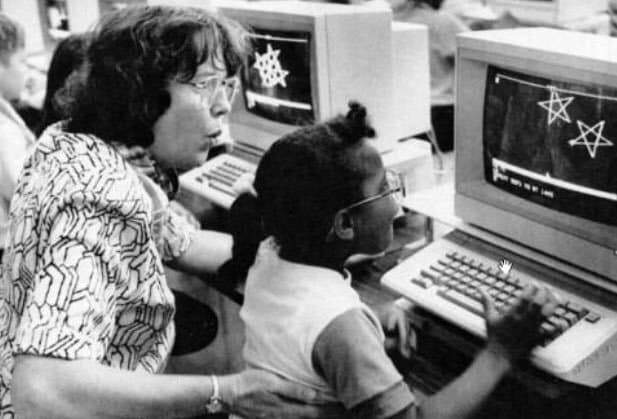
The Apple II’s unexpected longevity stemmed from a mix of open hardware, a thriving third‑party ecosystem, and aggressive pushes into K‑12 education, especially through Minnesota’s MECC and Apple’s “Kids Can’t Wait” program. While Steve Jobs chased flashier projects, the pragmatic work of engineers and educators kept the platform profitable well into the mid‑1990s.
An Apple (II) for Teacher – Creatures of Thought
By early 1980 the Apple II had overtaken the PET and TRS‑80, largely thanks to VisiCalc and a flexible expansion architecture. The IPO at year‑end turned many early employees into millionaires, but the two co‑founders reacted very differently.
The founders diverge
Steve Wozniak had built the machine he wanted, amassed wealth, and was more interested in engineering than management. After a 1981 plane crash he stepped back, dabbed in a Berkeley degree, funded the US Festival, and even applied for a regular engineering job at Apple in 1983 before finally leaving in 1985. His later stint teaching computer skills in Los Gatos was low‑key, driven by personal amiability rather than a grand vision.
Steve Jobs chased the next “dent in the universe”. He pushed the Apple III, a business‑oriented successor with more memory, a built‑in floppy, lower‑case support and an 80‑column display. Rushed design choices—case first, cramped wiring, missing clock chip—led to massive production failures and a delayed market launch. Even when the hardware finally worked, the software ecosystem was thin (VisiCalc was the only major app) and backward compatibility was crippled; users with 80‑column cards on their II had to abandon those investments. Sales fell far short of the 50 000 units Jobs expected.
The flywheel that kept Apple afloat
Despite the III’s flop, the Apple II line kept the company profitable for half a decade. The IIe (1983) added lower‑case characters and a better keyboard, while the IIc (1984) packaged a floppy and printer controller in a luggable case. The real advantage was custom chips that replaced off‑the‑shelf components, cutting manufacturing cost enough to keep prices stable even as inflation rose. By 1984 a fully equipped IIe sold for about $1300, comparable to the barebones II Plus launched six years earlier.
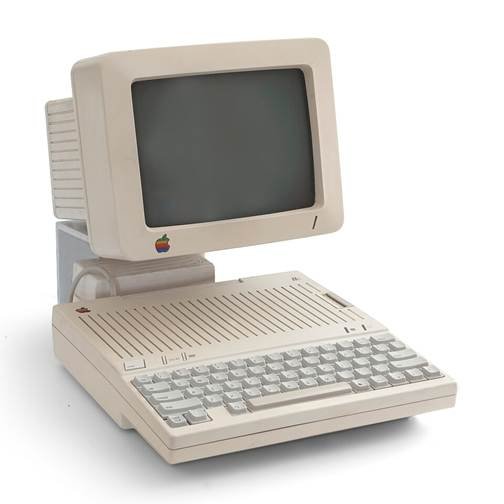
The II series captured roughly a quarter of the US micro‑computer market in 1982 and maintained a 10‑15 % share through the early‑80s. The model’s success wasn’t just hardware; it was an ecosystem:
- Open hardware – eight expansion slots and published schematics invited third‑party cards (memory, graphics, 80‑column displays, modems, etc.).
- Open software – Apple published full technical specifications, encouraging independent developers. VisiCalc proved a killer app, and later titles like Ultima and Wizardry made the II a gaming platform as well.
- Retail partnerships – Apple’s close ties with ComputerLand gave schools a single point of purchase for hardware, software, and support.
Education: the hidden engine
By the mid‑80s Apple held about half of the K‑12 market. The story begins in Minnesota, where the Minnesota Educational Computing Consortium (MECC) built a state‑wide network of time‑sharing terminals in the 1970s. As micro‑computers became affordable, MECC switched to Apple II hardware in 1978, attracted by built‑in color graphics and the Apple II Disk, which eliminated long cassette load times.
MECC’s catalog grew to dozens of high‑quality disks covering elementary, secondary, and special‑education topics. Programs such as Odell Lake let students model ecosystems with detailed documentation—far superior to the rote‑learning drills offered by competitors.
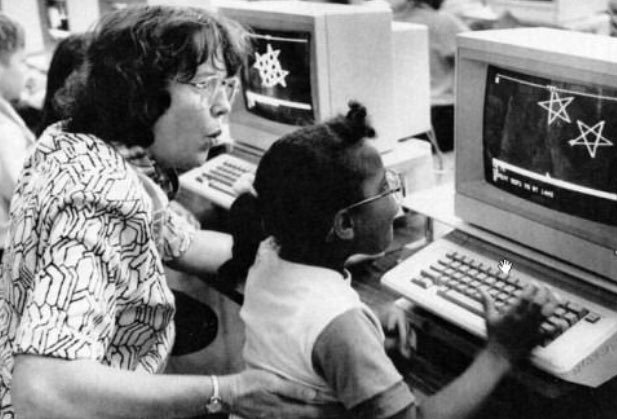
MECC’s success created a ripple effect: other states partnered with MECC or built their own consortia, and Apple leveraged the relationship with a dedicated education liaison, Roger Cutler. By 1984 MECC had shipped roughly 10 000 Apple IIs to Minnesota schools, and similar numbers followed in California, Colorado, Alaska, and beyond.
“Kids Can’t Wait” – Jobs’ shortcut
Jobs grew impatient with the slow pace of school procurement. After a conversation with Congressman Pete Stark, Apple backed the Computer Equipment Contribution Act, a tax incentive for donating computers to schools. The bill stalled in the Senate, so Apple pursued a state‑level version in California.
In September 1982 the state passed a law mirroring the federal proposal. Apple donated about 9 000 computers to California schools under the “Kids Can’t Wait” program, effectively seeding the market and gaining a public‑relations boost as the “company that cares about education”.
Market share versus headline sales
The Apple II never topped overall US sales—TRS‑80, Atari 400/800, and later the Commodore 64 outsold it—but it dominated the classroom. In 1984 only 8 % of US households owned a computer, yet 82 % of elementary schools and 93 % of high schools had at least one. For most students, the Apple II was their first encounter with personal computing.
Competitors tried to fight back. Radio Shack’s Color Computer captured about 20 % of the school market in 1984, Commodore about 15 %, but Apple’s entrenched software library, trained technicians, and existing hardware stock made switching costly.
The long tail
MECC’s influence waned in the 1990s as the consortium became a private software firm (later bought by SoftKey). Nonetheless, the flywheel set in motion in the early‑80s kept Apple profitable long after the III and Lisa had failed. By 1995, 37.5 % of public‑school computers were still Apple II models, with another 20 % being Macintosh machines.
The Apple II’s story illustrates how open design, a vibrant third‑party ecosystem, and a focused push into education can sustain a platform far beyond its technical prime. While Jobs chased flashier products, the quieter work of engineers, educators, and software developers kept Apple afloat until the era of IBM‑compatible PCs finally took over.
References are available in the original post. For further reading see the Apple II History site, the Computer History Museum archives, and the MECC collection at the Minnesota Historical Society.
Comments
Please log in or register to join the discussion